

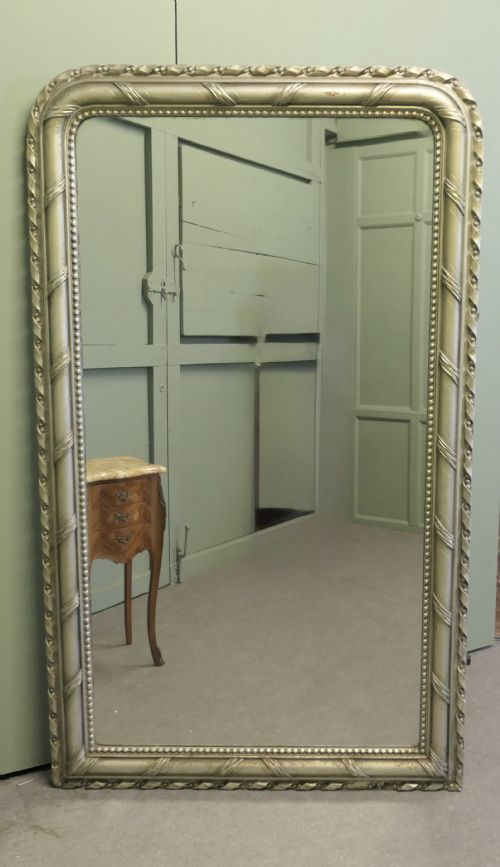


Tall Leaning Mirror
A tall leaning mirror brings height and reflected light to a room, drawing the eye upwards through nineteenth-century French and English design.
Tall Leaning Mirror
When you search for a tall leaning mirror, you are looking at substantial nineteenth-century looking glasses designed to stand directly against a wall without permanent hanging. These pieces include large floor dressing mirrors, pier mirrors, and overmantel forms that span heights from the mid-nineteenth century up to nineteen hundred.
You are most likely to meet French examples on this page, particularly seventeenth-inspired Louis Philippe and French Rococo Revival pieces. They arrive in painted finishes, gesso, and giltwood, often featuring arched or shaped tops designed to create a sense of expansive space.
The selection ranges from ornate carved wood designs with detailed gilt surfaces to plainer bistro mirrors and Victorian frames. Each object combines utility with decorative presence, functioning as both a dressing glass and an architectural focal point in a room.
How they were made
Frames are constructed primarily from pine and carved wood, providing a sturdy foundation for intricate surface decoration. Artisans applied layers of gesso over the wood base to build up smooth contours and relief ornament before gilding or painting.
Gilding was executed using gold or silver leaf applied to the prepared gesso surface, creating the luminous metallic finishes seen on Louis Philippe and Victorian examples. Alternatively, simpler pieces received coats of paint, as observed in nineteenth-century bistro mirrors.
Tall Leaning Mirror Retail Price Guide 2026
Typical asking prices for tall leaning mirror among the pieces listed under this phrase on Sellingantiques today, from the lower quarter to the upper quarter. They describe what is for sale here now, not the wider market.
Many of these towering glasses spent decades leaning quietly in Parisian apartments, quietly memorising generations of shifting furniture arrangements.
What varies in quality
Quality in these looking glasses rests upon the depth and precision of the wood carving and the crispness of the gesso moulding. Superior pieces display hand-carved details with sharp definition, whereas lesser examples rely on simpler moulded composition work.
The integrity of the original surface finish, whether gilt leaf or paint, dictates the character and desirability of the piece. Surviving original silver and gold leaf retention without heavy modern intervention separates standard frames from exceptional ones.
The Tall Leaning Mirror Glossary
- Giltwood
- Wood that has been coated with gold leaf or gold paint. This technique was widely utilised across nineteenth-century frames to add brilliance and formal presence.
- Gesso
- A plaster-like mixture applied to wood frames to create a smooth surface for carving or gilding. It allows for intricate relief decoration that holds metallic leaf securely.
- Louis Philippe
- A mid-nineteenth-century French style characterised by restrained classical curves and often an arched top. These frames balance decorative appeal with simpler architectural lines.
- Pier mirror
- A tall, narrow mirror traditionally hung on the pier or wall space between windows. They maximise light reflection in high-ceilinged nineteenth-century rooms.
Tall Leaning Mirror: Frequently Asked Questions
How do I secure a tall leaning mirror safely?
These large looking glasses are designed to rest against a wall, but safety brackets or wall tethers are commonly employed at the top of the frame to prevent tipping.
Ensuring the base rests evenly on the floor while the weight is secured to the wall protects both the heavy wood frame and the room.
Where should I place a tall leaning mirror?
Placing these pieces opposite a window maximises natural light distribution and creates an illusion of greater room depth. They suit living rooms, hallways, and dressing rooms where full-height reflection is useful.
Positioning them away from heavy foot traffic prevents accidental knocks against the leaning frame.
How do I identify a Louis Philippe mirror?
Louis Philippe frames typically feature a simple arched top, rounded upper corners, and restrained decorative moulding rather than heavy baroque carving. They date from the mid-nineteenth century and offer a clean architectural silhouette.
The absence of excessive ornamentation distinguishes them from later Rococo Revival pieces.
What is the difference between giltwood and silver leaf?
Giltwood uses gold leaf to produce a warm, rich metallic tone across the carved wooden frame. Silver leaf creates a cooler, brighter reflective surface that was often used on alternative nineteenth-century designs.
Both finishes age over time to develop distinct patinas depending on exposure to light and air.