

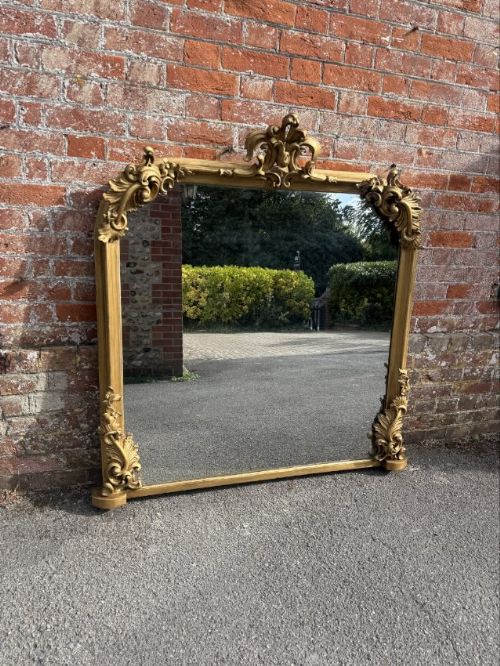


Large Mirror for Wall
A large mirror for wall placement changes a room by gathering light and throwing it deep across the floor.
Large Mirror for Wall
A large mirror for wall placement appears in several distinct forms across this selection, ranging from nineteenth-century overmantel mirrors designed to sit above a fireplace to tall pier mirrors and French Louis Philippe wall hangings. These pieces serve to anchor a room, bringing proportion and historical weight to domestic spaces through generous dimensions and considered framing.
The material record leans heavily towards nineteenth-century production, with specific representation from the Regency, Victorian, and Georgian eras alongside French regional pieces. Buyers encounter arched tops, elaborate crests, and rectangular frames constructed to command substantial wall space in high-ceilinged interiors.
Materials and construction
Makers built these frames using carved wood, pine, oak, and mahogany as a base, applying layers of gesso to build up intricate relief ornament before finishing the surface with gold leaf, silver leaf, or paint. Water gilding and oil gilding techniques created the characteristic metallic sheen seen on these period surfaces.
Reflective surfaces include both traditional mercury glass and later bevelled plate glass, held within heavy timber or composite structures designed to support significant weight. Structural elements often incorporate carved foliage, lion masks, or classical motifs executed by hand.
Large Mirror for Wall Retail Price Guide 2026
Typical asking prices for large mirror for wall among the pieces listed under this phrase on Sellingantiques today, from the lower quarter to the upper quarter. They describe what is for sale here now, not the wider market.
Several mirrors retain the quiet proof of past domestic life through faint foxing on the glass that has watched centuries pass.
Evaluating quality
Quality rests in the crispness of the carved gesso relief and the depth of the gilding applied to the wood framework. Superior examples display sharply defined foliage and crests where the hand of the maker remains evident in every contour.
The integrity of the original glass plate and the stability of the timber backing distinguish finer items from simpler utilitarian alternatives. Original mercury glass and untouched gilt surfaces carry greater authenticity than later replacements.
Arsène Rochette of Versailles
The Large Mirror for Wall Glossary
- Gesso
- A plaster mixture applied to wood frames as a base for gilding or painting. It allows carvers to achieve fine detail before the metallic leaf is laid down.
- Overmantel mirror
- A wide mirror specifically designed to hang on the wall directly above a mantelpiece. These pieces often feature arched tops to fit architectural chimney breasts.
- Pier mirror
- A tall, narrow mirror traditionally hung on the wall space between two windows. They reflect natural light into the darker central areas of a room.
- Mercury glass
- An early type of silvered glass created by pouring a liquid mercury amalgam between two layers of glass or coating the back. It produces a mottled, atmospheric reflection.
- Water gilding
- A traditional technique where gold leaf is applied to a wet gesso and bole surface. This method allows the metal to be burnished to a high shine.
Large Mirror for Wall: Frequently Asked Questions
How do I hang a heavy mirror?
These substantial frames require professional wall anchors fixed directly into masonry or solid studs to bear the significant weight safely.
Distributing the load across heavy-duty brackets ensures the mirror hangs securely without straining the wooden frame or backing.
What is an overmantel mirror?
An overmantel mirror is a wide format glass created to sit in the architectural space directly above a fireplace mantel.
Their proportions complement the hearth below, drawing the eye upward and reflecting light across the entire room.
How do I identify mercury glass?
Mercury glass displays a distinctive, dark, mottled reflection with tiny bubbles and uneven patches behind the glass plate.
This historical silvering method creates a softer, deeper reflection than modern mirror glass.
Can these mirrors go in bathrooms?
Period frames with gesso and gold leaf ornamentation suffer damage from sustained steam and high humidity found in bathrooms.
Keeping them in dry living spaces, halls, or bedrooms preserves the delicate gilt surfaces and timber backings.