
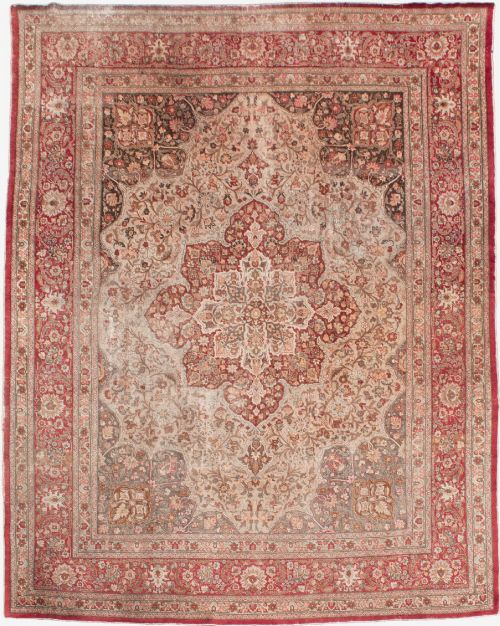
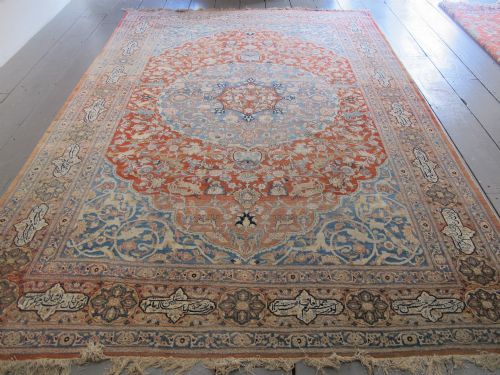


Tabriz Medallion Rug
A tabriz medallion rug brings Persian knotwork into a room, offering intricate centre motifs and structured floral borders.
Tabriz Medallion Rug
A tabriz medallion rug originates from North-West Persia, featuring distinct central motifs surrounded by traditional floral patterns. Buyers seek these pieces for their grand scale and historical presence in country houses and reception rooms.
The selections span from smaller village formats to large room-size carpets, dated across the late nineteenth and early twentieth centuries. These woven works display Persian styles ranging from traditional compositions to specific regional workshop productions.
Materials and construction
The foundational structure relies on sturdy cotton foundations that support dense wool pile, while select examples incorporate silk. Weavers knotted these materials tightly to produce durable floor coverings capable of withstanding heavy daily use.
Natural dye palettes create soft pastel tones and deep traditional shades that mature gracefully over decades. The construction balances structural rigidity in the warp and weft with supple flexibility in the pile.
Certain village rugs include slight asymmetries in their central medallions, revealing the hand of an independent weaver working off-grid.
Assessing the weaving
Knot density dictates the crispness of the medallion and the precise definition of the surrounding floral motifs. Tighter knotting allows for intricate curves and balanced symmetry across the field.
The integrity of the wool and cotton foundation determines how well the textile holds its shape under foot traffic. Original edge bindings and balanced pile height across the entire surface indicate careful preservation.
Haji Jalili·Benlian
The Tabriz Medallion Rug Glossary
- Medallion
- The central ornamental design element placed in the middle of the rug field. This focal point anchors the geometric and floral layout.
- Pile
- The vertical tufts of wool, cotton or silk that form the usable surface of the carpet. This dense layer bears the weight of foot traffic.
- Warp
- The longitudinal threads stretched tightly on the loom that carry the weight of the structure. These cotton strands form the visible fringe at either end.
- Weft
- The horizontal threads passed across the warp threads to lock the knots in place. This material creates the firm grid underlying the pile.
- Village rug
- A textile woven in a smaller settlement rather than a major urban workshop. These pieces often display idiosyncratic designs and local materials.
Tabriz Medallion Rug: Frequently Asked Questions
How do I date a tabriz medallion rug?
Dating relies on stylistic markers, wool characteristics, and structural evidence recorded across late nineteenth and early twentieth-century examples. Comparisons with documented workshop pieces help narrow the decade of production.
Changes in dye chemistry and weaver signatures also assist in establishing a reliable timeframe for each individual carpet.
Where should I place a large carpet?
These room-size textiles suit low-traffic reception rooms or studies where their substantial dimensions and central medallions remain fully visible. Maintaining clearance around the edges showcases the decorative borders.
Placing the textile away from direct sunlight protects the natural dyes from fading over time.
Are these rugs suitable for daily use?
Sturdy wool pile and resilient cotton foundations allow these historical floor coverings to handle standard domestic use. Regular, gentle cleaning preserves the integrity of the fibres.
Utilising a quality underlay prevents unnecessary sliding and reduces friction between the foundation and the floor.
What defines the traditional floral design?
Traditional compositions incorporate stylised blossoms, vines, and palmettes arranged around a central geometric anchor. This symmetry reflects classic Persian design principles developed in urban workshops.
Master weavers arranged these botanical elements to create a balanced rhythm across the entire field.