


Large Tabriz Rug
A large tabriz rug delivers monumental Persian craftsmanship to grand interiors, bringing centuries of weaving heritage straight beneath your feet.
Large Tabriz Rug
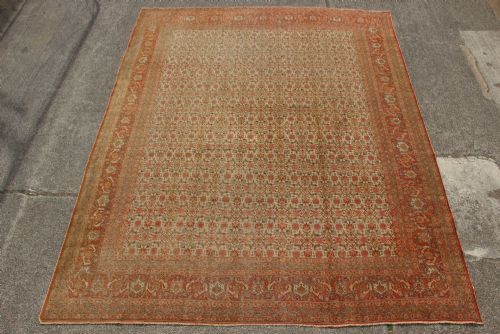
A large tabriz rug represents the pinnacle of Persian carpet production, originating from the historic weaving centre of Tabriz in north-west Persia. These substantial floor coverings span room sizes and country house dimensions, created to anchor expansive reception spaces and formal drawing rooms.
The examples gathered here date from the nineteenth century through the early twentieth century, encompassing periods such as the Qajar era and the nineteen-twenties. Buyers encounter formats ranging from traditional room-size room carpets to grand scale pieces exceeding four metres in length.
Materials and construction
These carpets rely on durable cotton foundations for the warp and weft threads, providing structural stability for large formats. Fine wool pile is then hand-knotted onto this grid, yielding a dense and resilient surface designed to withstand generations of use.
Weavers utilise traditional Persian techniques to execute intricate traditional Persian patterns and hunting motifs. The resulting textiles balance structural robustness with a supple drape across the floor.
Some carpets feature lively hunting scenes populated by minuscule figures and animals frozen in motion.
Distinctions in quality
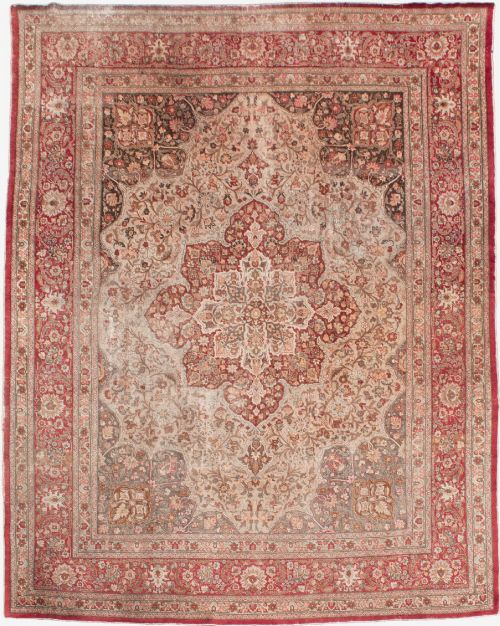
Quality reveals itself in the fineness of the knotting and the complexity of the design execution. Master workshops achieve greater precision in floral medallions and pictorial elements, whilst country house pieces offer a more relaxed, rustic interpretation of traditional motifs.
The nuance of the palette also defines the upper tier, with soft pastel tones and naturally dyed hues creating a harmonious visual depth. Superior examples maintain structural integrity across vast surface areas without losing the suppleness of the wool pile.
Haji Jalili·Benlian
The Large Tabriz Rug Glossary
- Tabriz
- A major historic weaving city in north-west Persia renowned for sophisticated design and technical mastery. Carpets from this region bridge classical Persian traditions with innovative compositions.
- Warp
- The vertical threads stretched lengthwise on the loom that form the foundational skeleton of the carpet. The fringe at either end of the rug consists of these finished threads.
- Weft
- The horizontal threads passed alternately over and under the warp threads to lock the knots in place. This grid provides the underlying tension of the textile.
- Pile
- The upright tufts of wool that form the soft surface and visual face of the carpet. Shorter, denser pile generally indicates finer knotting and greater detail.
- Qajar
- The Iranian royal dynasty spanning the nineteenth and early twentieth centuries under whose patronage Persian arts flourished. Carpets from this period often display refined classical revivals.
Large Tabriz Rug: Frequently Asked Questions
Where should I place a large tabriz rug?
These generous floor coverings suit principal reception spaces, dining rooms, and high-ceilinged drawing rooms where their scale can be fully appreciated. They naturally anchor large furniture arrangements, such as central seating groups or long dining tables.
Ensure that surrounding furniture allows the outer borders of the carpet to remain visible rather than crowding the edges. This creates a balanced proportion between the textile and the architectural dimensions of the room.
How do I care for wool carpets?
Regular gentle vacuuming without a rotating brush roll prevents dust accumulation within the wool pile. Professional cleaning by specialists in antique textiles is recommended every few years to maintain the lustre of the natural fibres.
Protect the carpet from prolonged direct sunlight to prevent fading of the soft pastel tones and dyed wools. Rotating the rug periodically also ensures even wear across high-traffic areas.
How do I date an antique carpet?
Dating relies on stylistic analysis, material composition, and structural characteristics recorded in the weaving traditions of the period. Nineteenth-century examples often exhibit specific floral vocabulary and natural dye characteristics that evolved by the nineteen-twenties.
Comparing the density of the weave and the specific workshop attribution helps narrow the period of origin. Archival records and historical signatures or inscriptions woven into the borders occasionally provide precise timelines.
What defines Persian regional styles?
Persian rug production varies significantly by city and workshop, with Tabriz known for architectural precision, floral urns, and hunting scenes. Other regions might favour geometric tribal patterns or open field designs with stark medallion layouts.
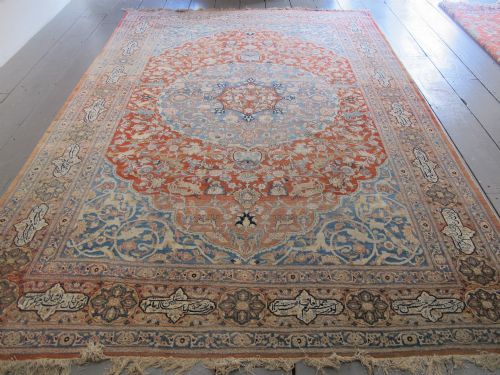
Tabriz pieces typically distinguish themselves through refined curvilinear drawing and balanced corner-and-medallion compositions. The influence of master designers in these northwestern ateliers shapes the distinct aesthetic found across these carpets.