

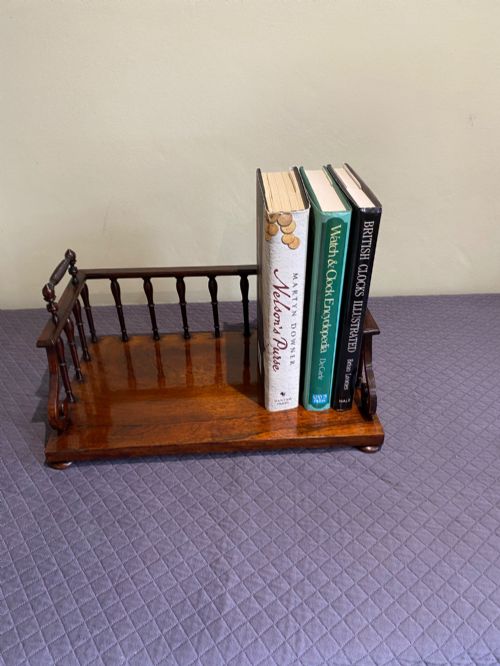


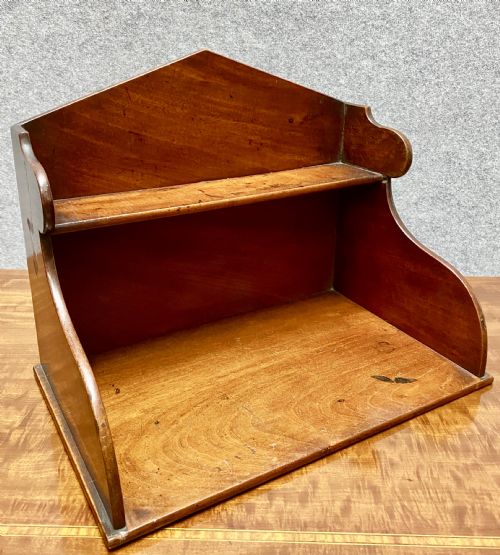
Tabletop Bookshelf
These tabletop bookshelf pieces keep working volumes close at hand on a desk or table.
Tabletop Bookshelf
A tabletop bookshelf sits upon a desk or table to hold a small working library within arm's reach. Buyers searching for a tabletop bookshelf encounter compact forms designed for daily reference.
Materials range from rich mahogany and rosewood to sturdy oak, frequently incorporating boxwood inlay for added decorative detail. These items serve both practical storage and surface display.
How they were made
Cabinet makers utilised dense timbers such as mahogany, rosewood, and oak to construct durable desktop frames. These woods provided the necessary strength to support heavy volumes without warping.
Intricate decorative touches often included boxwood inlay to accent the timber grain on Edwardian and nineteenth-century pieces. Simple metal fastenings or extending mechanisms allowed certain models to adjust in length.
Tabletop Bookshelf Retail Price Guide 2026
Typical asking prices for tabletop bookshelf among the pieces listed under this phrase on Sellingantiques today, from the lower quarter to the upper quarter. They describe what is for sale here now, not the wider market.
Art Deco horses stand ready to guard the ends of one sturdy oak book shelf.
What varies in quality
Quality rests upon the selection of timber and the precision of the joinery rather than mere age. Finely figured mahogany or rosewood demonstrates a higher grade of craftsmanship than plain utility oak.
Smooth operation distinguishes superior revolving or extending mechanisms from stiffer counterparts. Refined inlay work and well-balanced proportions separate exceptional pieces from standard workshop output.
The Tabletop Bookshelf Glossary
- Book slide
- An extending desk accessory designed to hold volumes upright between adjustable ends. This mechanism allows the holder to expand as more texts are added.
- Revolving bookcase
- A rotating desktop unit mounted on a central pivot for easy book selection from any angle. Edwardian makers frequently produced these in oak.
- Book trough
- A V-shaped open receptacle for storing books flat or at a slanted angle on a tabletop. These often appear in mahogany or oak.
- Desk tidy
- A small compartmentalised desktop organiser combining shelf space with slots for writing equipment. Nineteenth-century examples often merge this form with a mini bookshelf.
- Boxwood inlay
- Contrasting pale wood inserted into a darker timber surface to create linear or geometric patterns. It provides subtle decoration on period cases.
Tabletop Bookshelf: Frequently Asked Questions
What is a tabletop bookshelf used for?
These compact units organise reference books, ledgers, and favourite volumes directly upon a desk or work table.
They maintain accessibility for daily reading while saving valuable floor space in smaller studies or offices.
How do revolving bookcases function?
A central pivot mechanism allows the entire wooden structure to turn smoothly in a circle.
This design lets a reader access multiple directions of shelving without moving the base.
What woods were used for these?
Cabinet makers relied primarily on durable hardwoods like mahogany, oak, and rosewood for structural stability.
Contrasting timbers such as boxwood were occasionally utilised for decorative inlay work.
How do I care for antique timber?
Keep wooden pieces away from direct heat sources and strong sunlight to prevent the timber from drying out.
Apply a traditional wax polish occasionally to nourish the grain and maintain the surface sheen.