


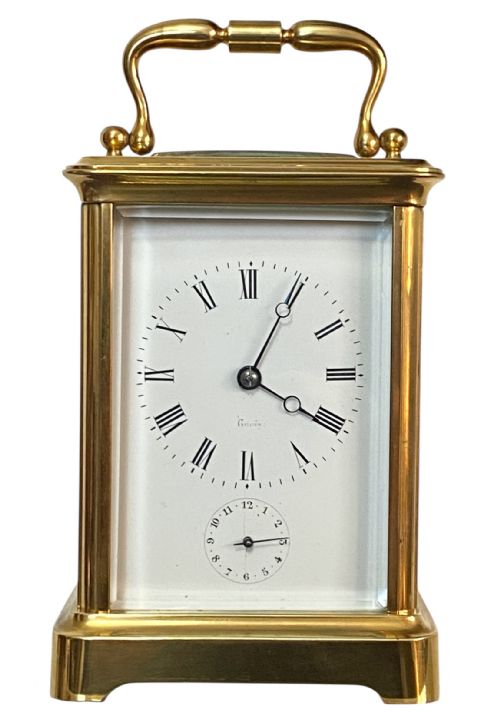


Swiss Brass Table Clock
A swiss brass table clock brings precision engineering and striking desk or mantel presence into any interior.
Swiss Brass Table Clock
A swiss brass table clock spans compact desk pieces, mantel clocks, and perpetual motion designs created across the nineteenth and twentieth centuries. These timepieces range from Edwardian champlevé enamel strut clocks to mid-century modern skeleton and Atmos models housed in glass and gilt metal.
Evaluating Quality
The division between standard and superior pieces rests upon the sophistication of the movement and the integrity of the casing. Intricate additions such as champlevé enamel work, alarm complications, or complex perpetual motion mechanisms elevate a piece above simpler timepieces.
Material finishing and preservation also dictate standing, with original boxing, papers, or undamaged vitreous enamel enhancing the overall integrity. Pieces retaining crisp gilding and clean glass components represent the finer end of the available range.
Listings span multiple periods including the nineteenth century, Edwardian era, and mid-century modern design phases.
Imhof·Jaeger LeCoultre·Luxor·J. F. Bautte Et Cie·Van Cleef And Arpels
The Swiss Brass Table Clock Glossary
- Atmos clock
- A mechanical timepiece manufactured by Jaeger-LeCoultre that is powered by subtle temperature changes in the environment, removing the need for manual winding. It utilises a sealed bellows containing a gas and liquid mixture.
- Strut clock
- A portable timepiece featuring a hinged prop or stand at the back, allowing it to rest securely on a desk, table, or dressing surface. They frequently incorporate protective folding leather cases for travel.
- Champlevé enamel
- A technique where troughs or cells are hollowed out in the metal surface and filled with vitreous enamel prior to firing. This creates intricate decorative patterns flush with the surrounding metal.
- Grande sonnerie
- A complex striking mechanism in a clock that chimes the hours and quarters automatically as they pass. These movements often include repeat functions and integrated alarms.
- Skeleton timepiece
- A clock designed with an open movement layout where the plates and bridges are cut away to reveal the gear train. This allows light to pass directly through the central housing.
Swiss Brass Table Clock: Frequently Asked Questions
How do Atmos clocks work?
An Atmos clock operates without a battery or manual winding by utilising a hermetically sealed expansion chamber. Changes in ambient room temperature cause a gas inside the chamber to expand and contract, constantly winding the mainspring.
This continuous micro-adjustment allows the clock to run indefinitely with minimal mechanical wear. It represents a significant achievement in Swiss horological engineering.
Where were these clocks used?
These clocks were designed primarily for domestic interiors, functioning as desk accessories, mantel ornaments, or bedside timekeepers. Smaller strut versions were also utilised for travel.
Owners placed them in studies, libraries, and living rooms where accurate timekeeping and decorative presence were equally valued. Many arrived with fitted leather cases specifically for transit.
How do I date a brass clock?
Dating relies upon stylistic markers, materials, and mechanical signatures recorded in the piece. Victorian and Edwardian examples often feature detailed enamel work or silver mounts, while mid-century models favor clean lines and minimalist dials.
Maker signatures, patent dates, and specific movement calibres also provide precise chronological reference points. Comparing the case style against known production periods narrows the origin window.
What is an eight-day movement?
An eight-day movement is a mechanical gear configuration designed to run for slightly over a week on a single winding. This reduced the frequency required for manual intervention by the owner.
Such movements were commonly integrated into desk clocks and carriage clocks for added convenience. They required robust spring barrels to maintain tension evenly across the full duration.