
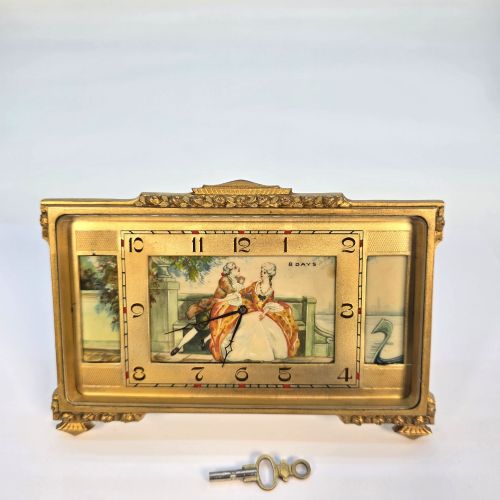


Swiss 8 Day Clock
A swiss 8 day clock is a dependable mechanical desk or travel timepiece built to run for over a week without winding.
Swiss 8 Day Clock
When you search for a swiss 8 day clock, you are looking at mechanical timepieces designed for desks, tables, travel, and bedside use. These pieces include portable carriage clocks, folding travel alarms, and distinctive Art Deco skyscraper designs.
You are most likely to meet mid-century desk models and Art Deco travel versions on this page. The selection spans from Edwardian and early twentieth-century pieces through to modernist creations from the nineteen-fifties and sixties.
Makers and retailers such as Imhof, Jaeger LeCoultre, Harrods, Asprey, and Mappin and Webb appear frequently in these forms. They range from simple brass desk instruments to complex weather stations combining clocks with barometers.
How They Were Made
These clocks rely on brass and gilt brass movements, often featuring jewelled escapements for precision. Casings utilise chrome-plated metal, solid silver, glass, and vitreous enamel work such as champlevé.
Travel and bedside pieces frequently incorporate fitted leather cases for protection during transit. Gilt wood and silvered dials provide contrasting finishes on wall and desk variations.
Some travel clocks fold neatly into their own leather waistcoats, ready to slip into a Gladstone bag.
What Varies in Quality
Quality rests in the refinement of the movement and the integrity of the casing materials. Pieces featuring multi-jewel escapements and signed dials by established firms stand apart from anonymous production.
The finish of the metalwork, whether champlevé enamel, heavy chrome plating, or polished gilt brass, determines the aesthetic standing of the piece. Intricate housing, such as original leather travel cases or architectural skyscraper forms, elevates the object.
Imhof·Jaeger LeCoultre·Harrods of London·Asprey·Mappin and Webb·BMC Ltd
The Swiss 8 Day Clock Glossary
- Champlevé enamel
- A technique where troughs are dug into the metal surface and filled with vitreous enamel before firing. This method creates colourful decorative patterns on clock bezels and struts.
- Gilt brass
- Brass coated with a thin layer of gold or a gold-coloured alloy. It provides a bright, durable finish popular in Edwardian and mid-century desk clocks.
- Escapement
- The mechanism inside a clock that controls the release of power from the mainspring to the gear train. Jewelled escapements reduce friction and improve timekeeping accuracy.
- Skyscraper desk clock
- An architectural clock style popular in the Art Deco period. These vertical pieces mimic the stepped setback forms of early twentieth-century skyscrapers.
Swiss 8 Day Clock: Frequently Asked Questions
How do I wind a swiss 8 day clock?
Most models use an attached key or a turning bezel to tension the mainspring.
Take care not to overwind the movement when resistance increases near the end of the power reserve.
Can I travel with a vintage swiss clock?
Pieces housed in original leather cases or sturdy folding frames were specifically designed for portability.
Ensure the travel door is securely fastened to protect the glass dial before packing.
How do I date an Art Deco clock?
Examine the case geometry, numeral typography, and materials such as chrome-plated metal.
Design cues from the nineteen-thirties often feature streamlined geometric forms and skyscraper silhouettes.
What does a jewelled movement mean?
The mechanism uses synthetic rubies at pivot points to reduce friction between moving metal parts.
Higher jewel counts typically indicate a more finely adjusted and durable movement.