


Swedish Circular Pedestal Table
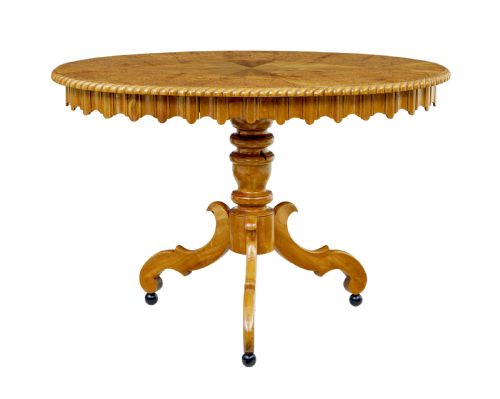
These swedish circular pedestal table examples bring tactile warmth and clean Scandinavian lines to a room, offering practical surface space anchored by a central support.
Swedish Circular Pedestal Table
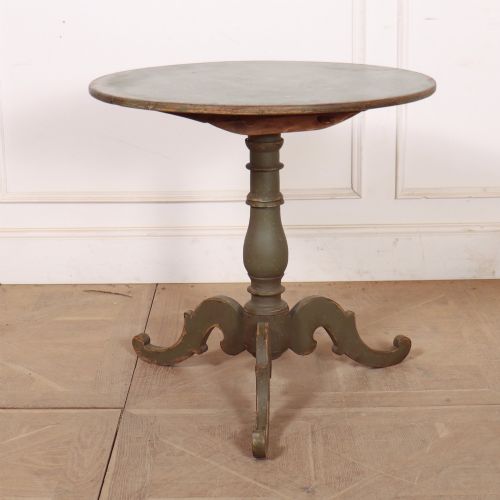
The selection on this page draws primarily from nineteenth century and early twentieth century periods, spanning Swedish Biedermeier, Karl Johan, Empire, and Scandinavian Art Deco aesthetics. Buyers frequently encounter variations in painted finishes alongside natural wood veneers such as birch and satin birch.
How they were made
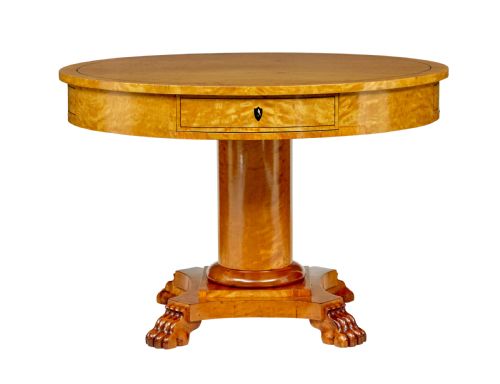
Cabinetmakers utilised indigenous and imported timbers, applying birch veneer, burr birch, and satin birch over solid carcases to achieve striking decorative patterns on the table tops. Mahogany and ebony appear occasionally as contrasting elements, while other examples receive a painted finish.
Structural integrity relies on a central pedestal construction, sometimes incorporating stone and iron in outdoor garden variants, or traditional joinery for indoor occasional and centre tables.
Materials recorded across these listings include birch, satin birch, burr birch, pine, mahogany, ebony, paint, stone, and iron.
What varies in quality
The visual impact of a swedish circular pedestal table often depends on the selection and matching of the wood veneer, particularly where figured birch or burr birch creates symmetrical patterns across the circular surface. Finer examples display meticulous attention to the proportions between the central column and the tabletop.
Execution of decorative inlays and the preservation of original painted surfaces or polished finishes distinguish superior craftsmanship from simpler country pieces.
The Swedish Circular Pedestal Table Glossary
- Pedestal table
- A table supported by a single central pillar or column rather than conventional legs. This design maximises floor clearance around the base.
- Centre table
- A freestanding piece designed to be viewed from all sides, traditionally placed in the middle of a room. These tables often feature circular tops suitable for lamps or display items.
- Biedermeier
- A prominent Central European and Scandinavian design style dating from the nineteenth century. It prioritises utilitarian comfort and clean lines over excessive ornamentation.
- Satin birch
- A timber featuring a lustrous, light-coloured grain utilised extensively in Scandinavian cabinetmaking. It provides a bright surface finish when polished.
- Veneer
- A thin layer of finely figured wood applied over a secondary timber base. This technique allows makers to display decorative grains economically.
Swedish Circular Pedestal Table: Frequently Asked Questions
Where should I place a swedish circular pedestal table?
These tables function well as freestanding centre pieces in hallways or as lamp tables beside seating arrangements. Their circular footprint allows for easy movement around them in smaller spaces.
Because the central column design eliminates corner legs, seating can be arranged flexibly around the perimeter when the surface is used for occasional gatherings.
How do I identify the wood on my table?
Scandinavian furniture from these periods frequently employs birch, recognised by its pale hue and subtle figuring. More decorative pieces utilise burr birch or satin birch, which display swirling grain patterns.
Contrasting darker elements in mahogany or ebony occasionally accent the primary birch structure, while other examples are finished entirely with paint.
What periods do these tables come from?
The available selection centres primarily on the nineteenth century, encompassing styles such as Biedermeier, Karl Johan, and Empire. Later examples extend into early twentieth century Scandinavian Art Deco.
Design characteristics shift from the classical influence of the early nineteenth century toward the simpler geometric forms of later decades.