
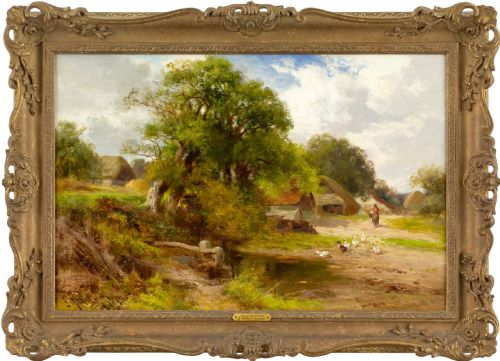


Sussex Landscape Painting
These sussex landscape painting works capture the rolling downs, historic towns and coastal waterways of the county through the eyes of artists working across several centuries.
Sussex Landscape Painting
A sussex landscape painting brings the specific topography of the southern English county into domestic interiors, depicting recognisable local landmarks such as Arundel Castle, Rye, Steyning and the South Downs. These works range from intimate village street scenes and river bridges to wide rural vistas filled with sheep or harvest activity.
The pieces encountered here span from naive eighteenth-century topographical views to mid-twentieth-century watercolours and oils. Victorian pastoral works and early twentieth-century British paintings form the core of the selection, reflecting changing artistic approaches to the same rural terrain over generations.
Materials and Techniques
Artists record the Sussex countryside primarily through oil on canvas or wood panel, and watercolour on paper, occasionally supplemented by gouache and pen work. Oil paintings offer rich texture and depth for capturing heavy skies and rolling fields, whilst watercolour allows for rapid, luminous studies of changing light along the coast and rivers.
Framing is an integral part of these pieces, with original gilt wood frames frequently housing the canvas or paper support. The combination of traditional pigments, paper or stretched canvas, and period frames defines the physical presence of each work.
The archive and current listings span multiple mediums including watercolour, oil on canvas, and gouache, across periods from the eighteenth to the mid-twentieth century.
Judgments of Quality
Quality in a sussex landscape painting rests upon the sureness of the hand and the artist's ability to render light and atmosphere rather than mere topographical accuracy. The finest examples demonstrate confident brushwork or delicate wash control that breathes life into foliage, water and sky without overworking the surface.
The harmony between the painting and its period frame also influences the overall merit of the piece. Works that retain their original gilt wood framing preserve the complete historical object as it left the artist's studio or early gallery.
Charles Gregory·Stanley Orchart·Arthur Winter Shaw·Henry Charles Fox·Harry Pennell·Henry John Kinnaird·Annie L. Lee·William Luker Snr·Yeend King·Walter J. Hall·Reginald Mills·Oliver Hall·Frank Charles Medworth·Margaret Fisher Prout·Abraham Hulk Junior
The Sussex Landscape Painting Glossary
- Topographical
- Depicting a specific, identifiable real-world location rather than an imaginary scene. These works serve as visual records of Sussex towns and landscapes as they appeared in the past.
- Pastoral
- Relating to the countryside and rural life, often portraying peaceful scenes of agriculture, sheep grazing or pastoral idylls. This style dominated much of the nineteenth-century approach to the English landscape.
- Gouache
- An opaque water-based pigment that provides heavier coverage and brighter highlights than traditional watercolour. Artists utilise it to add solid areas of colour and sharp detail to paper supports.
- Naïve
- Characterised by a direct, unacademic perspective and simplified proportions, frequently seen in eighteenth-century folk art. These works charm through their honest observation rather than strict adherence to academic rules of perspective.
Sussex Landscape Painting: Frequently Asked Questions
What periods do these paintings cover?
The works stretch from eighteenth-century folk art pieces up through Victorian pastoral and Edwardian fine art into the mid-twentieth century. This timeline shows how artistic interpretations of the same rural county evolved over two hundred years.
Earlier examples often lean towards naive topographical recording, whilst later Victorian and twentieth-century pieces focus more closely on atmospheric light and specific brush techniques.
Which materials were commonly used by the artists?
Painters relied primarily on oil on canvas, oil on wood panel, and watercolour on paper, with occasional instances of gouache. Each medium creates a distinct visual texture, from the heavy, worked surface of an oil painting to the fluid transparency of a watercolour sketch.
Original gilt wood frames frequently accompany these works, preserving the presentation intended by the creator.
How do I identify a specific Sussex location?
Many titles and subjects reference exact local landmarks such as Arundel Castle, the Mermaid Inn in Rye, Pevensey Bay, or the South Downs. Inscriptions on the reverse or front of the work often provide the precise place name and sometimes the date.
Matching the visual geography to known Sussex bridges, rivers, and coastal inlets helps place the painting in its exact local context.
How should I care for an antique painting on paper?
Watercolours and works on paper require protection from direct sunlight to prevent the fading of delicate pigments. Keeping them away from excessive moisture and hanging them in stable environmental conditions ensures the paper and any accompanying frame remain sound.
Professional framing with acid-free mounts further protects the paper from degradation over time.