




Sultanabad Style Carpet
A sultanabad style carpet brings grand Persian design into a room, offering large-scale floral motifs and muted palettes that suit period and modern interiors alike.
Sultanabad Style Carpet
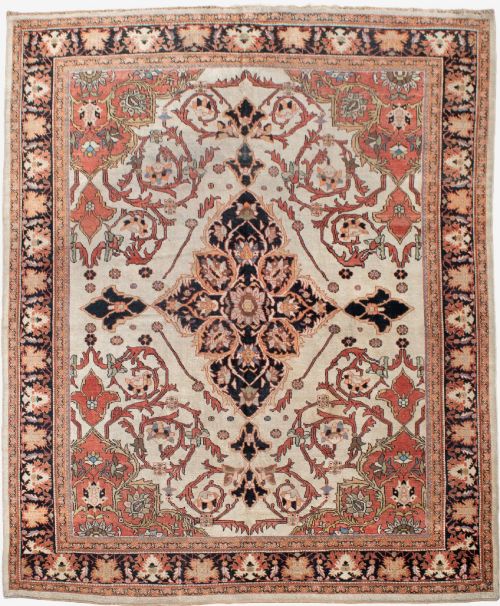
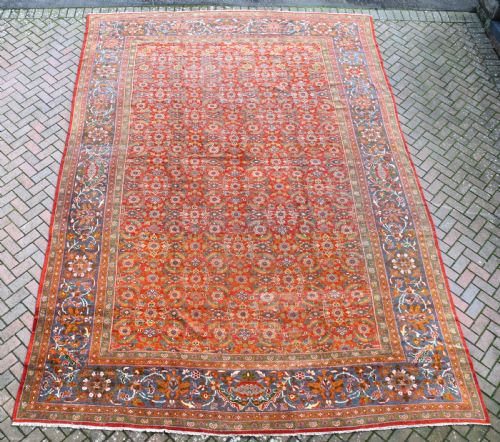
A sultanabad style carpet is a large floor covering rooted in Persian traditions, frequently associated with the Arak region and nineteenth-century workshop production. These pieces often feature expansive floral layouts, including the mina khani design, which arranges repeated blossom patterns across a field of soft colour.
The pieces available on this page date from the late nineteenth century and around nineteen hundred, spanning the eighteen eighties to nineteen hundred. Buyers encounter overlapping stylistic descriptions such as Mahal and Ziegler, reflecting the commercial networks that exported these floor coverings to Western markets.
How They Were Made
These carpets are constructed using wool pile knotted onto cotton foundations, a combination that provides both surface warmth and structural stability for large formats. The materials were dyed to achieve muted, earthy tones that distinguish nineteenth-century Persian workshop output from brighter subsequent commercial weaves.
Weavers employed traditional hand-knotting techniques to execute grand, all-over patterns and spacious borders that define the aesthetic of these large floor coverings.
Sultanabad Style Carpet Retail Price Guide 2026
Typical asking prices for sultanabad style carpet among the pieces listed under this phrase on Sellingantiques today, from the lower quarter to the upper quarter. They describe what is for sale here now, not the wider market.
Listings span three distinct decades from eighteen eighty to nineteen hundred, encompassing wool and cotton floor coverings from Persian workshops.
What Varies in Quality
The distinction between tiers of quality rests on the finesse of the drawing and the harmonious balance of the vegetable or early synthetic dyes across the large field. Carpets with more purposeful line work and well-proportioned borders command greater appreciation among collectors than those with rigid or crowded compositions.
Preservation of the original pile depth and intact outer edge bindings across large dimensions also separates standard room-size rugs from those with extensive historical restoration.
The Sultanabad Style Carpet Glossary
- Mahal
- A designation for carpets originating from the district around Arak, sharing close stylistic ties with Sultanabad productions. These pieces often display large-scale floral designs.
- Ziegler
- A reference to the Manchester firm that established production centres in Persia during the late nineteenth century to supply European tastes. Ziegler carpets typically feature restrained palettes and open fields.
- Mina khani
- A traditional Persian repeating pattern composed of four-petalled flowers linked by delicate vines. This motif frequently appears across large carpet fields.
- Foundation
- The underlying structure of a carpet, consisting of warp and weft threads. In these examples, the foundation is made of cotton.
Sultanabad Style Carpet: Frequently Asked Questions
What is a sultanabad style carpet?
A sultanabad style carpet is a large nineteenth-century Persian floor covering known for its expansive floral patterns and muted tones. These pieces were produced for both domestic use and export.
They often overlap in design and origin with Mahal and Ziegler productions from the Arak region, sharing similar wool and cotton construction.
How old are these carpets?
The carpets listed here date from the late nineteenth century, specifically between eighteen eighty and nineteen hundred. This period represents a key era of workshop weaving in Persia.
Production during these decades utilised traditional hand-knotting techniques on cotton foundations using durable wool pile.
Where were they made?
These carpets originate from Persia, specifically the Arak region where workshops produced large room-size floor coverings for Western markets. European firms like Ziegler coordinated much of this output.
The regional weavers adapted traditional Persian motifs into larger, more open compositions suited to Western drawing rooms.
How do I live with a large carpet?
Living with a nineteenth-century carpet involves placing it in a low-traffic area or using a quality underlay to cushion the cotton foundation. Regular gentle rotation helps ensure even wear across the wool surface.
Protecting the piece from direct sunlight preserves the muted vegetable and early aniline dyes characteristic of the period.