
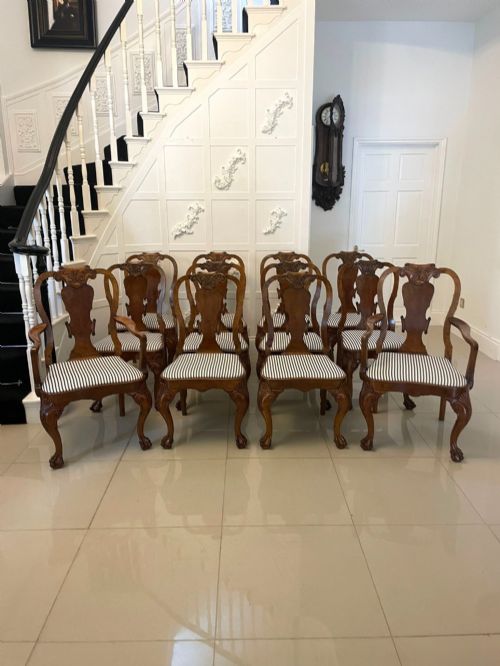
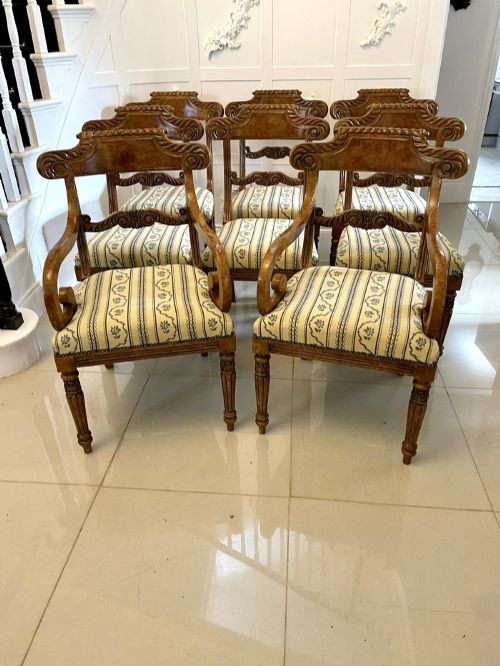
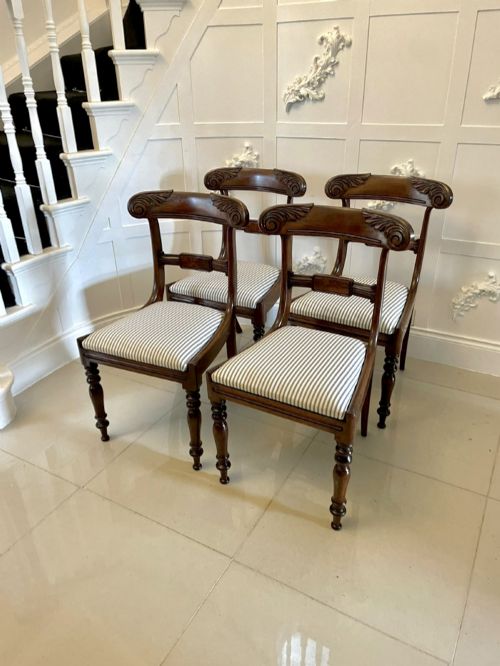
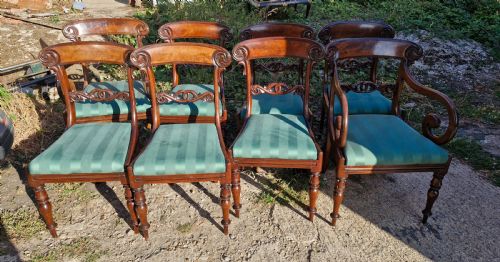
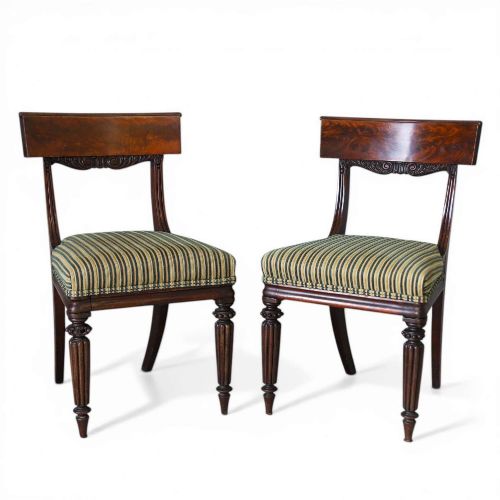
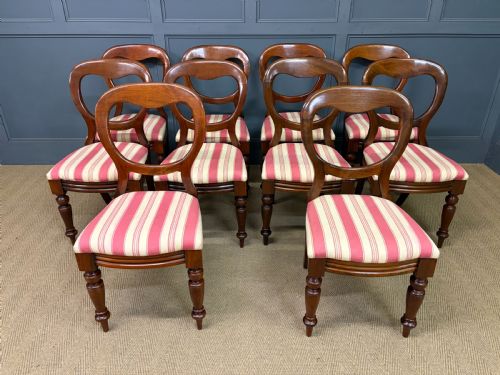
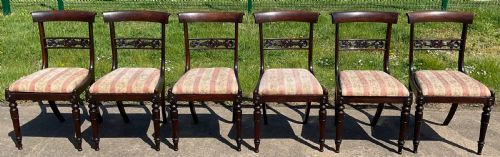


Striped Seat Dining Chairs
Striped seat dining chairs bring classical elegance and refined textile patterns to the table, uniting historic wood frames with patterned upholstery.
Striped Seat Dining Chairs
When buyers search for striped seat dining chairs, they encounter a range of formal seating primarily from the Regency, Victorian, and Georgian periods. These pieces include sets of dining chairs, side chairs, and armchairs configured with upholstered pads or backrests.
The versions most frequently met on this page are mahogany, rosewood, walnut, and oak dining chairs featuring distinct fabric stripes. Frames span styles from simple balloon-back Victorian forms to grand Regency and Chippendale design ebonised models.
How they were made
Cabinetmakers constructed the frames using solid hardwoods such as mahogany, rosewood, walnut, and oak, often incorporating intricate carving, scroll work, and string inlay. Wood selection dictated the structural integrity and visual weight of each chair.
Upholstery fabrics and textiles were fixed over padded seats to create the characteristic stripe pattern, sometimes complementing shaped balloon backs and cabriole legs.
Listings span multiple centuries, incorporating 18th Century, Regency, Victorian, and Edwardian periods in mahogany, rosewood, walnut, and oak.
What varies in quality
The refinement of the wood carving and the depth of the timber grain separate standard examples from finer works. Pieces exhibiting crisp scroll carving, detailed inlay, and substantial timbers like rosewood or burr walnut command greater attention.
The scale of the matched set also alters the nature of the piece, as large sets spanning eight to fourteen chairs require uniform construction and consistent timber selection across every frame.
The Striped Seat Dining Chairs Glossary
- Balloon-back
- A chair back shaped in a continuous curve resembling a balloon, popular during the Victorian era. This form provides ergonomic comfort alongside distinct visual lightness.
- Regency stripe
- A vertical linear pattern on upholstery fabric associated with the Regency period. It creates a formal and structured appearance on dining chair seats.
- String inlay
- Fine lines of contrasting wood veneer embedded into the primary timber surface. This decorative technique appears on Edwardian salon chairs and formal dining seats.
- Cabriole leg
- A furniture leg that curves out and then in, mimicking animal legs. It frequently terminates in carved scroll or foot details on 19th-century chairs.
Striped Seat Dining Chairs: Frequently Asked Questions
How do I identify a Regency dining chair?
Regency chairs often feature dark timbers like mahogany or rosewood, sometimes with ebonised finishes or classical classical proportions. They frequently display simpler, cleaner lines than heavier Victorian iterations.
Look for sabre legs or reeded framing elements that define the period style.
What materials were used for these chairs?
Cabinetmakers primarily utilised dense hardwoods including mahogany, rosewood, walnut, and oak. Frames were shaped from solid timber, occasionally featuring faux birds eye maple or ebonised surfaces.
Upholstery fabrics and textiles provide the striped seat elements across these historic pieces.
Are large sets of dining chairs common?
Larger sets spanning eight, ten, or twelve chairs do appear, though they require extensive searching compared to smaller pairs or sets of four. Matched sets of fourteen chairs represent substantial dining arrangements from the 19th century.
Finding uniform large sets reflects the original grand scale of formal dining rooms.
How do Victorian chairs differ from Georgian ones?
Georgian chairs generally exhibit restrained classical proportions and geometric joinery in mahogany or walnut. Victorian pieces often introduce balloon-back forms, heavier carved walnut, and more exuberant decorative details.
Examining the backrest shape and timber finish helps distinguish between these eras.