

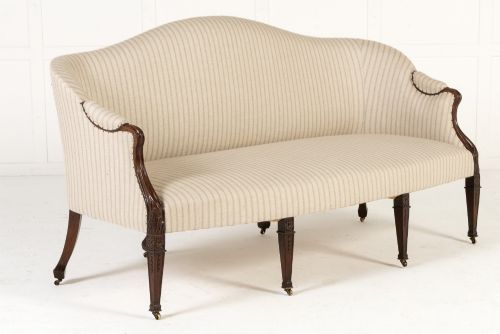
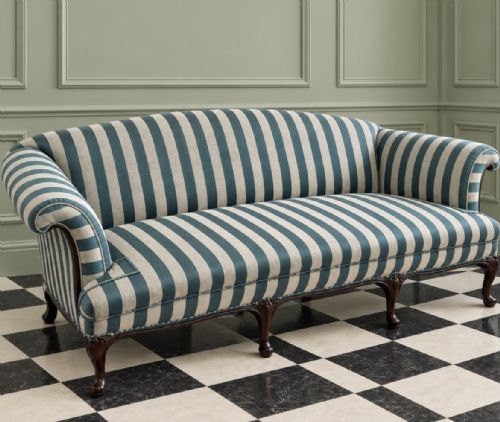
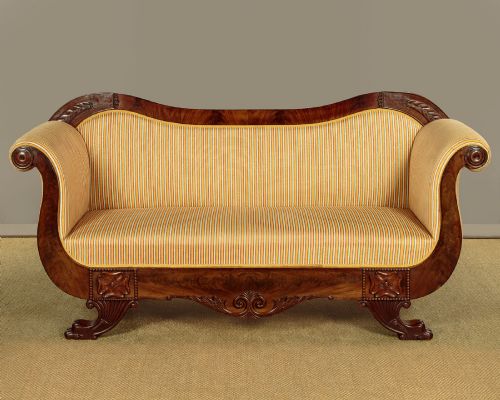


Striped Mahogany Settee
A striped mahogany settee brings the linear grain of the timber and period upholstery straight into a modern interior.
Striped Mahogany Settee
A striped mahogany settee spans multiple eras, with Regency, 19th Century, and Edwardian examples making up the selections seen on this page. These seating forms range from double scroll-ended sofas and chaise longues to three-seater country house sofas and salon suites.
The dominant aesthetic draws heavily on Regency and Chippendale style design, alongside Biedermeier and Art Deco influences. Buyers encounter frames shaped with carved mahogany woodwork, often complemented by contrasting satinwood inlay.
Upholstery defines the character of a striped mahogany settee, utilising patterned fabric, velvet, and standard fabric upholstery over sprung or padded seats. Forms vary from intimate two-seater salon settees to expansive three-seater couches.
How they were made
Makers built the structural frames using solid mahogany, occasionally integrating satinwood inlay for decorative contrast on the woodwork. Brass elements sometimes appeared on castors or decorative mounts depending on the specific period of manufacture.
Upholsterers applied fabric, velvet, and fabric upholstery directly to the frames to finish the seating surface. Artisans shaped the timber into scroll arms, carved rails, and double scroll ends characteristic of Regency and Chippendale style pieces.
Striped Mahogany Settee Retail Price Guide 2026
Typical asking prices for striped mahogany settee among the pieces listed under this phrase on Sellingantiques today, from the lower quarter to the upper quarter. They describe what is for sale here now, not the wider market.
One exceptional settee on this page spent its earlier days inside the ballroom of the RMS Queen Elizabeth ocean liner.
What varies in quality
Quality reveals itself in the crispness of the carved mahogany woodwork and the precision of any satinwood inlay work integrated into the frame. Finer examples display balanced proportions, particularly in the sweep of scroll ends and the curve of the arms.
The sophistication of the upholstery choices and the execution of the timber finishing set finer pieces apart from standard manufacturing. Original frames retain their structural integrity better when joinery was executed with rigorous attention to detail.
The Striped Mahogany Settee Glossary
- Mahogany
- A dense tropical hardwood prized for its rich reddish-brown colour and stable grain. It served as the primary structural material for fine seating across the Regency and Edwardian periods.
- Scroll End
- A furniture terminal shaped into a tight outward or inward curl, frequently seen on the arms and ends of Regency couches. This decorative flourish defines the silhouette of many traditional settees.
- Satinwood
- A luminous yellowish wood utilised for contrasting decorative inlays on cabinetwork and seating frames. Artisans cut it into fine veneers to create geometric or floral patterns.
- Biedermeier
- A Central European design style spanning the nineteenth century that prioritised clean lines and domestic comfort over heavy ornamentation. Pieces from this tradition often feature unadorned timber surfaces and restrained forms.
Striped Mahogany Settee: Frequently Asked Questions
What periods do these settees come from?
The selections span the Regency era, the nineteenth century, the Edwardian period, and the 1930s. Different eras introduced distinct structural proportions and decorative motifs.
Regency pieces often showcase bold scroll ends and carved frames, while Edwardian examples tend toward lighter salon furniture with inlaid details.
How are mahogany and satinwood combined?
Cabinetmakers used mahogany as the primary structural timber for the frame and legs. Satinwood was applied as a contrasting veneer for inlay work.
This technique created geometric or linear patterns that highlighted the edges and crest rails of the woodwork.
What upholstery materials appear on these pieces?
Upholstery options recorded in the listings include standard fabric, patterned textiles, and velvet. These materials cover the seat bases and backrests of the settees.
The choice of textile often reflects the original period aesthetic or a subsequent restoration phase.
Are these settees suitable for daily use?
These seating pieces function well in living spaces, drawing rooms, and studies when matched with appropriate interior layouts. Their diverse sizes accommodate different room dimensions.
Owners should consider the scale of scroll arms and double scroll ends when positioning them against walls or in open spaces.