
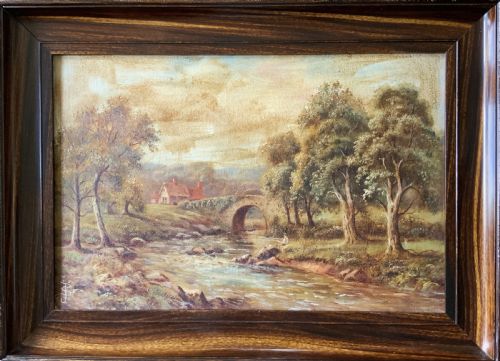


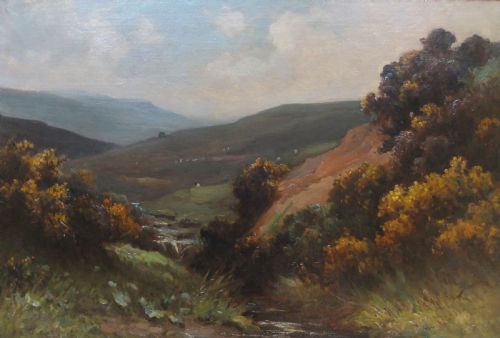

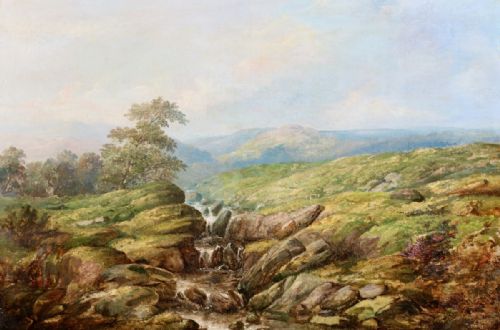


Stream Landscape Canvas Painting
These stream landscape canvas painting works capture moving water and rural countryside across various historic periods.
Stream Landscape Canvas Painting
A stream landscape canvas painting depicts natural waterways, rural rivers, and pastoral settings rendered in oil paint on woven fabric supports. These works frequently incorporate animals such as cattle resting near banks, woodland backgrounds, and mountainous terrain.
Examples span several distinct eras, originating from the late eighteenth century through the Edwardian period and mid-twentieth century. Stylistic approaches range from Victorian pastoral and romanticism to British impressionism and nineteenth century realism.
Materials and Construction
Artists painted primarily with oil paint on stretched canvas supports, occasionally housed within wooden and giltwood frames featuring gesso preparation. The combination of oil pigments on canvas allowed painters to build rich textures and tonal depths for water surfaces and foliage.
Framing elements often utilised timber mouldings finished with gilded or painted surfaces to complement the pastoral subjects depicted within the composition.
Materials across the selection consist of canvas, oil paint, gesso, wood, and giltwood.
Assessing Quality and Execution
Superior examples demonstrate confident brushwork and sophisticated handling of light, particularly in capturing the reflection on moving water and atmospheric conditions at sunset or across moorland streams. The anatomical accuracy of depicted cattle and the integration of figures into the landscape further distinguish finer works.
The preservation of the original canvas support and the integrity of the oil paint layer influence the overall condition, alongside the quality and period appropriateness of the surrounding wooden or giltwood frame.
Sydney Yates Johnson·John Grenville Fennell·Ernest Higgins Rigg·Henry John Yeend King·Robert Watson·David Watts·William Sidney Cooper·Owen Bowen·George F Wetherbee·William Greaves·Thomas Creswick·Clarence Roe
The Stream Landscape Canvas Painting Glossary
- Canvas
- A heavy woven fabric used as a surface for oil painting. It is typically stretched tightly over a wooden frame before application of the ground and pigments.
- Gesso
- A plaster-like mixture used as a base coat on wooden frames to prepare the surface for gilding or painting. It provides a smooth foundation for decorative details.
- Giltwood
- Wood that has been covered with a thin layer of gold leaf or gold paint. This finish is frequently found on traditional picture frames.
- British Impressionism
- An art movement focusing on everyday subject matter and the transient effects of natural light. Painters in this style often worked outdoors to capture immediate visual impressions.
Stream Landscape Canvas Painting: Frequently Asked Questions
What periods do these stream paintings come from?
The works span from the late eighteenth century through the nineteenth century, Edwardian era, and mid-twentieth century.
Specific dates within the listings include the eighteen-eighties, nineteen-hundreds, and nineteen-twenties.
What subjects typically appear in these landscapes?
Common subjects include rural streams, mill streams, moorland waters, and mountain streams set in countryside or woodland locations.
Many compositions also feature livestock such as cattle drinking or resting near the water's edge alongside human figures.
How should I display a canvas painting?
Display these works on interior walls away from direct sunlight and excessive moisture fluctuations to protect the canvas and oil pigments.
Ensure the piece is securely hung using appropriate fixings suited to the weight of the canvas and its wooden frame.
How do I identify the painting style?
Styles encompass Victorian pastoral and romanticism, nineteenth century realism, and British impressionism depending on the execution date.
Brushwork techniques and lighting choices help differentiate between the structured realism of the nineteenth century and looser impressionist approaches.