


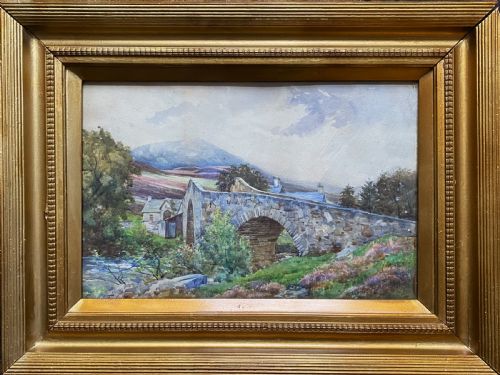

Stone Bridge Landscape Painting
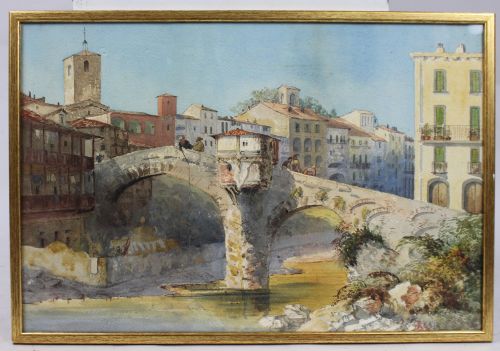
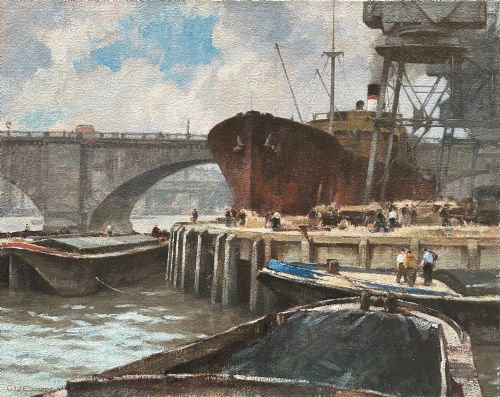
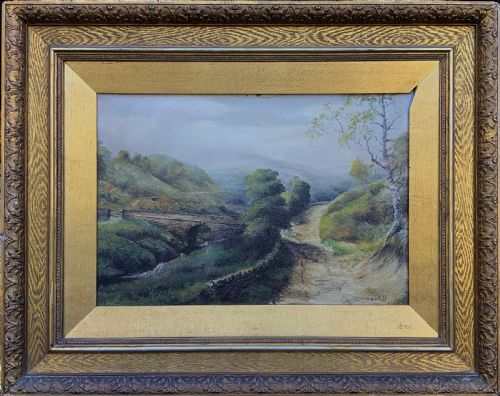
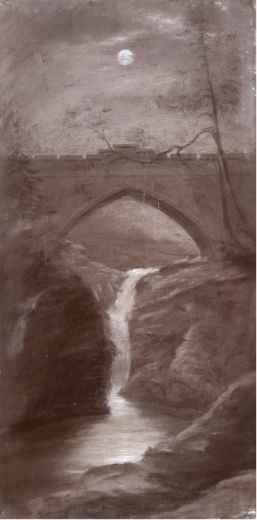
A stone bridge landscape painting captures water, masonry and open air across British and European views from the nineteenth and twentieth centuries.
Stone Bridge Landscape Painting
A stone bridge landscape painting typically depicts rivers, streams or valleys anchored by masonry arches, ranging from quiet rural crossings to dramatic Highland and continental scenes. These works appear across nineteenth-century Victorian styles, British Impressionism and early twentieth-century compositions.
The pieces on this page span watercolours on paper and oil paintings on canvas, wood panel or board. Subjects stretch from Yorkshire and North Wales to Scotland, Venice and Switzerland, often framed by figures, riversides and local architecture.
Buyers encounter everything from intimate nineteenth-century watercolours signed by regional artists to larger twentieth-century oil paintings by named hands. The enduring appeal lies in the way artists balance the rigid geometry of stone against the fluid movement of water and sky.
Materials and Technique
Artists built these compositions using oil paint or watercolour paint applied to canvas, paper, wood panels or terracotta plates. Pigments were brushed onto primed canvas or heavy paper supports, capturing natural light and tonal depth.
Techniques range from precise nineteenth-century watercolour washes to bolder twentieth-century brushwork in oil. Painters utilised charcoal underdrawings or direct application of pigment to establish the texture of masonry, foliage and water.
Represented movements include British Impressionism, nineteenth-century Romanticism, Norwich School and regional British schools.
Assessing Quality
Quality rests upon the artist's control of light, atmospheric perspective and structural draughtsmanship within the composition. Stronger works render the solidity of stone and the motion of water with confident, assured handling.
Provenance and clear attribution to named nineteenth and twentieth-century painters elevate an example above anonymous school pieces. The harmony of the palette and the preservation of the original painted surface further distinguish the finest items.
Cyril Walduck Edwards·Florence Adelina Hess·Thomas Lound·Percy Lancaster·Noel Harry Leaver·Franz Reder-Broili·Charles Edmund Rene His·George Graham·Clarkson Frederick Stanfield·Fred Elwell·Owen Bowen
The Stone Bridge Landscape Painting Glossary
- Watercolour paint
- A medium consisting of colour pigments suspended in a water-soluble vehicle, applied to paper supports. It allows for translucent washes and delicate atmospheric effects.
- Oil paint
- A slow-drying medium made by mixing pigments with oils such as linseed, used across canvas and wood panels. It provides rich colour saturation and varied surface textures.
- British Impressionism
- A late nineteenth and early twentieth-century painting movement focused on light, loose brushwork and everyday outdoor subjects. Artists sought to capture transient weather and natural illumination.
- Panel painting
- A work executed on a flat piece of wood rather than canvas. Wooden supports offer a rigid ground that influenced how artists built their paint layers.
Stone Bridge Landscape Painting: Frequently Asked Questions
What periods do these paintings come from?
The available selection spans the nineteenth century through the early decades of the twentieth century. This covers Victorian academic styles, British Impressionism and early twentieth-century regional schools.
Dates range from mid-nineteenth-century watercolours to works produced up to nineteen-thirty.
Where were these landscape scenes painted?
Locations include British settings such as Yorkshire, North Wales, Scotland, Dartmoor and London, alongside continental views in Venice and Switzerland. Artists often painted specific regional rivers, mills and historic bridges.
Local topography informed much of the nineteenth and early twentieth-century British school output.
How should I hang and care for a watercolour?
Watercolours on paper require protection from direct sunlight to prevent fading of the pigments. Framing behind conservation glass with suitable mounts keeps the paper stable.
Keep them in rooms with stable humidity away from damp walls and heat sources.
How do oil paintings differ from watercolours?
Oil paintings use thick or layered pigments on canvas, wood or board, offering a textured surface and deep colour saturation. Watercolours use translucent washes on paper, emphasising lightness and fluid transparency.
Oils are generally more robust regarding light exposure than works on paper.