
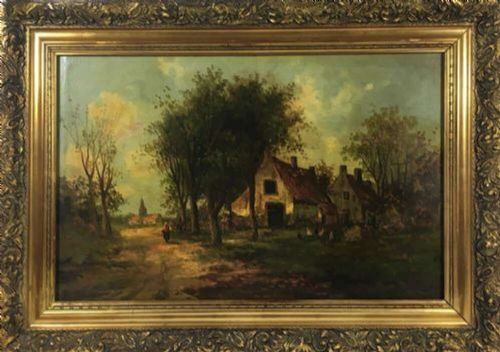


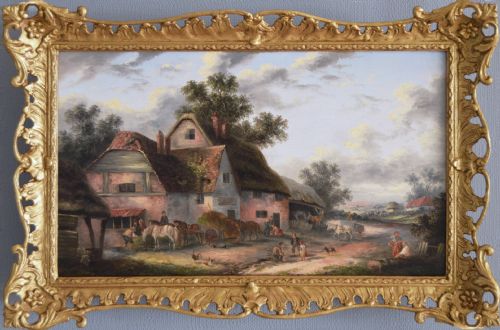

Rustic Village Oil Painting
A rustic village oil painting brings domestic rural life into a room, offering nineteenth-century landscapes and rural street scenes.
Rustic Village Oil Painting
When you search for a rustic village oil painting, you encounter works depicting rural street scenes, farmyards, and country landscapes. These canvases record village life through the eyes of nineteenth-century and early twentieth-century painters.
You are most likely to meet nineteenth-century works on canvas and panel, executed in oil paint. These range from French village scenes and Barbizon school compositions to British landscapes and primitive folk art.
The subjects span from figures on riverbanks and children at fairs to village taverns and cart tracks. Each piece captures a specific community or rural view from periods including the Victorian era and the Edwardian years.
How they were made
These works rely on oil paint applied to canvas or wood panels. Artists used traditional pigments to build up depth in their rural street scenes and landscape views.
Many examples retain their original gold leaf or gilt framing, which complements the oil on canvas construction. Wooden stretchers and panels support the painted surface across the centuries.
What varies in quality
The distinction between a standard piece and a finer work lies in the handling of light, atmosphere, and brushwork. Works by named artists demonstrate a firmer control over composition and detail than anonymous primitive examples.
Condition also separates the range, as some canvases survive untouched while others require repairs to the panel or backing. The presence of a signature or attribution to a known painter elevates the stature of the piece.
Charles Vickers·Robert McGregor·Henry Charles Bryant·Eugene Battaille·Joseph Thors·William Greaves·John Holland Snr·Georgina Lara
The Rustic Village Oil Painting Glossary
- Oil on Canvas
- Pigment mixed with drying oil applied to a woven fabric support. This is the primary medium for nineteenth-century landscape and genre paintings.
- Barbizon School
- A nineteenth-century French movement focused on realism in landscape painting. These artists painted nature and rural life directly from observation.
- Folk Art
- Artistic work created within a traditional culture by self-taught makers. These pieces prioritize narrative and direct expression over academic technique.
- Gilt Frame
- A wooden moulding coated with gold leaf or metallic gilt paint. These frames enclose and protect the painted surface.
Rustic Village Oil Painting: Frequently Asked Questions
What is a rustic village oil painting?
It is an artwork depicting rural communities, cottages, and country life using oil paint on canvas or panel. These works date primarily from the nineteenth and early twentieth centuries.
They serve as historical records of European and British country life, created by academic painters and folk artists alike.
How old are these paintings?
The works seen here span from the early nineteenth century through the Edwardian period and into the mid-twentieth century. Many date specifically from the mid-to-late nineteenth century.
Dates are determined by stylistic evidence, artist signatures, and the materials used in the canvas and stretcher construction.
How should I hang an oil painting?
Hang paintings away from direct sunlight and significant moisture fluctuations to protect the oil paint and canvas. Secure the work using appropriate fixings suited to the weight of the frame.
Ensure the wall can support both the canvas and any heavy gilt or wood frame accompanying the piece.
How do I identify different periods?
Periods are identified through clothing styles of figures, framing techniques, and the painting style itself. Victorian and Edwardian works often show distinct approaches to landscape perspective and genre subjects.
Signatures, artist dates, and stretcher construction also help place a painting within a specific nineteenth or twentieth-century decade.