
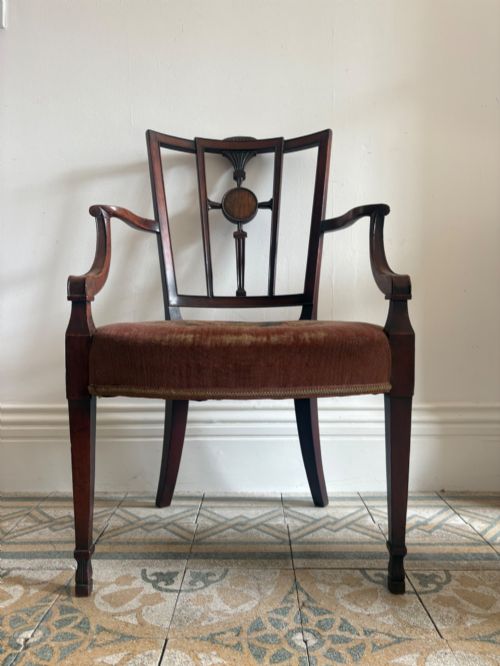


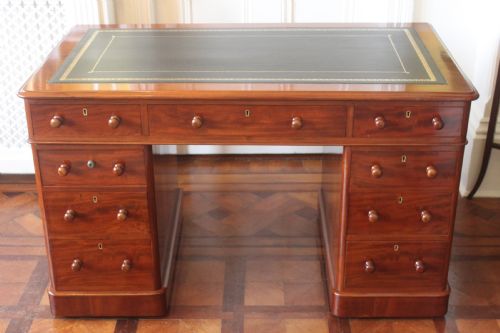


Stamped Mahogany Desk
A stamped mahogany desk carries the maker's mark within the timber, identifying the hands that shaped the wood.
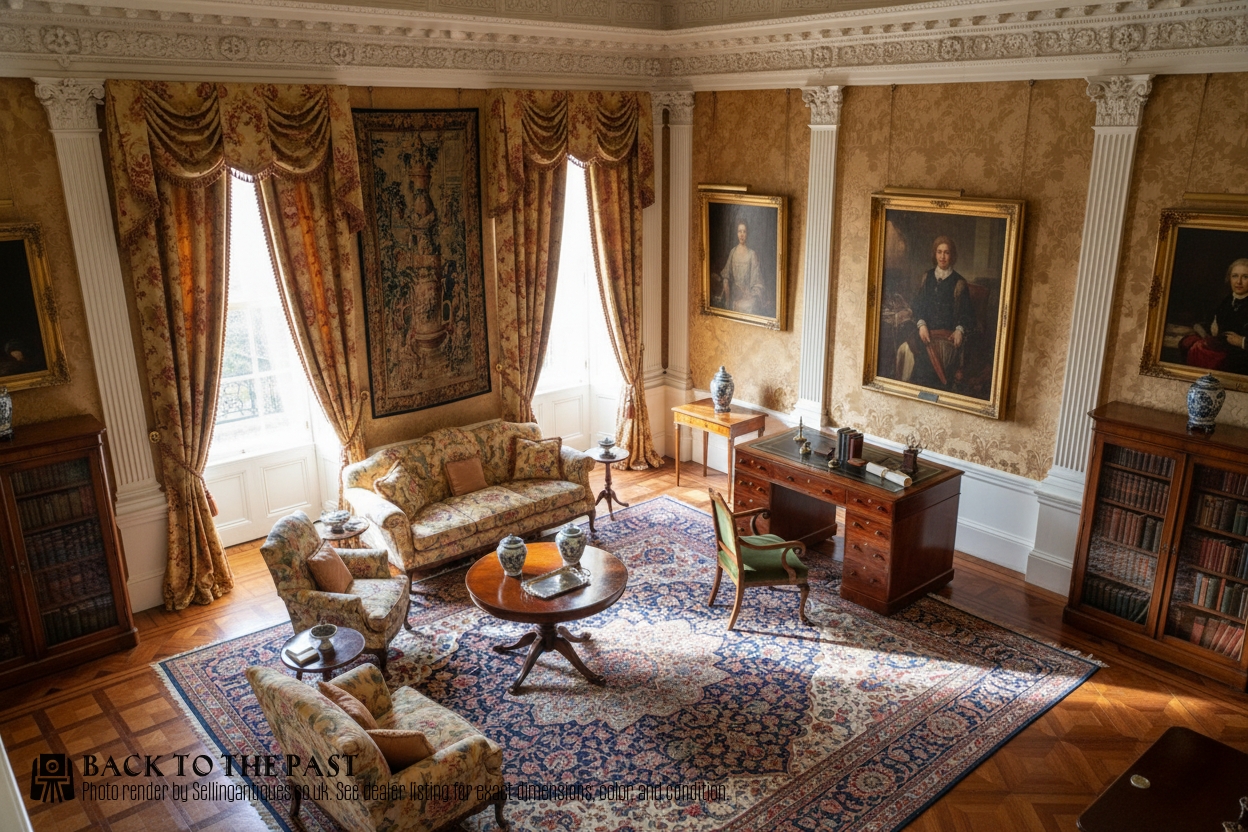
Stamped Mahogany Desk
A stamped mahogany desk brings together structural timber and a distinct maker's mark, connecting the writing surface directly to a documented workshop. The examples on this page span the eighteenth, nineteenth, and early twentieth centuries, moving through Georgian, Regency, Victorian, and Edwardian periods.
The forms range from partners tables and pedestal desks to kneehole writing tables, dressing desks, and associated seating. Mahogany provides the primary frame, frequently paired with secondary woods and specialised inserts.
Makers stamp drawers, rails, and legs to record their production, giving the modern buyer a clear path to attribution. These pieces served executive and domestic studies, holding correspondence and ledgers in established households.
Materials and Construction
Makers selected solid mahogany and figured veneers for the main bodies, occasionally incorporating satinwood inlay or rosewood details to break the dark grain. Leather surfaces provide the writing plane, sometimes bordered with gold tooling.
Brass fittings appear as drawer pulls, casters, and campaign mounts on military variants. Drawer linings utilise secondary timbers like oak or pine, joined with hand-cut dovetails that conceal the inner skeleton of the desk.
Some makers stamped their names so faintly on drawer tops that generations of housemaids polished straight over them without noticing.
Gradations in Quality
The calibre of a stamped mahogany desk rests on the clarity and depth of the timber's figure alongside the precision of the maker's stamp. Crisp stamps placed cleanly on drawer edges or rails hold more weight than worn or partial markings.
Joinery execution dictates longevity, visible in the tightness of drawer dovetails and the smooth action of pedestals. Original brass hardware and undamaged leather writing surfaces further separate standard workshop output from exceptional commissions.
Gillows Lancaster·Edwards & Roberts·Jas Shoolbred·Hobbs & Co·Maples & Co·James Winter & Sons·John Gregory London·W Priest·Gillington of Dublin·Sigmund Jaray Wien·Graygoose London·S and H Jewell·W Fry and Co·W E Marson Ltd
The Stamped Mahogany Desk Glossary
- Partners Desk
- A large double-sided desk designed for two people to work opposite one another, featuring drawers and cupboards on both faces. These pieces typically rest on twin pedestals.
- Pedestal Desk
- A freestanding desk comprising a top section resting on two independent pedestals containing banks of drawers. They offer substantial storage and a finished back.
- Kneehole Desk
- A compact form with a central recessed space for the legs, flanked by single or multiple vertical stacks of drawers. This layout allows a seated writer to face the desk squarely.
- Satinwood Inlay
- Decorative contrasting wood veneer inserted into recesses cut into the mahogany surface to form geometric or floral patterns. It brightens the darker primary timber.
- Dovetail
- A joint formed by interlocking wedge-shaped fingers, used to connect drawer sides to drawer fronts. Hand-cut dovetails indicate traditional pre-industrial construction.
Stamped Mahogany Desk: Frequently Asked Questions
Where do I find the stamp on a desk?
Makers usually placed their stamp along the top edge of the upper drawers, inside the drawer sides, or stamped directly onto the wooden framework near the kneehole.
Inspect these areas under directional light, as years of wax and polish can obscure faint impressions in the mahogany.
Are partners desks double sided?
True partners desks feature operational drawers and cupboards accessible from both the front and the back. This allows two people to sit opposite each other and use the desk simultaneously.
Many large single-sided pedestals are mistaken for partners pieces, but examination of the rear will reveal dummy drawers or plain panels.
How do I care for the leather top?
Leather writing surfaces require gentle cleaning with a slightly damp cloth followed by a neutral leather cream to prevent the hide from drying and cracking. Avoid harsh modern chemical cleaners or excessive water.
Keep the desk away from direct sunlight and heat sources, which cause both the mahogany timber and the leather insert to warp and fade.
How do I tell a Georgian desk from a Victorian one?
Georgian desks emphasise restrained classical proportions, often utilising Cuban mahogany with minimal decorative carving and straightforward bracket feet. Victorian examples tend to be heavier and more ornate, frequently employing pedestal configurations with panelled sides and plinth bases.
Construction details inside the drawers, such as the shape and spacing of the dovetails, help confirm the period alongside the maker's stamp.