

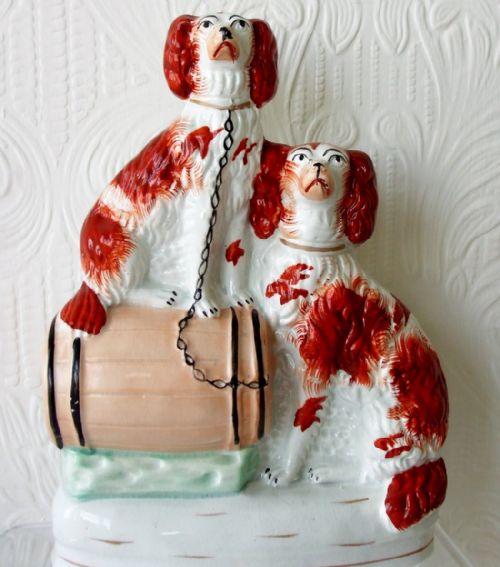


Staffordshire Flatback Dogs
Staffordshire flatback dogs are charming Victorian earthenware pottery figures designed to sit on mantelpieces, bringing character and colour to any room.
Staffordshire Flatback Dogs
Staffordshire flatback dogs are decorative ceramic figurines produced during the Victorian era, specifically spanning the mid to late nineteenth century around eighteen sixty to eighteen eighty. These pottery figures take various forms, including spaniels with barrels, greyhounds with hares, poodles, and children on setters, alongside figural groups such as huntsmen, musicians, and clock faces.
The pieces on this page represent typical nineteenth century English production, featuring flat backs designed to stand flush against a wall or mantelpiece. Buyers encounter pairs of animals, miniature versions, and larger sculptural groups that capture the domestic and sporting tastes of the Victorian period.
How they were made
These figurines utilise earthenware bodies shaped into distinct animal and human forms, finished with lead glazes that provide a glossy surface sheen. The ceramic construction relies on traditional moulding techniques typical of nineteenth century Staffordshire potteries.
Staffordshire Flatback Dogs Retail Price Guide 2026
Typical asking prices for staffordshire flatback dogs among the pieces listed under this phrase on Sellingantiques today, from the lower quarter to the upper quarter. They describe what is for sale here now, not the wider market.
Victorian makers occasionally paired aristocratic greyhounds with humble hares, creating mantelpiece scenes of eternal canine pursuit.
What varies in quality
Scale and complexity also differentiate the range, moving from simple miniature poodles to large pairs of greyhounds and elaborate clock groups. Greater artistic ambition in the modelling elevates certain figures above simpler production pieces.
The Staffordshire Flatback Dogs Glossary
- Flatback
- A pottery figure with an unglazed or simply finished flat rear side designed to be placed against a wall or mantelpiece rather than viewed in the round.
- Earthenware
- A porous type of pottery fired at lower temperatures, requiring a glaze to render it watertight and form a smooth surface for painting.
- Lead glaze
- A glossy coating containing lead compounds applied to pottery before firing to give a shiny finish and seal the clay body.
- Enamel paint
- Coloured glassy paints applied over the fired glaze and subjected to a second, lower temperature firing to fuse the colours to the ceramic.
- Figurine
- A small carved or moulded statuette representing a human, deity, or animal, used primarily for interior decoration.
Staffordshire Flatback Dogs: Frequently Asked Questions
What are Staffordshire flatback dogs?
Staffordshire flatback dogs are Victorian earthenware pottery figures created during the nineteenth century to adorn mantelpieces and shelves.
They depict various animals and scenes, most notably spaniels, poodles, and greyhounds, often modelled as pairs with flat backs intended for placement against a wall.
Where were these pottery figures made?
These ceramic pieces originate from the Staffordshire potteries in England during the Victorian era.
The regional workshops produced numerous decorative figurines and figure groups using local earthenware and traditional glazing methods.
How do you date Victorian Staffordshire figures?
Dating relies on stylistic clues, manufacturing techniques, and the specific types of glazes and enamels used on the earthenware body.
Pieces from this era generally span from the mid to late nineteenth century, including specific styles recorded around eighteen sixty and eighteen eighty.
How were these figures displayed?
Victorian households typically placed these ceramic figures on mantelpieces, tabletops, and shelves as decorative ornaments.
Because of their flat backs, they fit neatly against walls or the backs of display surfaces, often arranged in symmetrical pairs.