



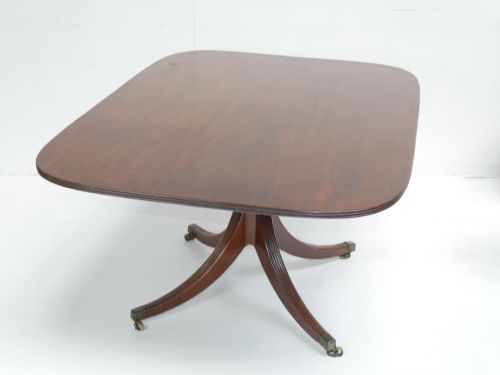


Splayed Leg Breakfast Table
A splayed leg breakfast table brings dependable surface area and architectural grace to a room, drawing on Georgian and Regency design.
Splayed Leg Breakfast Table
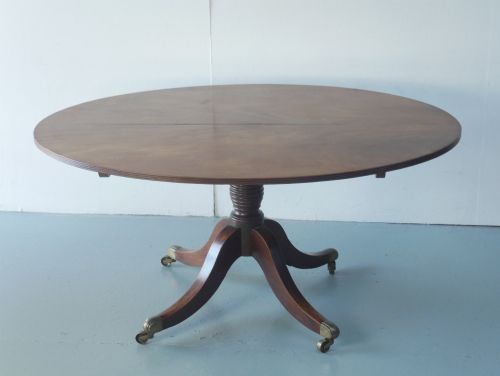
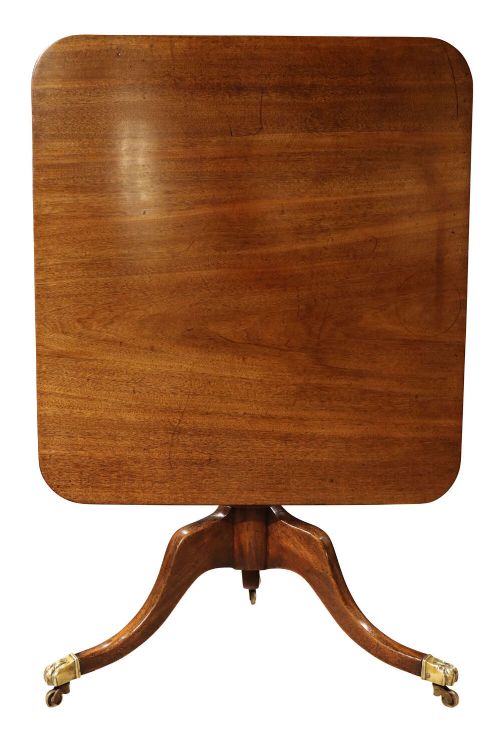
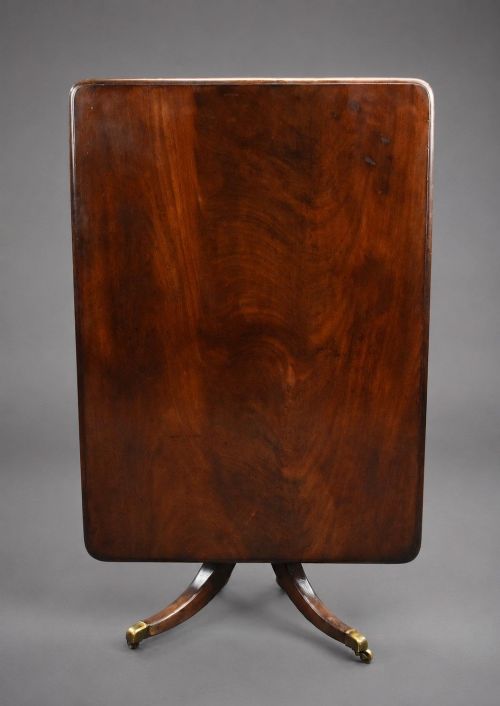
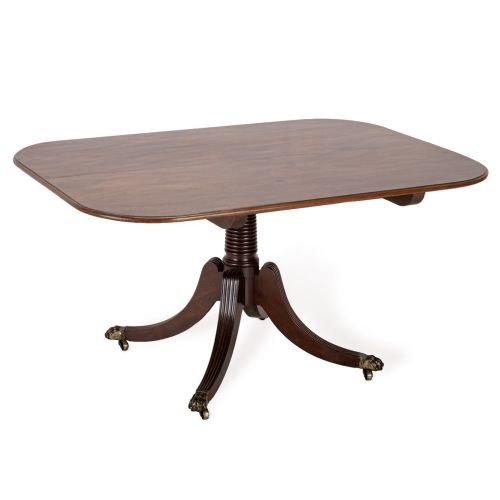
The splayed leg breakfast table appears most frequently in forms dating from the Georgian and Regency periods, constructed primarily in mahogany with occasional examples in rosewood or lacewood. These pieces often feature circular, oval or rectangular tops, sometimes designed to tilt when not in service.
Buyers encountering this group will find dining tables, centre tables and pembroke tables sharing the characteristic outward-reaching pedestal supports. The selection ranges from early Georgian forms originating around 1750 up to later revivals from the 1920s and 1930s.
Materials and construction
Cabinet makers relied heavily on figured and Cuban mahogany for these tables, frequently employing solid timbers alongside matched veneers. Secondary details often incorporated contrasting elements such as satinwood banding, boxwood inlay and ebony stringing.
Support structures typically utilise a turned column rising from a central pillar that branches into splayed legs. Many pieces incorporate brass casters to aid mobility across flooring.
Splayed Leg Breakfast Table Retail Price Guide 2026
Typical asking prices for splayed leg breakfast table among the pieces listed under this phrase on Sellingantiques today, from the lower quarter to the upper quarter. They describe what is for sale here now, not the wider market.
Some tables tilt up so smoothly you might suspect they are secret dancing partners waiting for the music to start.
Evaluating craftsmanship
Quality reveals itself in the selection of the timber grain, particularly where figured mahogany or satinwood banding has been matched across the top. Cabinet makers who invested time in selecting richly figured wood produced pieces with superior visual depth.
The integration of the mechanical elements, such as the tilt-top mechanism and the alignment of the splayed pedestal legs with brass casters, marks the division between standard production and exhibition grade execution.
James Mein·Gillows·Duncan Phyfe
The Splayed Leg Breakfast Table Glossary
- Tilt-top
- A hinged tabletop mechanism that allows the surface to rotate vertically for compact storage against a wall when not in use. This clever design preserved valuable floor space in period interiors.
- Splayed leg
- Support legs that angle outward from a central pedestal column to provide stability. This configuration offers both firm footing and clearance for chairs.
- Pembroke table
- A drop-leaf table featuring hinged flaps on opposing sides supported by folding brackets. These versatile pieces function effectively as small dining surfaces or occasional tables.
- Crossbanding
- A decorative border veneer applied to the perimeter of a tabletop where the grain runs perpendicular to the main centre panel. This technique creates a distinct framing effect.
- Casters
- Small wheel attachments fixed to the base of table legs to permit easy movement. Period examples frequently utilise brass mounts.
Splayed Leg Breakfast Table: Frequently Asked Questions
What is a splayed leg breakfast table used for?
These pieces served historically for morning dining and light domestic tasks in fashionable households.
Today they function as flexible dining or centre surfaces in sitting rooms and libraries.
How do I tell a Georgian table from a Regency one?
Georgian examples often display restrained proportions and simpler pedestal turnings dating from the mid to late eighteenth century.
Regency pieces tend to introduce bolder classical motifs, brass inlays and more pronounced pillar designs from the early nineteenth century.
How do tilt-top mechanisms work?
A clever catch beneath the surface allows the top to pivot from horizontal to vertical.
This permits the table to rest flat against a wall when the room requires open space.
What woods were used for these tables?
Mahogany served as the primary timber, including dense Cuban varieties prized for their rich figure.
Cabinet makers also incorporated rosewood, lacewood, and contrasting stringing of satinwood, boxwood and ebony.