
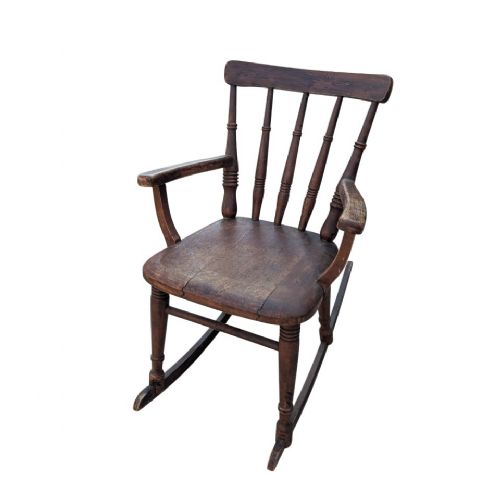


Spindle Back Child Chair
A spindle back child chair brings country vernacular seating into miniature scale, offering rustic charm and honest woodwork for the home.
Spindle Back Child Chair
A spindle back child chair takes the traditional turned timber construction of full-sized seating and scales it down for domestic use. The listings on this page span several centuries, including Georgian, Regency, and Victorian eras, alongside Edwardian examples.
Most pieces encountered here emerge from English and Scandinavian country traditions, utilising vernacular building methods. Forms vary from simple low chairs to high chairs, rockers, potty chairs, and Windsor armchairs.
Makers shaped these for functional use in domestic settings rather than purely decorative display. The evidence shows sturdy seating designed to support children through daily life in the home.
How they were made
Joiners relied on native hardwoods such as elm, ash, beech, and fruitwood, often pairing woods within a single piece for seats and turned uprights. Elm frequently formed the solid plank seats, while ash and beech provided the tensile strength needed for slender spindles and legs.
Construction involved traditional green woodworking techniques, including steam bending and pole lathe turning. Components were fitted using mortise and tenon joints or wedged through-tenons to ensure durability under heavy daily use.
The listings on this site show pieces built from elm, ash, beech, and pine, reflecting traditional English and Scandinavian country workshop methods.
What varies in quality
The sophistication of the turning work on the spindles and legs dictates much of the visual distinction across examples. Crisp, deeply defined turnings reflect higher workshop skill compared to simpler, uniform profiling.
Proportion and material selection separate standard utilitarian seating from finer regional interpretations. Pieces retaining original surface treatments, such as early paint or undisturbed polish on dense elm and ash, hold greater integrity.
LIBERTY of LONDON FORD MADDOX BROWN
The Spindle Back Child Chair Glossary
- Spindle back
- A chair back constructed from a series of slender, turned wooden rods set into a top rail and seat. This method distributes weight evenly while reducing the overall mass of the furniture.
- Windsor
- A chair style featuring a solid wooden seat into which the legs, back spindles, and bow are separately dowelled. It represents a cornerstone of English country vernacular furniture making.
- Vernacular
- Everyday domestic objects made by regional craftsmen using local materials rather than following high-style academic design. These pieces prioritize function and local tradition over courtly fashion.
- Turned
- Shaped on a lathe by rotating the timber against a cutting tool to create symmetrical profiles. It is the primary method for producing spindles, legs, and stretchers.
Spindle Back Child Chair: Frequently Asked Questions
What woods were used?
Makers relied on durable native hardwoods suited to country workshop traditions. Elm, ash, beech, and fruitwood appear frequently across the surviving examples.
Seats were often carved from solid elm planks for strength, while ash and beech provided flexible support for turned spindles and structural framing.
How were high chairs used?
These elevated seats allowed children to join adults at the dining table during family meals. They combined sturdy low bases with extended legs or added footrests for stability.
Many incorporate enclosed safety rails or solid protective arms to keep small children secure during daily use in the kitchen or parlour.
Are rocking chairs common?
Rocking variants form a distinct group within the wider selection of miniature seating. Country joiners adapted standard low chair designs by adding curved wooden rockers to the base.
These pieces served to soothe infants and young children in domestic nurseries before the widespread availability of modern nursery furniture.
How do I date a piece?
Dating relies on observing construction methods, tool marks, and overall styling traits. Georgian and early nineteenth-century examples often display simpler hand-turned spindles and heavier timber sections.
Later Victorian and Edwardian pieces frequently incorporate more refined machinery turning or reflect specific revival styles like Arts and Crafts.