
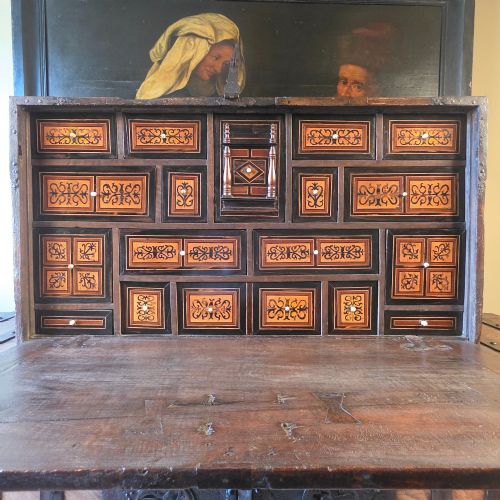
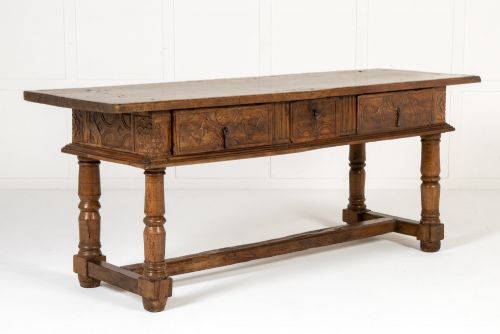


Spanish Wooden Desk
These spanish wooden desk examples are substantial pieces built from walnut and fruitwood, offering a grounded surface for writing.
Spanish Wooden Desk
A spanish wooden desk brings heavy timber construction and centuries of domestic utility into a modern room. The selection here spans the seventeenth century up to nineteen hundred, showing how these heavy wooden forms evolved from functional workspaces into decorative furnishings.
Most examples you encounter on this page lean heavily on solid walnut and fruitwood, often featuring wrought iron supports or trestle bracing. These robust timbers define the utilitarian character of early Spanish furniture making.
How they were made
Cabinet makers relied on solid walnut and fruitwood planks, joined together with simple pegged mortise and tenon construction to withstand daily strain. Wrought iron stretchers and braces were frequently added beneath to stabilise the heavy wooden frames.
Details like bone inlay appear on earlier seventeenth century pieces, while later revivals in nineteen hundred maintained the use of solid timber and dark ebonised finishes to mimic older traditions.
Early makers occasionally slipped pieces of bone into the woodwork, perhaps just to see if anyone was paying attention.
What varies in quality
The distinction between a standard piece and a superior one rests in the quality of the original timber and the depth of its patina. Tables and desks featuring untouched walnut surfaces carry a warmth that replacement boards simply lack.
Construction details also dictate value, particularly the complexity of ironwork bracing and whether decorative elements like bone inlay remain intact. Simpler pine versions from the eighteenth century serve a more rustic function compared to finely figured walnut dining tables.
The Spanish Wooden Desk Glossary
- Patina
- The surface sheen and colour developed by walnut and fruitwood over centuries of handling and polishing. This ageing process gives old timber its distinct depth.
- Trestle
- A supportive structure consisting of two or more uprights connected by a horizontal beam, commonly found beneath heavy wooden tables and desks.
- Fruitwood
- Dense timber gathered from fruit-bearing trees, utilised by makers for smaller panels and detailed turnings alongside primary walnut construction.
- Wrought iron
- Iron beaten into shape by hand, used extensively for structural braces and stretchers on seventeenth century Spanish furniture.
Spanish Wooden Desk: Frequently Asked Questions
How do I care for a wooden desk?
Keep timber surfaces away from direct heat sources and strong sunlight to prevent the walnut from drying out or splitting.
Apply a gentle beeswax periodically to nourish the grain and maintain the natural lustre of the wood.
What is Spanish Baroque style?
This design period embraces dramatic forms, heavy proportions, and restrained ornamentation built from solid walnut and iron.
It prioritises structural strength and dark, imposing silhouettes over delicate carvings.
Are these desks suitable for daily work?
Most historic tables and desks provide ample surface area and sturdy construction suited to contemporary writing tasks.
Buyers should check the height clearances to ensure comfortable seating matches the antique proportions.
How do I spot a reproduction?
Examine the underside and joints for hand-cut marks, pegged construction, and genuine timber shrinkage rather than modern machine tooling.
Genuine pieces from the seventeenth and eighteenth centuries show consistent wear patterns unique to long periods of use.