

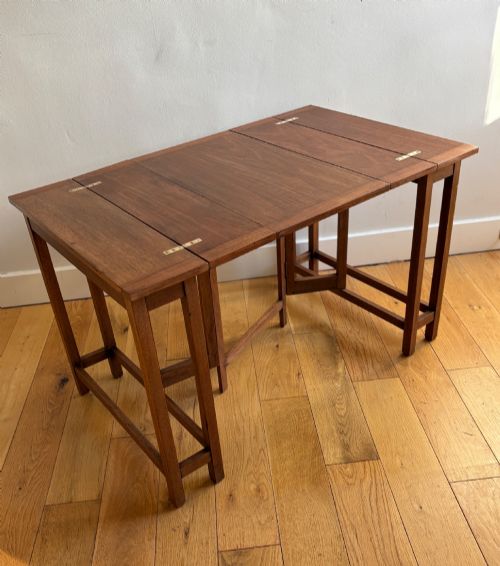


Space Saving Wooden Table
These space saving wooden table examples are ingenious folding and drop-leaf designs that expand your dining space instantly when you need it.
Space Saving Wooden Table
A space saving wooden table is a practical antique form designed to maximise living areas through clever folding, dropping, or gateleg mechanisms. You will most frequently encounter mahogany and oak drop-leaf dining tables originating from the Georgian, Victorian, and Edwardian eras.
The selection ranges from compact 1920s folding tables and narrow oak dining pieces to substantial 18th-century walnut flap tables. Each piece serves as a functional dining surface that tucks away neatly against a wall when not in use.
How they were made
Cabinetmakers constructed these tables primarily using solid mahogany, oak, and walnut, frequently enhancing the movement with brass fittings. The folding leaves and drop flaps rely on sturdy gatelegs or hinged supports to bear weight securely.
Joinery techniques such as mortise and tenon frames ensure the stability required for tables that undergo daily folding and unfolding. Timber selection focused on durable hardwoods capable of withstanding the stress of moving leaves.
Space Saving Wooden Table Retail Price Guide 2026
Typical asking prices for space saving wooden table among the pieces listed under this phrase on Sellingantiques today, from the lower quarter to the upper quarter. They describe what is for sale here now, not the wider market.
Listings feature pieces spanning the eighteenth century through to the nineteen-twenties, constructed in mahogany, oak, and walnut.
What varies in quality
Quality rests in the precision of the folding mechanism and the grain figure of the timber, such as rich mahogany or figured walnut. Superior examples maintain rigid stability when fully extended, with leaves aligning flush to the main top.
Finer pieces show careful attention to the turning of the legs and the subtlety of the gateleg action, separating everyday utility furniture from more considered cabinet work.
Fred Foster
The Space Saving Wooden Table Glossary
- Drop leaf table
- A table with a fixed centre section and hinged flaps that fold down when not in use. These flaps are supported by swing-out legs or brackets.
- Gateleg table
- A table featuring hinged legs that swing out like a gate to support folding leaves. This design provides sturdy under-table framing.
- Sutherland table
- A specific type of narrow drop-leaf table with exceptionally slender leaves and a narrow fixed centre. It folds down into a very compact footprint.
- Solid mahogany
- A dense, durable tropical hardwood prized for its deep reddish-brown colour and fine grain. It forms the primary material for many Georgian and Victorian examples.
Space Saving Wooden Table: Frequently Asked Questions
How do drop leaf tables work?
Drop leaf tables use hinged side panels that lift up to extend the surface area for dining. These leaves are supported underneath by swinging wooden legs or pivoting wooden brackets.
When the meal is finished, the supports swing back and the leaves drop down vertically, significantly reducing the floor space the table occupies.
How do I date an antique wooden table?
Dating relies on examining the timber species, the style of the turned legs, and the construction methods used for the hinges and joints. Georgian and 18th-century pieces often display dense mahogany or walnut with hand-finished surfaces.
Later Victorian and Edwardian examples introduce machine-made fixings and slightly different proportions while retaining traditional folding forms.
Are these tables suitable for daily use?
These folding tables were originally built for everyday dining in homes with limited floor space. Their hardwood construction in oak, mahogany, and walnut makes them durable for contemporary living.
Routine care and gentle handling of the folding mechanisms will keep them functional for regular meals.