

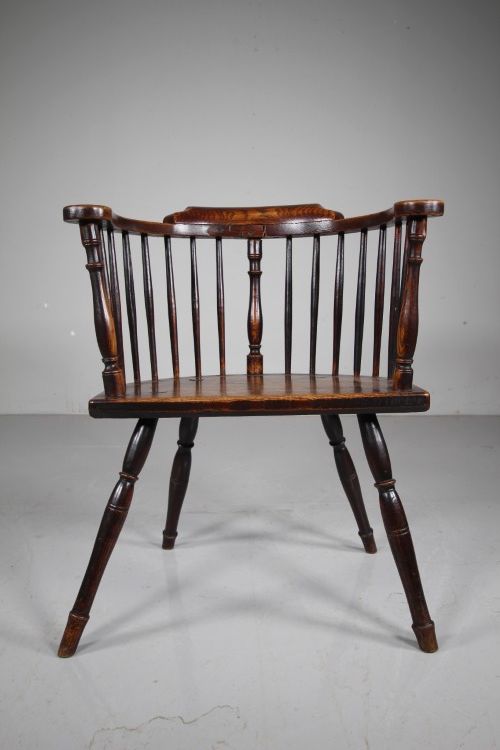


Solid Elm Desk Armchair
A solid elm desk armchair brings honest regional craftsmanship and deep timber character straight into a working space.
Solid Elm Desk Armchair
A solid elm desk armchair represents a sturdy seating tradition developed for everyday country and domestic use across Britain. These heavy chairs span periods from the eighteenth century through the Victorian era and into the early twentieth century.
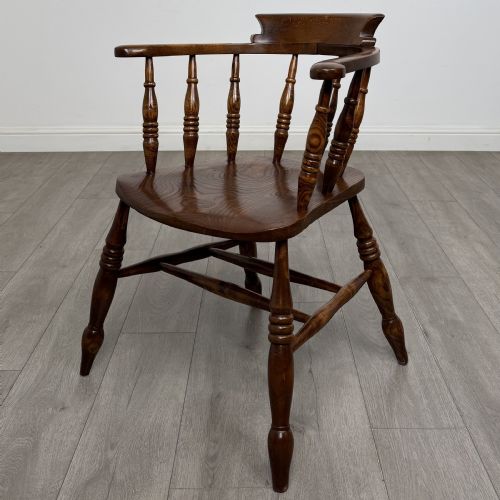
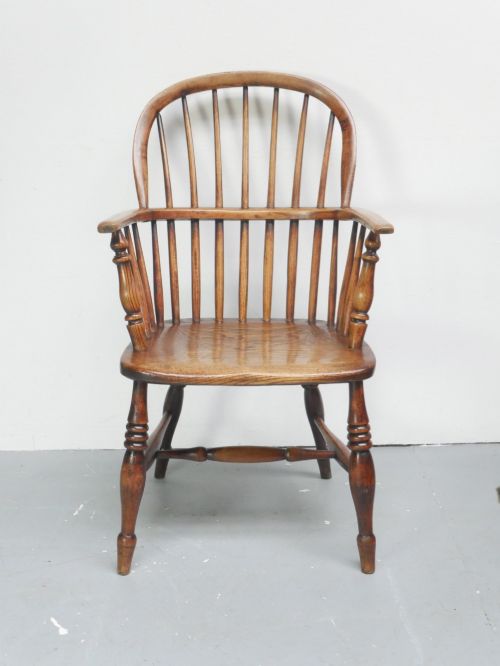
You will most commonly encounter regional Windsor forms, smoker's bows and captain's chairs on this page. They combine generous wooden seats with curved backrests designed for comfort during long hours at a table or desk.
Most examples hail from English and Scottish vernacular traditions, showing the robust utilitarian shapes favoured in farmhouses, offices and country houses. The timber selection typically pairs a thick elm seat with ash, beech or alder components.
How they were made
Chairmakers relied on a combination of turned spindles, steam-bent bows and sculpted solid wood seats. Elm provided a tough, interlocking grain for the seat plank that resisted splitting when bored and wedged.
Makers turned supporting legs and arm spindles from contrasting timbers like beech or ash on a lathe. These vertical members joined the seat through wedged tenons, creating a rigid frame without metal fixings.
Current listings demonstrate a prevalence of Victorian smoker's bows alongside eighteenth-century George III country house armchairs.
What varies in quality
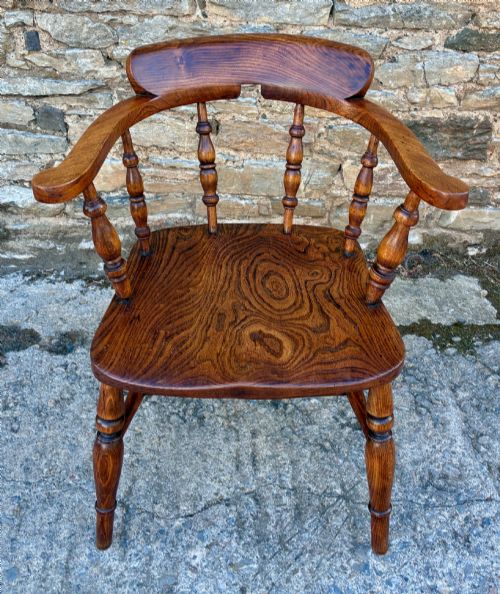
The sculptural depth and thickness of the wooden seat determine much of the visual character. Finer pieces display deeply dished saddles shaped by hand adze work rather than flat boards.
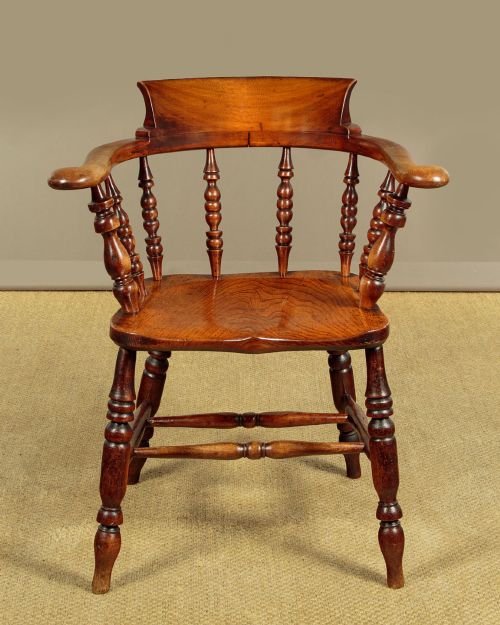
Balance and proportion in the turned components separate standard workshop production from superior regional pieces. Well-defined spindle turnings and balanced arm bows create a harmonious silhouette.
The Solid Elm Desk Armchair Glossary
- Smoker's bow
- A low-backed Windsor armchair featuring a continuous curved rail serving as both armrest and back support. This form gained popularity in Victorian pubs and smoking rooms.
- Captain's chair
- A compact wooden armchair designed with a rounded low back to fit neatly beneath a desk. They often feature spindles supporting a curved crest rail above a solid saddle seat.
- Windsor chair
- A chair built with a heavy wooden seat into which the legs and back spindles are directly inserted. Regional variations distinguish themselves through the arrangement of the back braces and central splats.
- Vernacular
- Objects designed by local craftsmen using traditional methods and regional materials to serve a practical function rather than following formal academic design rules.
- Saddle seat
- A wooden seat base sculpted with hollows and dips to mimic the contours of a riding saddle for comfort. Makers used adzes and scorps to hollow out the thick elm planks.
Solid Elm Desk Armchair: Frequently Asked Questions
Are these chairs comfortable for daily desk work?
The curved wooden backrests and wide seats offer solid lumbar support for working at a table.
Adding a small loose cushion provides extra padding for extended sitting periods without altering the chair.
What is the best way to clean and maintain elm timber?
Regular dusting with a dry cloth keeps the surface clean, supplemented occasionally by traditional beeswax to nourish the wood.
Keep these chairs away from direct heat sources and radiators to prevent the solid elm planks from splitting.
Why are different woods used in the same chair?
Country chairmakers selected specific timbers for their distinct mechanical properties to ensure structural durability.
Elm provided a non-split seat, while straight-grained ash or beech suited the turned legs and steam-bent arm bows.