


Small Oak Bedroom Chest
A small oak bedroom chest brings genuine period character and compact storage to a room, offering sturdy timber and practical proportions.
Small Oak Bedroom Chest
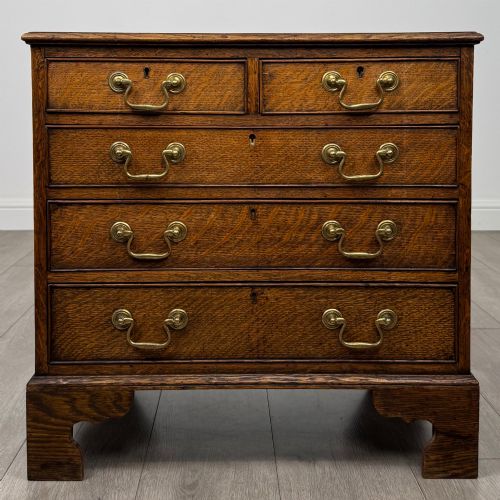
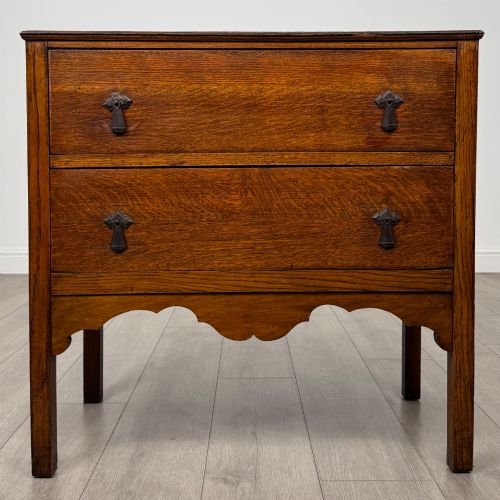
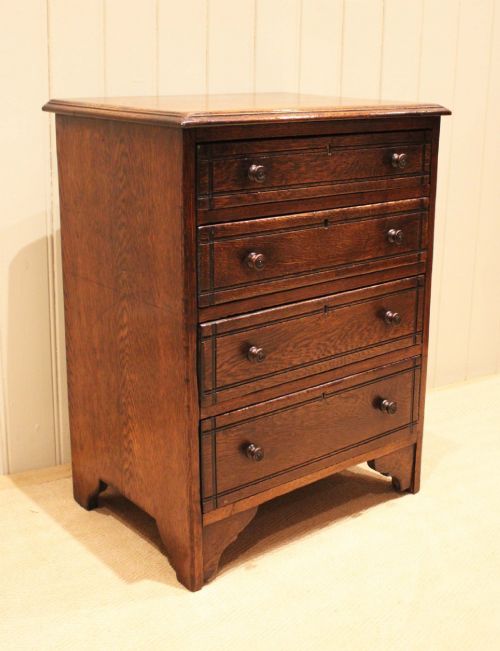
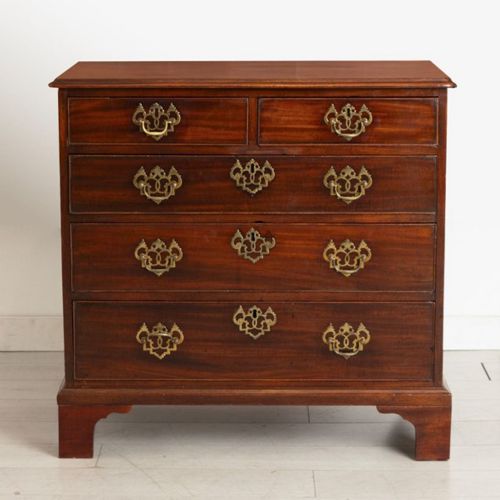
The versions most commonly met range from Georgian and Victorian periods to Edwardian and later 20th-century examples. Forms include standard chests of drawers, bedside chests, tallboys, and commodes.
Makers and regional workshops produced these items in various styles such as English Country, Arts and Crafts, Art Deco, and Gothic Revival. Oak remains the predominant material seen across these forms.
What varies in quality
Timber selection and grain figure separate standard examples from finer pieces, particularly where quarter-sawn oak or subtle cross-banding is employed.
The refinement of joinery, the retention of original hardware, and the proportion of the piece dictate its standing within the range of available examples.
Some chests hide fold-over tops designed for letter-writing by gentlemen who preferred standing while dealing with correspondence.
The Small Oak Bedroom Chest Glossary
- Bachelor's chest
- A small chest of drawers, often featuring a fold-over top used as a writing surface. These versatile pieces date predominantly from the Georgian period.
- Tallboy
- A tall chest of drawers made by stacking one chest on top of another, providing substantial storage with a small floor footprint. They appear in 18th-century oak and mahogany.
- Commode
- A decorative chest of drawers or cabinet, frequently of French or English origin. Examples range from plain wood finishes to painted surfaces.
- Bracket feet
- Support feet shaped like small brackets, commonly found on Georgian furniture. They lift the case slightly off the floor.
- Cross-banding
- A border of veneer laid around the edges of a drawer front or top with the grain running perpendicular to the surrounding wood.
Small Oak Bedroom Chest: Frequently Asked Questions
What periods do these chests date from?
The pieces span from the late 17th century through the Georgian and Victorian eras up to the 1930s. Each era brings distinct proportions and decorative details.
Earlier examples often display simpler plank construction, while later pieces incorporate refined veneers and diverse stylistic influences.
Are these chests suitable for modern bedrooms?
Their compact dimensions make them practical for contemporary room layouts where floor space is limited. They provide functional drawer storage without dominating a bedroom.
Mixing these wooden pieces with modern interiors adds texture and historical interest to a space.
How do I distinguish a Georgian chest from a Victorian one?
Georgian examples often feature proportioned bracket feet, cockbeaded drawer edges, and simpler, cleaner lines. Timber choice tends towards distinct native oak or figured mahogany.
Victorian pieces frequently display heavier proportions, darker finishes, and different hardware styles reflecting the manufacturing shifts of the 19th century.
What materials are used besides oak?
While oak is dominant, some examples incorporate mahogany, painted wood surfaces, and metal fixtures like brass handles. Bakelite and alternative accents appear on later 20th-century pieces.
Cross-banding in contrasting timbers is also found on select bachelor's chests and commodes.