

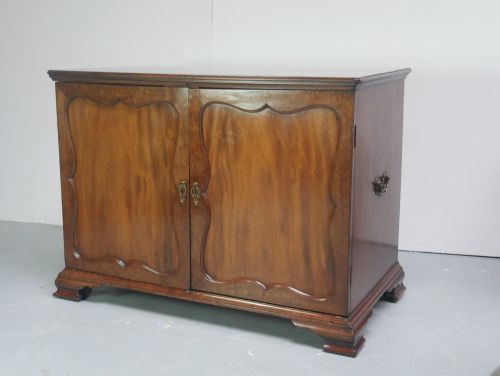


Small Mahogany Press
A small mahogany press organises clothing and linen compactly in rich cabinet timber, bringing Georgian and Victorian craftsmanship into smaller rooms.
Small Mahogany Press
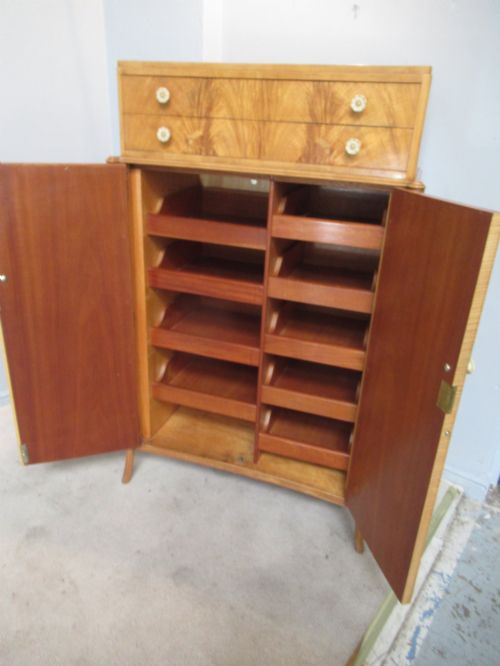
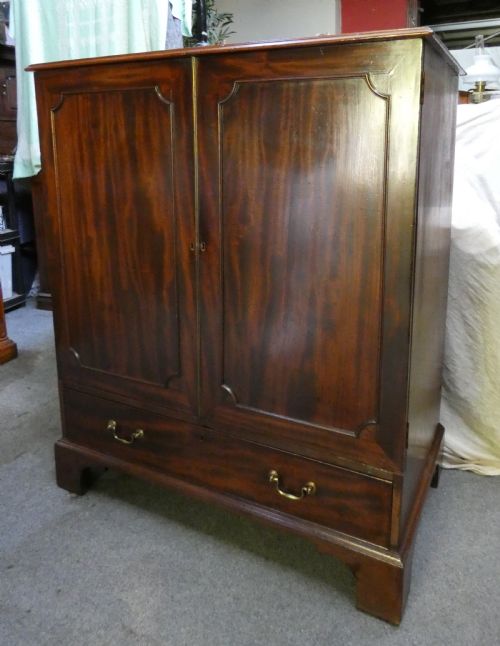
A small mahogany press provides compact storage for garments and household linens within domestic spaces, uniting enclosed cupboard sections with sliding tray interiors. These pieces appear across Georgian, Regency, and Victorian periods, often taking the form of dwarf presses, miniature cabinets, or low housekeeper cupboards.
The versions most commonly met on this page span the eighteenth and nineteenth centuries, including dwarf Georgian linen cupboards and early nineteenth-century miniature examples. Makers built these items using solid mahogany alongside flame mahogany veneers and banded details, sometimes incorporating maple or brass fittings.
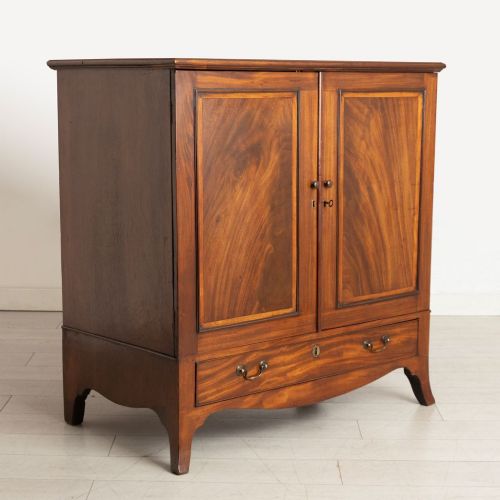
Formats range from serpentine cupboards with oval veneered doors to tallboys and compactums scaled down for modest rooms. Anglo-Indian variations also occur, reflecting global exchange within nineteenth-century cabinet making traditions.
How they were made
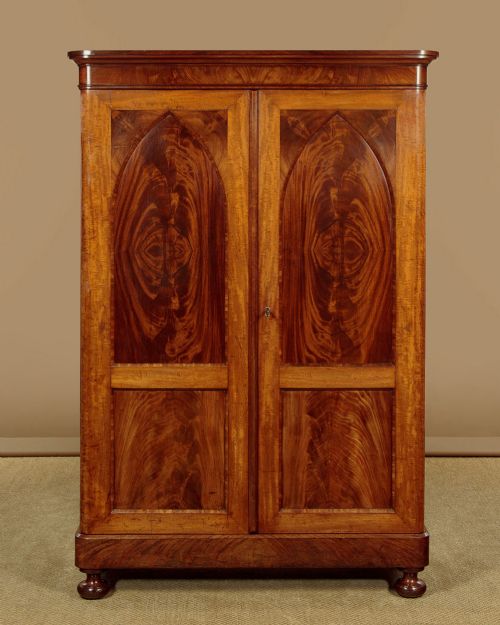
Cabinet makers constructed the carcasses of these presses using dense hardwoods, applying flame mahogany veneer to primary display surfaces to create distinctive grain patterns. Banded borders and contrasting secondary timbers like maple provided decorative contrast around drawer fronts and panel doors.
Joinery techniques relied on traditional dovetailed drawer construction and precise framing to house internal sliding trays or hanging space. Brass hardware, including hinges and escutcheons, secured the doors and added functional detail to the exterior.
Small Mahogany Press Retail Price Guide 2026
Typical asking prices for small mahogany press among the pieces listed under this phrase on Sellingantiques today, from the lower quarter to the upper quarter. They describe what is for sale here now, not the wider market.
Some miniature presses were built as master cabinet maker trade samples to show clients portable skill.
What varies in quality
Quality rests on the selection and matching of mahogany veneers across the facade, where symmetrical grain patterns elevate the visual impact of a dwarf press. Superior examples display refined proportions and careful timber selection, particularly where banded borders meet the primary wood.
The execution of internal fittings, such as sliding linen trays and dovetailed drawer boxes, separates standard utility pieces from finer cabinet work. Original brass hardware and intact structural framing further distinguish higher-grade pieces from later reproductions or heavily altered items.
The Small Mahogany Press Glossary
- Dwarf press
- A low-format storage piece combining upper cupboard doors with lower drawers, designed to sit beneath standard ceiling heights.
- Flame mahogany veneer
- A sliced sheet of timber exhibiting a flickering, flammiform grain pattern applied over a stable hardwood base.
- Housekeeper cupboard
- A utilitarian storage unit traditionally used for linens and provisions, often featuring internal sliding shelves.
- Banded
- Adorned with a narrow strip of contrasting timber veneer around the perimeter of a door or drawer front.
- Serpentine
- Curving in a concave-convex-concave wave shape across the front of a cabinet or chest.
Small Mahogany Press: Frequently Asked Questions
What is a small mahogany press?
A small mahogany press is a compact storage cabinet designed for garments and household linens, typically featuring upper doors and lower drawers.
These pieces use rich mahogany timbers and veneers, spanning periods from the eighteenth century through the Victorian era.
How were they used originally?
Households utilised these presses to store folded linen, folded garments, and household provisions away from dust.
Internal sliding trays kept textiles organised without the creasing associated with standard shelving.
How do I date a press?
Dating relies on observing construction methods, timber choices, and stylistic traits such as Georgian proportions or Regency banding.
Hardware styles and secondary woods like maple also provide clues to the manufacturing decade.
Where do I place one at home?
These compact presses suit bedrooms, hallways, or living spaces where floor space is limited but vertical storage is required.
Their shallow depths allow them to fit into narrow alcoves and smaller period rooms.