

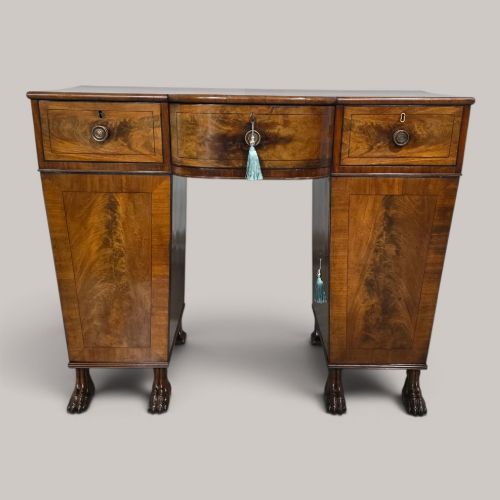
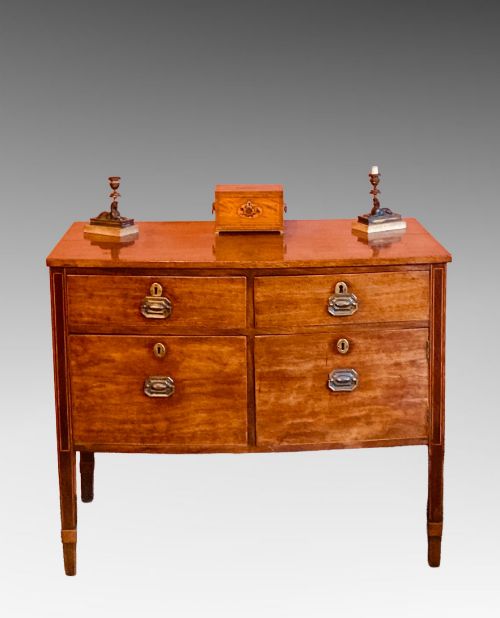
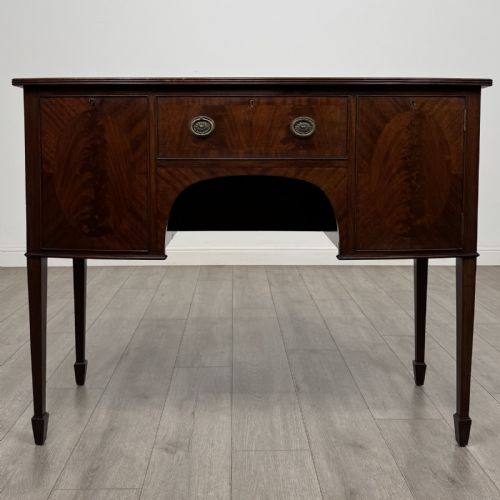
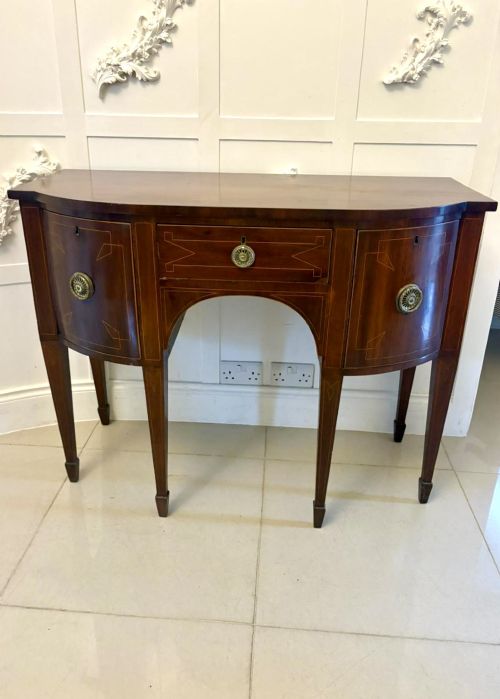
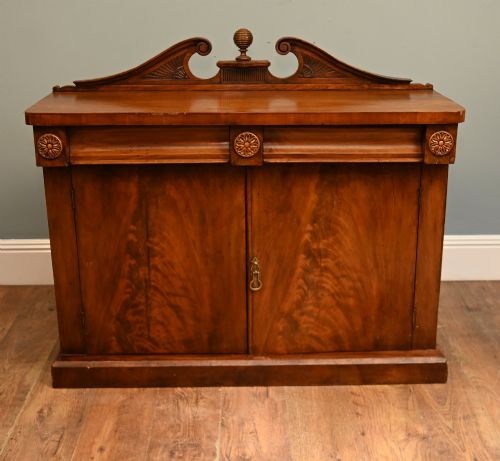
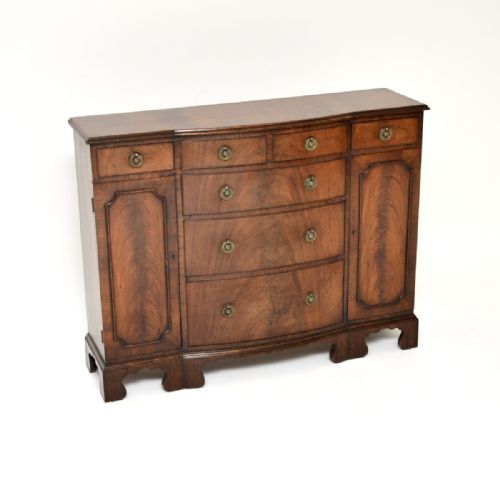
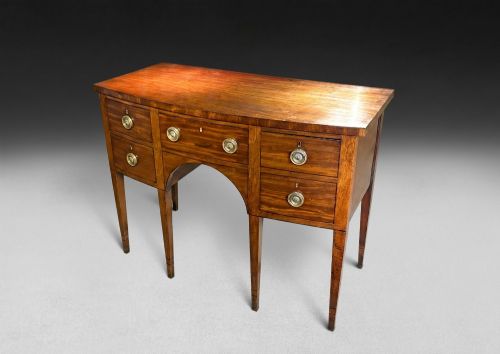


Small Mahogany Dining Sideboard
These small mahogany dining sideboard examples offer compact storage for the dining room without overwhelming smaller spaces.
Small Mahogany Dining Sideboard
A small mahogany dining sideboard provides a compact surface and storage for dining rooms, most commonly appearing in Georgian, Regency, and Victorian formats across this selection.
Buyers seeking this phrase encounter pieces shaped with bowfronts, serpentine fronts, and breakfronts alongside simpler rectangular forms dating from the eighteenth century into the twentieth century.
Many examples incorporate cupboards and drawers scaled down for modest proportions, reflecting the practical needs of period dining spaces.
How they were made
Cabinet makers utilised solid timber alongside flame mahogany veneer to construct these pieces, often selecting figured boards for drawer fronts and cupboard doors.
Details such as boxwood and satinwood inlay, marquetry, and ebony stringing decorate the surfaces, while brass handles and hardware finish the construction.
Small Mahogany Dining Sideboard Retail Price Guide 2026
Typical asking prices for small mahogany dining sideboard among the pieces listed under this phrase on Sellingantiques today, from the lower quarter to the upper quarter. They describe what is for sale here now, not the wider market.
The listings combine Georgian, Regency, and Victorian periods using mahogany, satinwood, and brass hardware.
What varies in quality
The sophistication of the timber figure and the precision of the stringing and inlay separate standard examples from finer works.
Construction methods such as hand-dovetailed drawer linings and well-figured secondary timbers indicate higher workshop standards.
The Small Mahogany Dining Sideboard Glossary
- Bowfront
- A curved convex front that swells outward in the centre. This shape frequently appears on Georgian and Regency dining pieces to soften room angles.
- Serpentine front
- A front configuration featuring a convex central section flanked by concave curves. This undulating profile requires skilled cabinet work.
- Chiffonier
- A compact low cabinet with shelves or drawers, often topped by a small mirror or back-shelf. These serve as smaller dining room storage units.
- Stringing
- Thin inlaid lines of contrasting wood such as boxwood or ebony. Craftsmen use this technique to outline drawers and borders.
- Breakfront
- A cabinet front where the central section projects forward from the flanking wings. This architectural arrangement creates depth on smaller sideboards.
Small Mahogany Dining Sideboard: Frequently Asked Questions
Where did they put sideboards?
These dining pieces stood against dining room walls to hold serving dishes and cutlery during meals.
Their compact proportions allowed them to fit into smaller rooms without blocking doorways or walkways.
How do I date a sideboard?
Look to the leg styles, overall proportions, and decorative details like stringing or veneer choices to determine the period.
Georgian and Regency pieces often show lighter framing, whereas Victorian versions tend to be heavier in build.
Are bowfronts harder to find?
Bowfront examples appear frequently among eighteenth and nineteenth-century listings in this category.
Cabinet makers produced many curved formats to maximise interior depth while maintaining compact exterior dimensions.
What is a chiffonier?
A chiffonier functions as a smaller enclosed sideboard, often featuring lower doors and an upper shelf structure.
Victorian dining rooms frequently utilised these cabinets for storing glassware and table linen.