




Small Jacobean Court Cupboard
A small jacobean court cupboard brings seventeenth-century architectural presence into a room without dominating the floor space.
Small Jacobean Court Cupboard
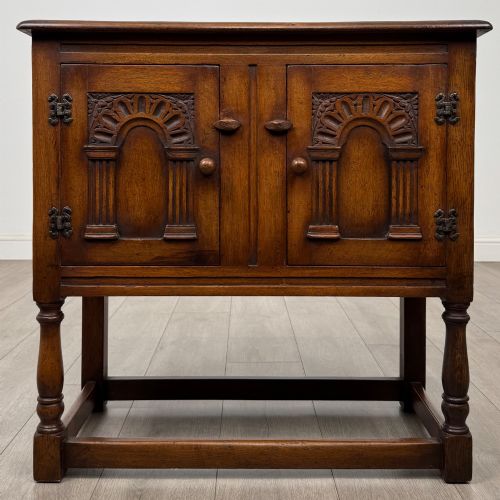
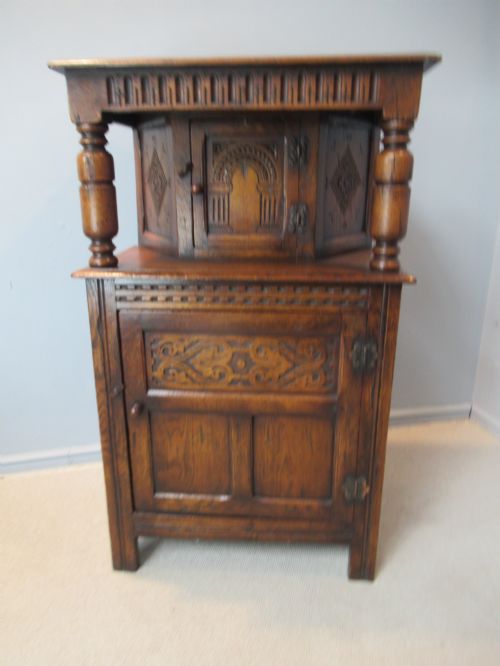
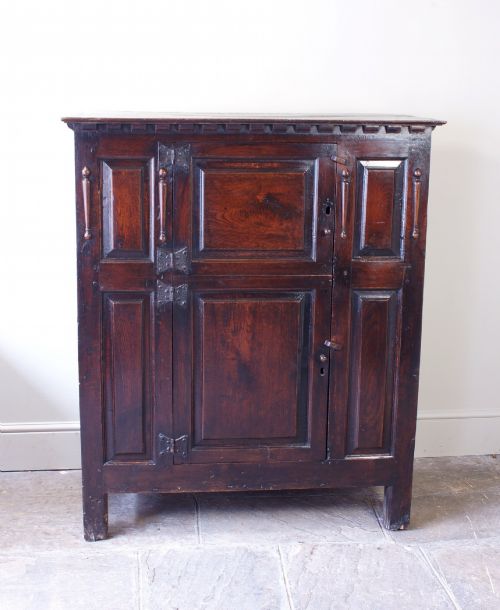
When you search for a small jacobean court cupboard, you are looking at sturdy timber furniture built with recessed upper stages and enclosed lower storage compartments. The examples you meet on this page span genuine seventeenth-century survivals alongside later revival interpretations from the eighteenth, nineteenth, and twentieth centuries.
The forms range from diminutive hutch and food court cupboard formats to miniature pieces and side cupboards on stands. Most options adhere to compact proportions, making them suitable for modern rooms that require period character without excessive scale.
Materials and construction
These pieces are built from solid oak, relying on heavy timber framing, pegged joints, and panelled construction to achieve their characteristic rigidity. Iron and brass hardware such as hinges and latches are integrated to secure doors and compartments.
Surface decoration relies heavily on hand carving, featuring motifs such as linenfold panels and geometric patterns cut directly into the timber. The work reflects traditional joinery methods passed down through generations of cabinet makers.
Judging quality in these cupboards
Quality rests in the crispness of the carved details and the integrity of the original timber construction. Pieces with deeply carved panels and well-balanced proportions sit at the upper end of the range.
The relationship between the upper and lower tiers dictates the visual harmony of the piece. Superior examples display careful timber selection where the grain patterns complement the architectural form.
The Small Jacobean Court Cupboard Glossary
- Court cupboard
- A traditional sideboard or storage unit typically featuring a recessed upper section supported by pillars above a lower cupboard. These items were originally used for displaying plate and storing food.
- Linenfold
- A style of wood carving that imitates folded linen, commonly seen on panels during the period. This technique creates a textured surface with vertical folds.
- Hutch
- An early form of enclosed storage furniture, often sitting on legs or directly on the floor. It provides a simple cabinet space accessed via hinged doors.
- Jacobean revival
- A nineteenth and twentieth century style that copies the heavy, ornate designs of the early seventeenth century. Makers utilised older decorative motifs on newer frames.
Small Jacobean Court Cupboard: Frequently Asked Questions
How were court cupboards used originally?
In early households, these cupboards functioned primarily for storing provisions and displaying valued plate on the upper stages.
Over time, their role shifted towards general storage while retaining a decorative presence in principal rooms.
How do I place one in a modern room?
Their compact proportions allow them to fit well in hallways, dining spaces, or living rooms as feature storage pieces.
Keep the surrounding decor simple to let the heavy oak grain and carved details stand out.
Are all these cupboards from the seventeenth century?
The selection includes genuine seventeenth-century pieces alongside revival interpretations made during the Edwardian era and the twentieth century.
Each period brings its own interpretation of the traditional form while maintaining the core oak construction.
What is a cupboard on stand?
This format elevates the main storage cabinet upon a distinct underframe or legs, creating a lighter visual profile.
It allows the piece to occupy less floor space while providing a useful compartment at a convenient height.