
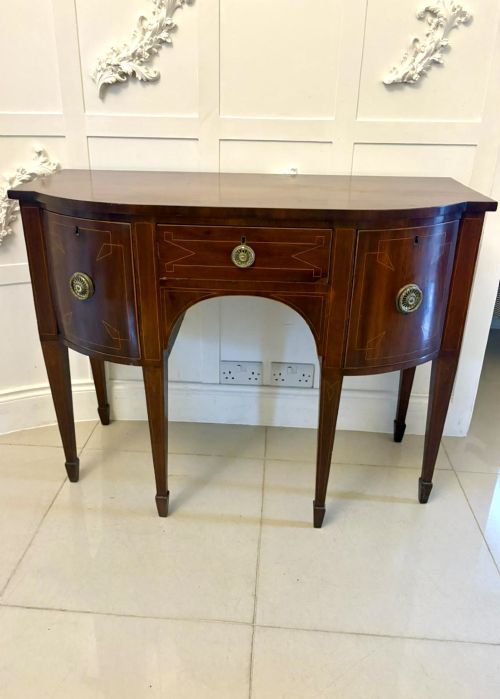
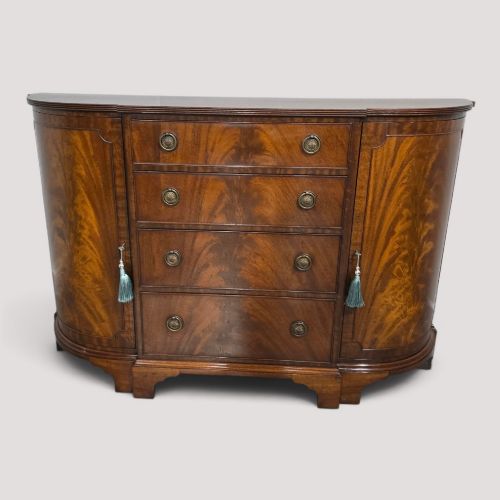
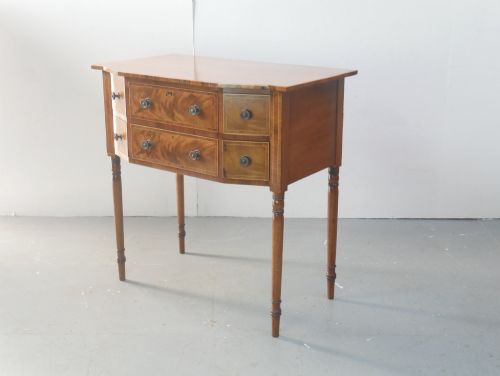
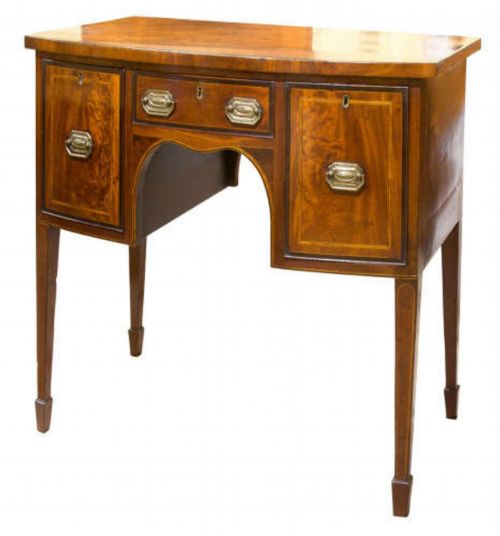
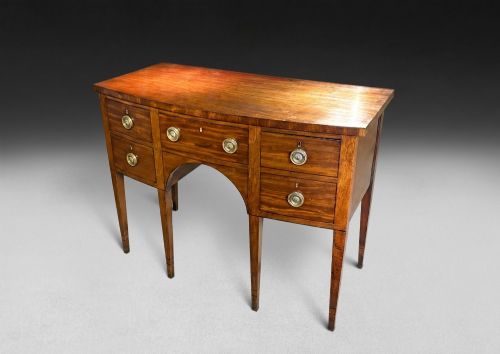
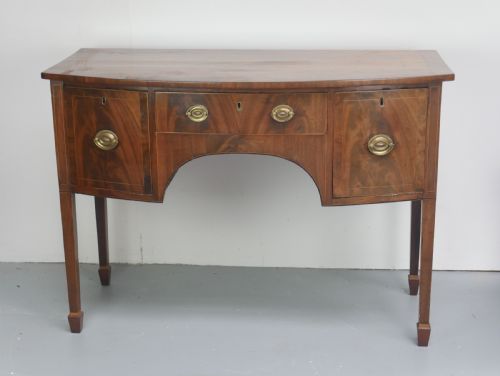


Small Bowfront Server
A small bowfront server offers the compact elegance of Georgian and Regency dining room furniture without demanding an unreasonable footprint.
Small Bowfront Server
A small bowfront server functions primarily as a serving piece, designed with a characteristic curved front to save floor space while providing essential surface area and drawer storage. When searching for a small bowfront server, one encounters pieces predominantly spanning the eighteenth century, the Georgian period, and the Regency era, alongside later nineteenth and early twentieth century revivals. These cabinets typically manifest as sideboards or serving tables, configured with deep central drawers flanked by smaller compartments.
The domestic scale of these items defines their appeal, as cabinetmakers of the Georgian and Regency periods engineered them specifically for smaller dining rooms and halls. Surviving examples demonstrate a clear preference for compact proportions, often featuring tapered legs or bracket feet that lift the heavy timber visually off the floor. The curved facade breaks the rigidity of straight-walled rooms, creating a fluid transition along a wall.
How they were made
Cabinetmakers constructed the main carcase and framing predominantly from mahogany, supported internally by secondary timbers such as pine and oak for drawer linings. To achieve the signature curved facade, workshops relied on solid timber shaping or delicate bending techniques before applying highly figured veneers across the exterior doors and drawer fronts. The structural integrity depends heavily on precise dovetail joinery in the drawer construction and sturdy corner blocking beneath the top boards.
Decorative enrichment relied on contrasting timbers and specialised stringing rather than heavy carving. Artisans inlaid delicate lines of boxwood, ebony, and purpleheart into the mahogany surfaces, often framing the drawer edges or highlighting the curved outline. Satinwood panels occasionally provide a pale contrast against the rich dark grain of the primary mahogany timber, complemented by cast brass handles and drawer pulls.
Some nineteenth-century makers thoughtfully lined the heavy mahogany drawers with cheerful oak and bone fittings to survive countless dining room suppers.
What varies in quality
The caliber of a small bowfront server rests largely upon the selection and matching of the wood grain across the curved drawer fronts. Master workshops utilised highly figured mahogany and symmetrical veneers that flow naturally around the convex radius, whereas lesser examples rely on plain, unselected boards. The crispness of the inlaid boxwood and ebony stringing further separates standard production from superior cabinet work.
Structural refinement in the underframing and secondary woods dictates long-term stability in these curved pieces. Superior construction employs quartersawn oak or pine for internal drawer boxes with hand-cut dovetails, while simpler iterations utilise coarser secondary woods and hurried assembly methods. The integration of original brass hardware and the smooth operation of the curved drawers complete the measure of quality.
The Small Bowfront Server Glossary
- Bowfront
- A convex, outwardly curving front facade typical of cabinets and sideboards designed to soften room angles. This curved profile requires specialised woodworking skills to fit drawers and doors accurately.
- Stringing
- Thin inlaid lines of contrasting wood such as boxwood, ebony, or satinwood used to outline panels and drawers. It creates a crisp geometric border that defines the primary timber.
- Satinwood
- A pale, lustrous exotic timber native to the West Indies and India, utilised extensively for contrasting veneers and crossbanding during the Sheraton period. Its golden hue brightens inlaid decorative panels.
- Purpleheart
- A dense South American hardwood prized for its distinct purplish-brown tone when freshly cut, appearing in fine stringing and banding details on eighteenth-century furniture. It darkens to a deep brown with age and exposure to light.
- Bracket foot
- A structural support foot shaped like a truncated bracket, extending outward from the corners of a case piece. It provides a stable base without heavy bulk.
Small Bowfront Server: Frequently Asked Questions
Where were small bowfront servers used?
These servers originated primarily in the dining room to hold serving dishes, cutlery, and glassware during formal meals.
Their compact proportions also allowed them to function effectively in entrance halls and reception rooms for general display and storage.
How do I identify a Georgian server?
Georgian pieces are identified by heavy reliance on solid mahogany, hand-cut drawer dovetails, and secondary woods like oak or pine.
Stylistic cues include bracket feet, tapered legs, and subtle stringing rather than heavy Victorian ornamentation.
Are these servers practical for daily use?
The shallow depth of the curved front makes them exceptionally well-suited for narrow hallways or modern dining spaces where standard furniture projects too far.
The deep drawers provide secure storage for table linens and flatware while maintaining a light visual profile.
How do I care for antique mahogany?
Maintain the timber by keeping it away from direct heat sources and rapid humidity shifts that can crack old veneers.
Apply traditional beeswax periodically to nourish the dry wood and preserve the natural lustre of the polish.