



Slatted Mahogany Canterbury
A slatted mahogany canterbury holds sheet music and periodicals with neat divisions and mobile charm.
Slatted Mahogany Canterbury
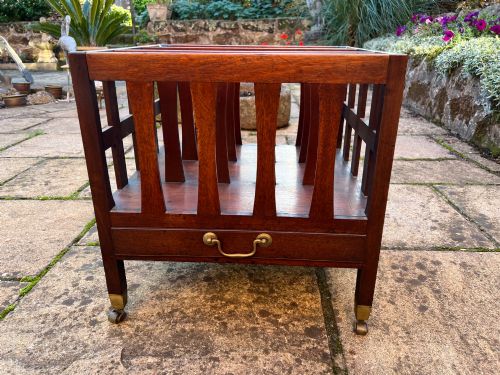
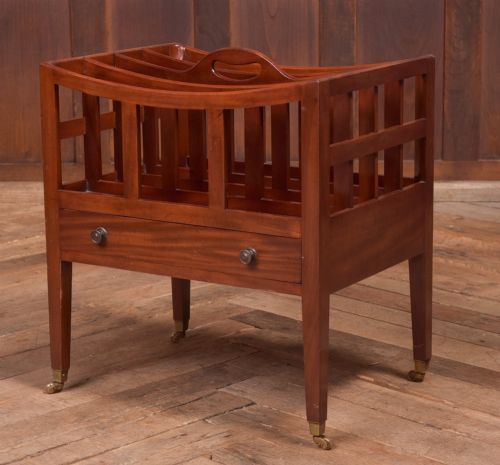
A slatted mahogany canterbury is a low stand designed to hold books, music sheets, or newspapers in upright partitions. These pieces emerged in the late eighteenth century and continued into the Edwardian era.
The versions met on this page span the Georgian, Regency, and Victorian periods, alongside Edwardian and later twentieth-century examples. Most take the form of compartmentalised wooden racks raised on short legs.
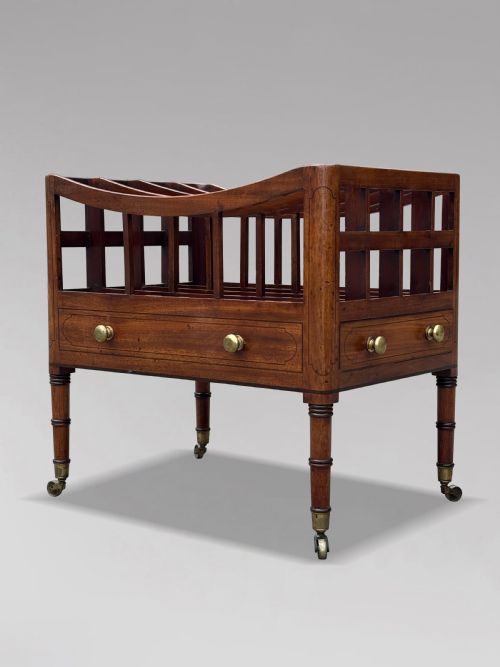
Makers often incorporated open slatted sides to keep the frame light and portable. Many examples include a single shallow drawer beneath the divisions for smaller items.
Assessing quality and proportion
Quality rests upon the crispness of the timber selection and the restraint of the proportions. Finer pieces display carefully chosen flame mahogany figures and slender, well-turned uprights rather than heavy, thick sections.
The integration of the drawer and the finish of the internal divisions mark the difference between standard workshop production and finer cabinet work. Original brass castors and harmonious proportions elevate the piece without recourse to excessive ornament.
Slatted Mahogany Canterbury Retail Price Guide 2026
Typical asking prices for slatted mahogany canterbury among the pieces listed under this phrase on Sellingantiques today, from the lower quarter to the upper quarter. They describe what is for sale here now, not the wider market.
The listings span the Georgian, Regency, Victorian, and Edwardian periods, constructed predominantly in mahogany with brass fittings.
The Slatted Mahogany Canterbury Glossary
- Canterbury
- A low stand with partitions for holding music sheets or books, named after the Archbishop of Canterbury who reportedly commissioned the first design. These pieces often feature fitted drawers and castors for mobility.
- Slatted
- Constructed with narrow strips of wood spaced apart to form open sides or partitions. This method reduces the overall weight of the furniture.
- Frieze drawer
- A shallow drawer integrated into the architectural band directly beneath the main compartment. It typically stores smaller accessories.
- Tapering leg
- A support column that gradually narrows toward the foot. This shape lightens the visual weight of the furniture.
- Boat shaped
- A curved or gondola-like profile seen in certain Regency designs. The sweeping ends give the piece a distinct silhouette.
Slatted Mahogany Canterbury: Frequently Asked Questions
What was a canterbury used for originally?
These stands were built to hold folios of sheet music, books, and daily newspapers near a piano or seating area. The upright divisions kept paper sorted and accessible.
Over time, owners adapted them to hold general periodicals and writing materials in drawing rooms and libraries.
How do I date a mahogany canterbury?
Dating relies on stylistic clues such as leg shape, edge moulding, and the construction of the drawer lining. Georgian and Regency examples often feature finer tapered legs and delicate slats.
Later Victorian and Edwardian pieces tend to show heavier turned posts and simpler assembly methods.
Are these stands sturdy enough for daily use?
Solid mahogany frames and pegged joints provide considerable strength for holding books and magazines. The structural design handles normal domestic weight without difficulty.
Care should be taken when moving them by the partitions rather than lifting solely by the upper rail.
Why do some have drawers and others do not?
Cabinet makers offered various configurations depending on cost and client preference. A single frieze drawer provided secure storage for small items like bookmarks and tuning keys.
Simpler models omitted the drawer to reduce weight and production expense.