
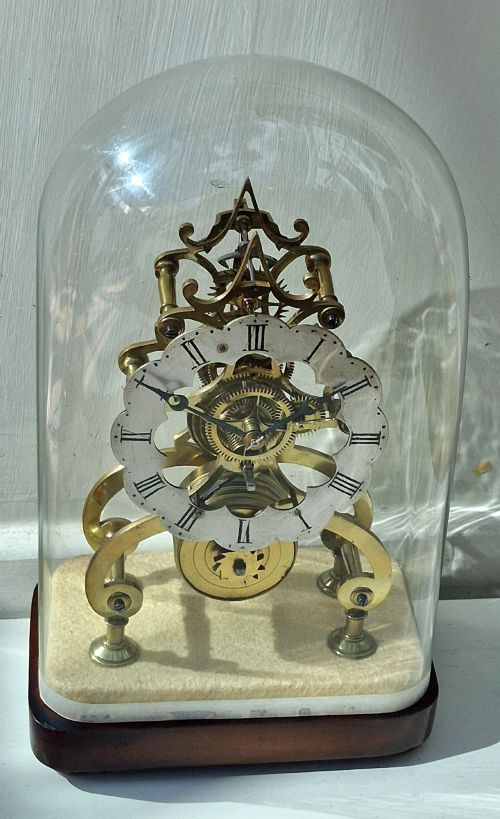
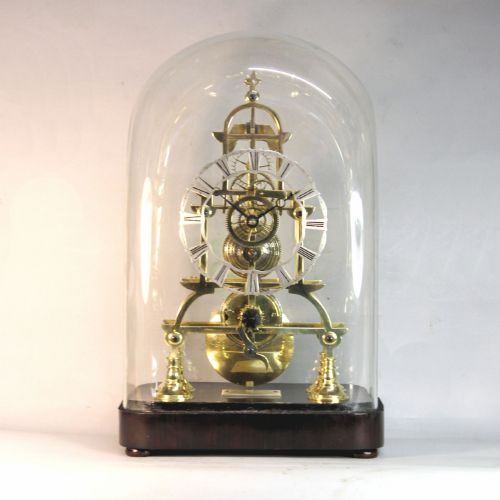


Skeleton Mantel Clock
A skeleton mantel clock strips away the traditional case to expose the intricate gear trains and escapements of mechanical timekeeping.
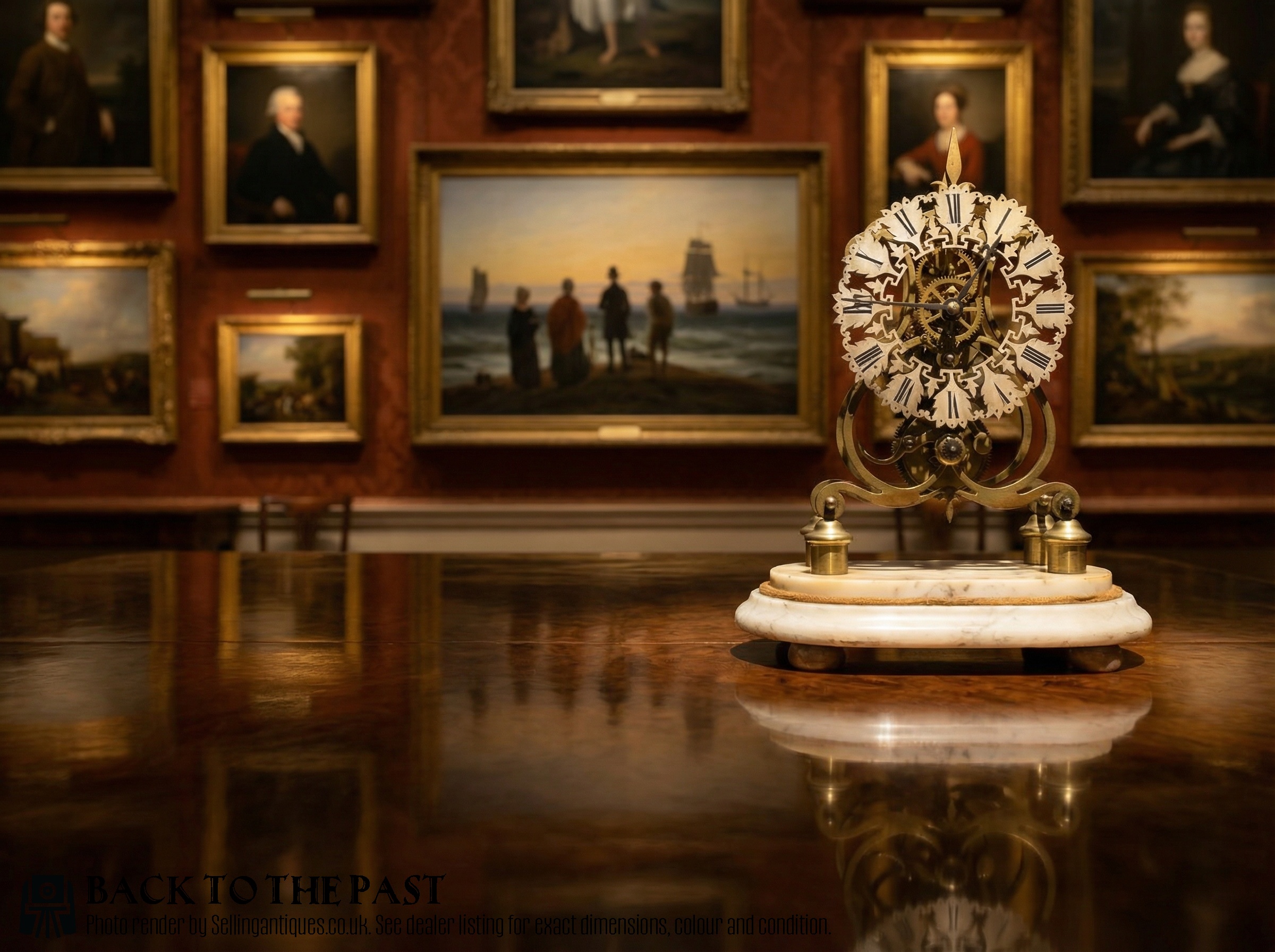
Skeleton Mantel Clock
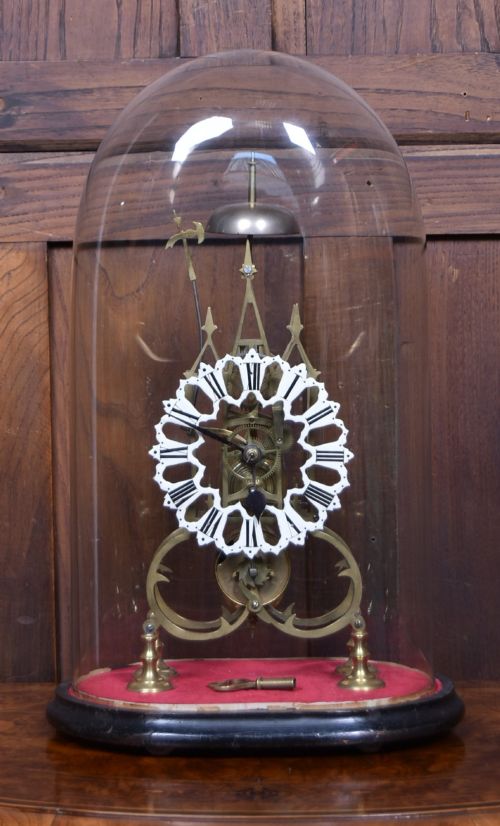
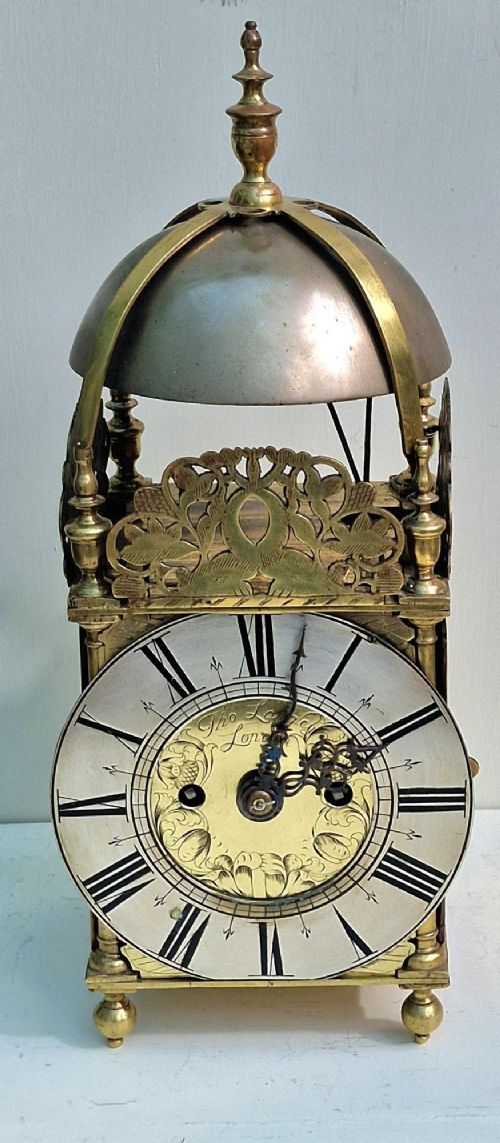
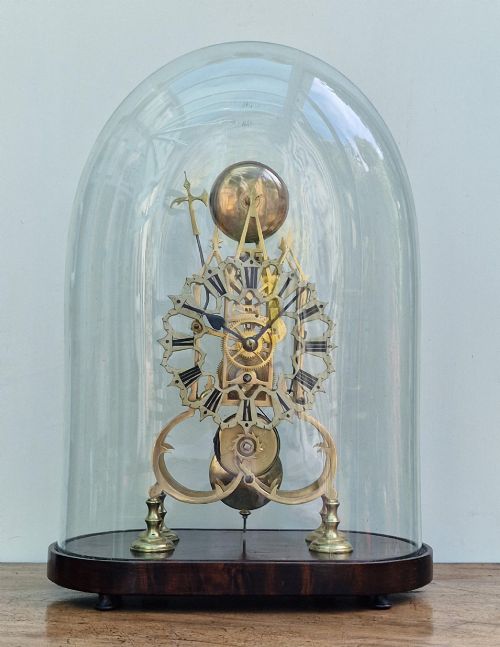
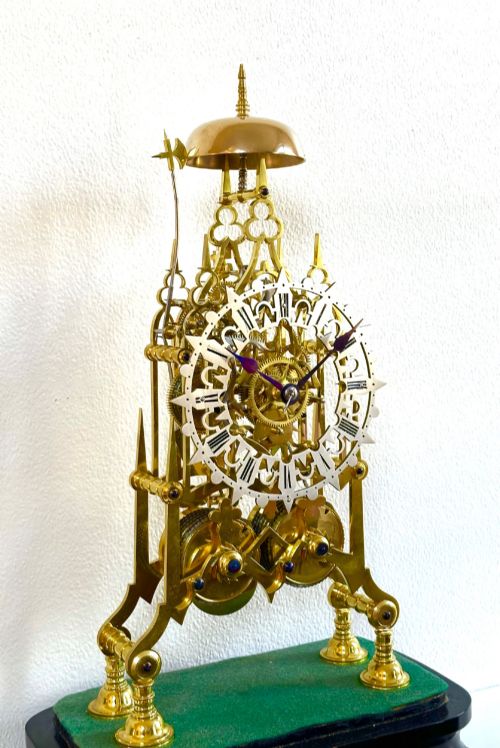
A skeleton mantel clock reveals the inner mechanics of timekeeping by removing the dial plates and enclosing the brass framework beneath a glass dome. These timepieces display elaborate wheelwork, fusee movements, and striking trains directly to the viewer.
Most examples found in these records belong to the Victorian period, originating from English and French workshops during the nineteenth century. Forms range from miniature Gothic designs to large cathedral shapes and double fusee models.
Makers housed these delicate movements on marble bases or wooden plinths to support the brass structures. Many retain their original glass domes to protect the exposed brass and steel components from dust.
Materials and construction
Clockmakers constructed the structural frames and gear trains primarily from brass, often cutting the wheel work into six-spoke or pierced configurations to reduce weight. Steel components were utilised for springs, pinions, and escapements.
Enamel featured on subsidiary dials or chapter rings where the numerals required clear legibility against the open brass background. Glass domes protected the entire mechanism, resting upon wooden, ebonised, or marble plinths.
Listings feature brass, marble, mahogany, and ebonised wood across Victorian, Art Deco, and Mid-Century Modern periods.
Craftsmanship and movement complexity
Quality rests in the precision of the wheel work cutting and the complexity of the movement, such as double fusee mechanisms or passing strikes. Simpler timepieces offer basic hour tracking, whereas finer examples incorporate intricate escapements like the coup perdu detent.
The architectural ambition of the brass frame distinguishes standard pieces from exceptional ones. Elaborate Gothic church designs and substantial cathedral skeletons require greater skill from the maker than plain rectangular brass plates.
Thomas Langley·Richard Winter·Thwaites·B H A·William Evans·Jaeger-LeCoultre·Thwaites and Reed·E White·Allen Colyer·Victor Athanase Pierret
The Skeleton Mantel Clock Glossary
- Fusee
- A conical pulley used in a clock to maintain an even pull on the gear train as the mainspring unwinds. This device ensures consistent timekeeping accuracy throughout the running duration.
- Double fusee
- A movement incorporating two separate fusee cones to power both the timekeeping train and the striking train independently. Such systems demand advanced mechanical arrangement within the open frame.
- Escapement
- The mechanism that controls the release of power from the gear train to the pendulum or balance wheel. It delivers regular impulses to keep the oscillation steady.
- Glass dome
- A blown or formed glass cover placed over a clock to shield delicate exposed mechanics from dust and air currents. These covers frequently rest on fitted wooden or marble bases.
- Chapter ring
- The circular band bearing the hour numerals on a clock face. In skeleton movements, this ring is often silvered or enamelled and mounted directly above the gear train.
Skeleton Mantel Clock: Frequently Asked Questions
What is a skeleton mantel clock?
A skeleton mantel clock is a mechanical timepiece designed without a traditional solid dial or cabinet case. The brass plates and gear trains are shaped and exposed so viewers can watch the wheels turn.
Most examples sit upon a wooden or marble plinth and are protected by a blown glass dome. They originated primarily during the nineteenth century in Britain and France.
How do you wind a fusee skeleton clock?
A fusee skeleton clock is wound using a specialised key inserted into the winding square on the dial or front plate. Turning the key winds the cord or chain back around the conical drum.
Care must be taken not to overwind the movement, as the mainspring requires measured tension. Many of these clocks run for eight days on a single winding.
Why do skeleton clocks have glass domes?
Glass domes protect the exposed brass and steel components from dust, moisture, and accidental damage. Because the mechanical parts lack a traditional outer case, airborne particles can settle between the gear teeth.
Keeping the dome in place preserves the polished finish of the brass and prevents the lubrication from drying out prematurely.
How do I identify a Victorian skeleton clock?
Victorian skeleton clocks are identified by their pierced brass frames, exposed wheel trains, and nineteenth-century architectural styles. Many feature Gothic arches, cathedral shapes, or classical pedestals supporting the movement.
Signatures engraved on the brass plates or chapter rings often name English and French makers from the period. The presence of fusee movements and marble bases further supports a nineteenth-century origin.