
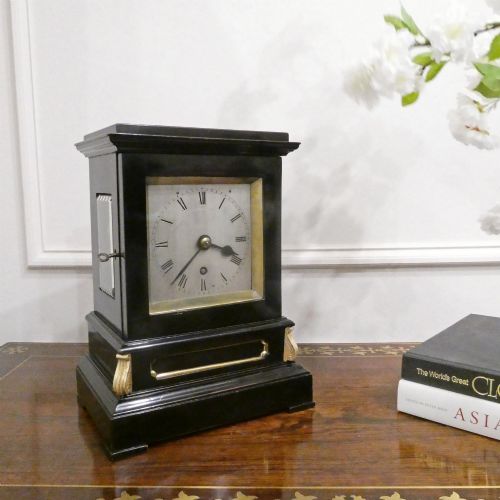


Single Fusee Bracket Clock
A single fusee bracket clock is a precision timepiece driven by a chain or cord and a conical pulley, prized for its mechanical reliability and architectural timber cases.
Single Fusee Bracket Clock
A single fusee bracket clock is a self-contained timekeeper designed to sit on a bracket, mantel, or table, driven by a weight-equalising mechanism rather than a spring barrel. These pieces span the Georgian, Regency, Victorian, and Edwardian periods, reflecting shifting tastes in interior ornamentation.
The version most commonly met on this page is housed in a mahogany or ebonised wood case, often featuring a white enamel or silvered dial behind glass. Formats vary from classic pad-top and pagoda designs to lancet, balloon, drum-head, and four-glass library styles.
Origins range widely across London workshops and provincial makers, encompassing diverse aesthetic revivals such as Rococo, Egyptian, and Empire styles. Each piece serves as both an accurate instrument and a sculptural focal point for a room.
How they were made
Clockmakers constructed the movements using brass plates and wheels, driving the gear train via a single chain or cord wound around a grooved conical fusee pulley. This ingenious device equalises the diminishing power of the mainspring as it unwinds, ensuring consistent tension and steady timekeeping.
Cases were built from dense timbers like mahogany, rosewood, coromandel, and ebonised wood, frequently enhanced with brass inlay, ormolu mounts, gilt bronze, and slate. Dials were formed from enamelled copper or engraved silvered brass, protected behind glazed doors or bezels.
Listings feature mahogany, rosewood, coromandel, and ebonised wood cases spanning the Georgian, Regency, Victorian, and Edwardian eras.
What varies in quality
Quality rests in the crispness of the movement engraving, the precision of the fusee cut, and the structural integrity of the timber case. Superior examples display signed movements by reputable makers with matching serial numbers and uncompromised wheel teeth.
Cabinetwork distinguishes the finer pieces, seen in matched wood veneers, finely cast gilt bronze or ormolu mounts, and well-executed brass inlay. Simpler provincial or later Edwardian iterations offer solid construction with more restrained ornamentation.
W Burton·Phillips Brothers·Wilkinson Leicester·Barrett London·J Kingerley Manchester·Hay London·Barraud and Lunds·John Massey London·Baetens London·Payne London·Brockbank and Atkins·James Voak London
The Single Fusee Bracket Clock Glossary
- Fusee
- A conical pulley with a spiral groove that regulates the pull of the mainspring. This ingenious mechanism ensures uniform power is delivered to the clock train as the spring unwinds.
- Bracket clock
- A portable timepiece originally designed to stand on a matching wall bracket or a table. Over time, the term became synonymous with larger mantel clocks regardless of whether a wall bracket was present.
- Library clock
- A compact timepiece intended for use in a study or library. These often feature rectangular brass and glass four-glass cases or distinct wooden housing designed for quiet rooms.
- Silvered dial
- A clock face made of brass that has been treated with a silver solution to create a matte metallic finish. Graduations and maker signatures are then engraved and filled with black wax for legibility.
- Pad top
- A raised, domed section surmounting the main cornice of a wooden clock case. This classic Georgian and Regency silhouette adds architectural height and presence to the design.
Single Fusee Bracket Clock: Frequently Asked Questions
How do I wind my clock?
Insert the winding key into the dial aperture and turn it gently in the indicated direction until resistance is felt. Care must be taken not to overwind the mechanism.
Ensure you support the pendulum or movement if the entire clock needs to be moved after winding.
What is a single fusee movement?
A single fusee movement uses a conical pulley and chain to equalise the force of the mainspring. This maintains steady power to the escapement throughout the running cycle.
It differs from twin-fusee models by omitting strike or chime trains, focusing entirely on accurate timekeeping.
How do I date a wooden case?
Examine the timber species, construction joints, and decorative motifs such as brass inlay or ormolu mounts. Georgian and Regency pieces typically favour figured mahogany or rosewood with restrained classical lines.
Later Victorian and Edwardian examples often incorporate ebonised finishes, heavier carvings, or alternative woods like oak and satinwood.
Where should I place a bracket clock?
Position the clock on a stable, level surface away from direct sunlight, drafts, and sources of heat. A sturdy mantelpiece, sideboard, or dedicated wall bracket works best.
A level foundation is essential for the pendulum and escapement to beat evenly and keep accurate time.