


Silver Plate Teapot
These silver plate teapots and tea sets offer the elegance of traditional silver without the heavier maintenance.

Silver Plate Teapot
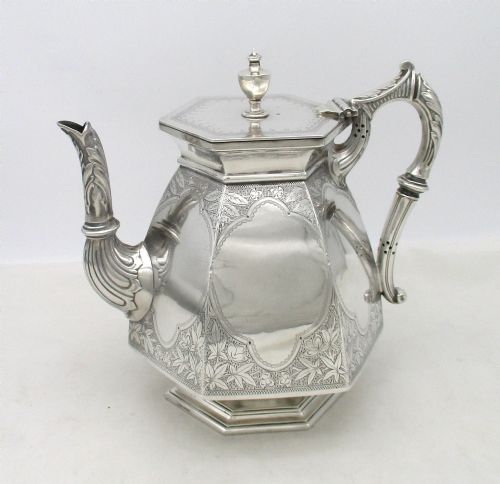
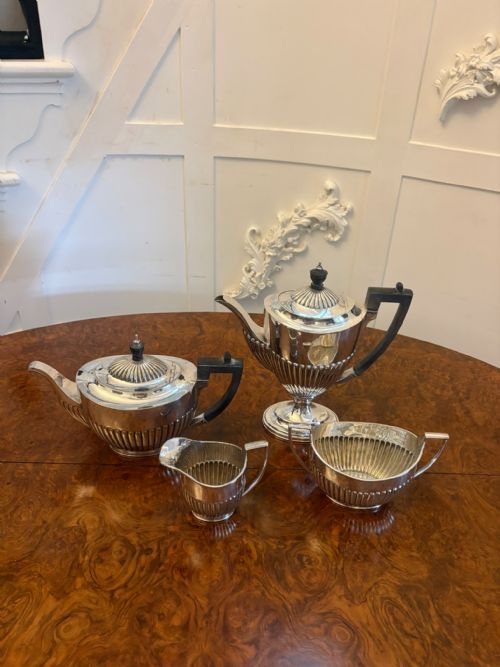
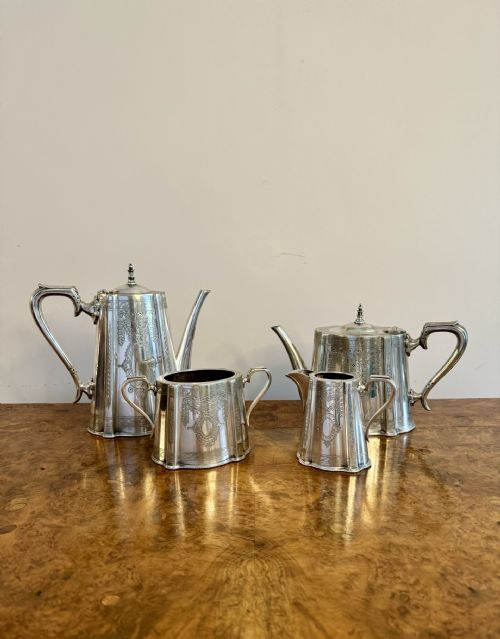
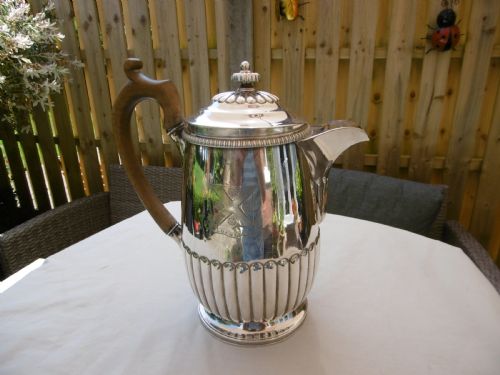
A silver plate teapot represents a tradition of domestic hospitality spanning from the Georgian period through the Edwardian era and into the Art Deco years. When you browse this selection, you encounter standalone teapots alongside larger matching tea services, coffee pots, and spirit kettles on stands.
The Edwardian period supplies the majority of the surviving pieces on this page, often appearing as three or four-piece matching sets. Alongside these, 19th-century Victorian examples, earlier Old Sheffield plate items, and later Art Deco geometric designs appear.
Forms range from simple melon shapes and lobed oval bodies to ornate vessels featuring grapevine detailing or dragon motifs. Makers varied from large silversmithing firms to specialised manufacturers producing everything from compact individual pots to expansive family services.
Materials and construction
Makers constructed these vessels using base metals like copper, nickel silver, or Britannia metal, coated with a layer of silver through electroplating or the older fusion method of Old Sheffield plate. Electroplated nickel silver became the dominant technique by the Victorian period, allowing manufacturers to deposit a durable silver skin over a resilient core.
Handles and insulators frequently incorporate complementary materials such as ebony, ebonised wood, or bone to prevent heat transfer during use. These organic and turned wooden elements provide a tactile contrast to the polished metallic surfaces of the pot bodies.
Materials recorded across the inventory include silver plate, Old Sheffield plate, wood, ebony, ebonised wood, bone, and metal.
Assessing quality and craftsmanship
Quality rests in the crispness of the chased or embossed ornamentation, such as grapevine detailing, and the structural integrity of hinged lids and spouts. Superior examples display balanced weight, secure handle attachments, and well-fitted components that indicate skilled silversmithing.
The thickness of the original plating and the survival of the silver layer over the base metal dictate the longevity and overall finish of the piece. Maker attribution also influences standing, with established firms like Walker and Hall, Elkington and Co, and Matthew Boulton representing high standards of production.
Walker and Hall·Matthew Boulton·Martin Hall and Co·Elkington and Co·J B Chatterley and Sons Ltd·William Hutton·Thomas Bradbury·Philip Ashberry and Sons
The Silver Plate Teapot Glossary
- Old Sheffield Plate
- A method of fusing a thin sheet of silver onto a copper core before shaping the metal. This early technique produces a distinctive warm tone.
- Electroplated Nickel Silver
- A process using an electrical current to apply a coating of silver to a base metal alloy of copper, nickel, and zinc. This method largely replaced older plating techniques by the mid-nineteenth century.
- Spirit Kettle
- A water kettle mounted on a metal stand with an integrated burner underneath. These pieces kept water hot for prolonged tea service.
- Britannia Metal
- A tin-based alloy used as a base metal for silver plating or shaped into teapots on its own. It provides a lightweight alternative to heavier brass or copper cores.
Silver Plate Teapot: Frequently Asked Questions
Can I still use these teapots for making tea?
Many people continue to use antique silver plate teapots for serving tea during gatherings. Before use, fill the pot with warm water to check for leaks and rinse the interior thoroughly.
Ensure that any historical residues are cleaned out completely. If the interior plating has worn down to the base metal, some owners prefer to keep the piece for display only.
What is the difference between Old Sheffield plate and electroplate?
Old Sheffield plate involves physically fusing silver sheets to copper through heat and pressure before fabrication. This technique creates a rich appearance where the underlying copper occasionally shows through areas of wear.
Electroplating uses an electrical bath to bond silver particles onto a nickel brass or white metal core. This later invention produced a more uniform silver coating across complex teapot shapes.
How do I date a silver plate teapot?
Examine the overall style, shape, and decorative motifs, comparing them against known periods like Georgian, Victorian, Edwardian, or Art Deco. Stylistic cues like aesthetic movement asymmetry or geometric art deco lines offer strong chronological clues.
Look for maker marks, registry numbers, or stamps on the base of the pot. Reference marks against silversmith directories to narrow down the decade of production.