

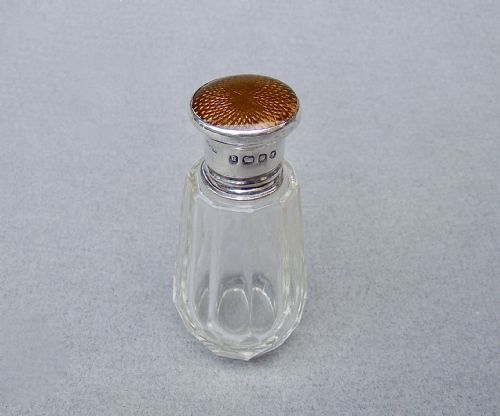


Silver Guilloche Vanity Bottle
A silver guilloche vanity bottle is a dressing table essential that brings intricate mechanical engraving and vibrant coloured enamel together in one pocket-sized piece.
Silver Guilloche Vanity Bottle
A silver guilloche vanity bottle combines precious metal with machined geometric patterns beneath translucent enamel, creating a refined dressing table accessory. When you search for a silver guilloche vanity bottle, you encounter scent bottles, perfume bottles, vanity jars, and cylindrical etuis spanning from the late nineteenth century through to the mid-twentieth century.
The objects originate from diverse stylistic traditions, ranging from French Belle Epoque and Edwardian pieces to bold Art Deco designs and mid-century British examples. Glass and cut glass bodies frequently form the lower reservoirs, topped with secure silver collars and enamelled caps.
Makers such as Henry Perkins, Mappin & Webb, and the Goldsmith's and Silversmith's Co. produced these items in London and across France. They served a practical role on dressing tables for holding perfumes and cosmetics while offering a decorative display of metalwork.
What varies in quality
The complexity and precision of the engine-turned engraving dictate the visual depth of the enamel work on the cap. Tighter, more intricate mechanical patterns create a more luminous interplay of light beneath the coloured surface.
The choice of materials also marks distinctions across the range, with heavier solid silver mounts, silver gilt, and high-clarity cut glass bodies representing higher tiers of production. Maker attribution to notable silversmiths further elevates the standing of an individual piece.
Silver Guilloche Vanity Bottle Retail Price Guide 2026
Typical asking prices for silver guilloche vanity bottle among the pieces listed under this phrase on Sellingantiques today, from the lower quarter to the upper quarter. They describe what is for sale here now, not the wider market.
Listings feature sterling silver, silver gilt, and solid silver paired with cut glass, plain glass, and guilloche enamel across multiple decades.
Henry Perkins·Mappin & Webb·Goldsmith's and Silversmith's Co.
The Silver Guilloche Vanity Bottle Glossary
- Guilloche Enamel
- A decorative technique where a metal surface is mechanically engraved with precise repetitive patterns and then covered with translucent enamel. This allows the underlying design to remain visible through the coloured glass layer.
- Sterling Silver
- An alloy of silver containing 92.5 percent pure silver and 7.5 percent other metals, usually copper. It provides the durable structural standard for the collars and lids of these vanity bottles.
- Silver Gilt
- Silver that has been coated with a thin layer of gold on its surface. This finish provides a warm golden tone while retaining the underlying structure of silver.
- Etui
- A small ornamental box or cylindrical case used for holding small items such as needles, cosmetics, or trinkets. In vanity pieces, these often feature matching engine-turned patterns.
- Art Deco
- A design style characterised by sleek geometric shapes, streamlined forms, and bold ornamentation. It heavily influenced the appearance of vanity bottles and jars produced during the 1920s and 1930s.
Silver Guilloche Vanity Bottle: Frequently Asked Questions
What is guilloche enamel?
Guilloche enamel is a decorative process involving mechanical engraving on metal beneath a translucent layer of coloured glass enamel. The technique creates a repeating geometric pattern that shines through the surface glaze.
This method was widely utilised on vanity items during the early twentieth century to add depth and colour to silver accessories.
How do I date a vanity bottle?
Dating these pieces relies on hallmarks stamped onto the silver mounts, which indicate the assay office, year of production, and maker's mark. Stylistic indicators such as Edwardian flourishes or Art Deco geometry also help narrow down the period.
Materials and construction methods further assist in placing an item within the late nineteenth or mid-twentieth century range.
Were these bottles used for perfume?
These bottles served primarily as portable or dressing table containers for scent, perfume, and liquid cosmetics. Glass reservoirs held the liquid safely while the silver and enamel caps sealed the contents.
Many examples feature glass stoppers beneath the decorative outer lid to prevent evaporation and leakage.
How do I clean silver and enamel?
Cleaning requires gentle care to avoid scratching the delicate glass enamel surface or damaging the underlying mechanical engraving. Soft cloths and mild, non-abrasive cleaners formulated for silver work best.
Moisture should be kept away from internal collars and older cement adhesives often used to secure glass to metal mounts.