
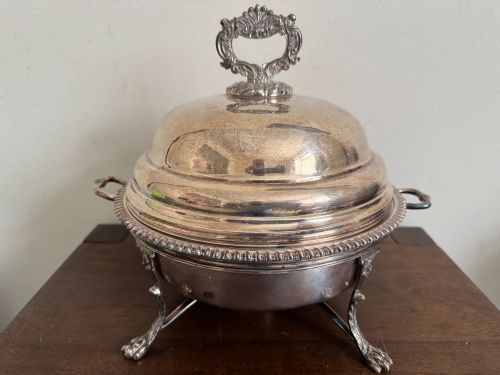


Silver Covered Entree Dish
A silver covered entree dish brings generous proportion and formal shine to a dining table, holding a hot course with practical elegance.
Silver Covered Entree Dish
A silver covered entree dish is a lidded serving vessel designed to keep food warm and present it handsomely at the table. These pieces take rectangular, oval and round forms, often equipped with removable handles or compartments for heated water.
The versions most commonly met here belong to the Victorian and Edwardian eras, alongside earlier Georgian examples and later twentieth-century work. They appear as single dishes, matched pairs or broader serving sets intended for substantial dining.
Materials and Construction
The construction relies heavily on silver plate, electroplated nickel silver and Old Sheffield Plate upon copper bases, alongside substantial sterling silver. Manufacturers fused or deposited silver onto base metals to achieve durable, gleaming surfaces suitable for daily service.
Workshops utilised wood components for insulation or handles in specific warming forms, while skilled smiths shaped and soldered heavier sterling pieces by hand. Edges often received applied decorative borders in cast silver or copper mounts.
Certain Victorian warming dishes included concealed spaces specifically designed to keep toast warm during breakfast.
Distinguishing Quality
Quality rests upon the weight of the metal and the crispness of the cast mounts, handles and borders. Heavier construction resists denting and maintains heat more effectively during a meal.
Makers who invested care in the engraving of crests, the smoothness of the interior silver layer and the precise fit of the cover created pieces that retain their balance and proportion after generations of use.
Hamilton and Inches·Mappin and Webb·Edward and John Barnard·Walker and Hall·Elkington·Matthew Linwood·William Hutton and Sons·Cresswick·Dan Holy·Christofle Gallia
The Silver Covered Entree Dish Glossary
- Old Sheffield Plate
- A method of fusing a thin sheet of silver to a thicker copper core by heat and pressure. This technique creates a distinctive edge where the underlying copper shows through wear.
- Electroplated Nickel Silver
- Abbreviated as EPNS, this material gained widespread use during the Victorian period. It provided a bright silver surface over a sturdy nickel, copper and zinc alloy base.
- Tureen
- A deep covered vessel used for serving soups, stews or larger portions of food. Many entries combine this form with standard entree dishes.
- Warming Dish
- A specialised serving vessel featuring a lower compartment for hot water or coals. It kept food at temperature throughout lengthy multi-course meals.
Silver Covered Entree Dish: Frequently Asked Questions
How were silver entree dishes used?
These dishes were brought directly from the kitchen to the dining table to serve meat, vegetables or fish while keeping the contents warm beneath a fitted lid.
Servants would lift the covers upon serving, or diners would help themselves from the sideboard depending on the formality of the household.
What is Old Sheffield plate?
Old Sheffield plate is an early form of plating created by fusing sterling silver to a copper ingot before rolling it into sheets.
This method differs from later electroplating by showing subtle hints of warm copper beneath high-use areas where the silver layer has thinned.
How do I clean an antique silver dish?
Maintenance requires a gentle silver polish and a soft cloth to protect the plated or solid surface from unnecessary abrasion.
Harsh chemical dips should be avoided, particularly on Old Sheffield plate where strong solutions can damage the underlying base metal.
Can I use these dishes for daily dining?
Many examples remain sturdy enough for contemporary table service, provided they are hand-washed promptly after use.
Careful handling prevents damage to vintage silver surfaces and preserves the structural integrity of hinged or fitted lids.