



Silver Lidded Serving Dish
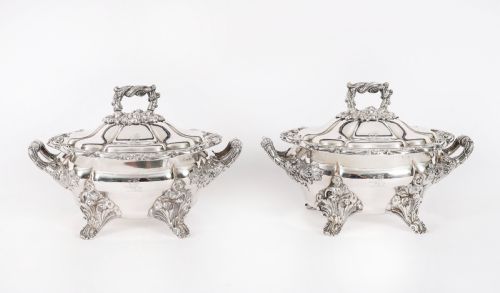
A silver lidded serving dish brings proper weight and shine to the dining table, taking the form of Edwardian entree dishes and Georgian sauce tureens.
Silver Lidded Serving Dish
A silver lidded serving dish is a practical table vessel designed to keep food warm and present it with decorum. The selection on this page spans from Georgian sauce tureens to Edwardian entree dishes and later Art Deco covered vessels.
Most pieces met here are silver plated or fashioned from Old Sheffield Plate, often shaped as rectangles or ovals with fitted lids. Makers applied these forms to sauce tureens, revolving butter dishes, warming dishes, and twin-handled serving pieces.
Buyers will find distinct stylistic eras represented, notably the ornate Victorian period, the restrained elegance of the Regency, and clean-lined Art Deco designs. Each type served a specific function at the formal dining table, from individual sauce presentation to large entrees.
How they were made
Craftsmen shaped these serving vessels using copper, nickel silver, and electroplated nickel silver as underlying metals. Old Sheffield Plate pieces relied on an earlier fusion method where a thin sheet of silver was fused to a copper base before shaping.
Later Victorian and Edwardian examples utilised electroplating, depositing a uniform layer of silver over base metals like nickel silver or copper using electrical current. Wood components occasionally appeared in handles and insulators on warming dishes and specialised cheese dishes.
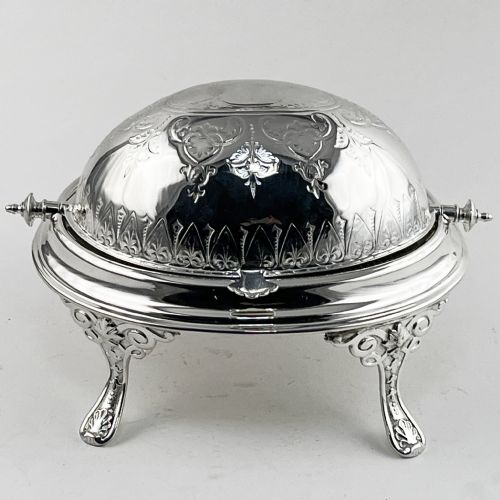
Interiors and mechanisms required precise engineering, particularly for revolving butter dishes and double rollover designs that required smooth rotation. Handles, finials, and crests were frequently cast separately and soldered or riveted to the main body.
Materials span from traditional copper and Old Sheffield Plate to electroplated nickel silver and occasional wood accents.
What varies in quality
Quality rests heavily on the crispness of cast borders, handles, and applied crests, which should show sharp detail rather than soft outlines. Thicker gauge metal provides a substantial feel in the hand and resists denting during daily use and cleaning.
The integrity of the silver plating distinguishes superior pieces from lesser ones, particularly where base metals begin to show through high-wear areas. Original fusing techniques in Old Sheffield Plate create a characteristic warm glow and durability that standard electroplating achieves differently.
Hamilton and Inches·Daniel and Arter·Walker and Hall·Elkington·Matthew Linwood·William Hutton and Sons·Cresswick·Christofle Gallia
The Silver Lidded Serving Dish Glossary
- Old Sheffield Plate
- An early method of fusing a thin sheet of silver to a copper core. This technique predates electroplating and often reveals thin lines of copper along exposed edges.
- Entree Dish
- A shallow lidded vessel designed for serving portions of meat or vegetables at the table. These often feature removable handles to allow the base to double as an open platter.
- Sauce Tureen
- A small lidded container with handles, built specifically for holding gravies and sauces. They frequently rest on fixed or matching undertrays.
- Electroplated Nickel Silver
- A base alloy of copper, nickel, and zinc coated with a layer of pure silver through electrolysis. This became the dominant manufacturing method by the mid-nineteenth century.
- Revolving Dish
- A specialised serving piece with a cylindrical roll-over lid that turns underneath the body. It allows access to butter, preserves, or cheese without requiring a separate lid to be lifted.
Silver Lidded Serving Dish: Frequently Asked Questions
What is an entree dish?
An entree dish is a lidded container used to serve main courses or side dishes at the dining table. They are commonly rectangular or oval in shape.
Many examples feature removable handles so the lid can be inverted to serve as a secondary dish.
How do I clean silver plate?
Cleaning requires warm water, mild soap, and a soft cloth to protect the underlying silver layer. Avoid harsh abrasives that can wear through the plating.
Specialised silver dips should be used sparingly, preferring gentle polishes formulated for plated items.
What is Old Sheffield Plate?
Old Sheffield Plate is an early composite material made by fusing silver onto a copper base. This technique creates a distinct look where copper occasionally shows at the cut edges.
Pieces made this way date primarily from the Georgian and early nineteenth-century periods.
How do revolving lids work?
Revolving lids utilise a curved metal cover that rolls smoothly beneath the body of the dish on a hinge mechanism. This design keeps butter or preserves covered when not in use.
Victorian makers applied this ingenious engineering mostly to breakfast and afternoon tea tables.