


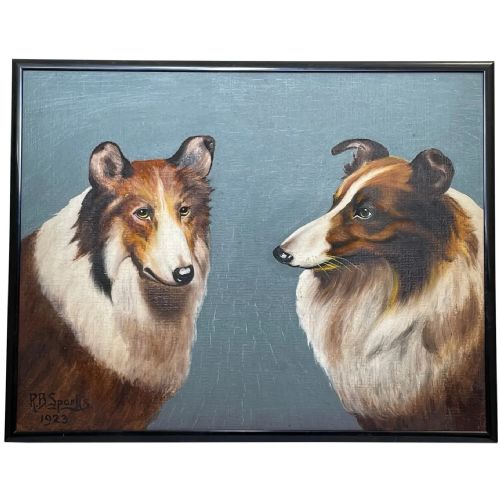


Signed Canine Oil Painting
These signed canine oil painting examples bring nineteenth-century and early twentieth-century realism into a room through canvas and oil paint.
Signed Canine Oil Painting
A signed canine oil painting is a portrait or sporting study executed in oil paint on canvas, bearing the signature of its creator. When you search for a signed canine oil painting, you encounter works spanning the nineteenth century through to the interwar period.
The pieces on this page lean heavily towards Victorian and early twentieth-century British school traditions. You will find collies, terriers, greyhounds, and St Bernards rendered in realistic detail against landscape or neutral backgrounds.
How they were made
These works utilise oil paint applied to canvas, often stretched over a wooden frame and housed in gilt or gold leaf wooden surrounds. Artists built up the subjects through layers of pigment, capturing the texture of dog fur and the light within landscapes.
The framing commonly involves wood with gilt finishes, complementing the warm tones typical of nineteenth-century and early twentieth-century fine art painting.
Signed Canine Oil Painting Retail Price Guide 2026
Typical asking prices for signed canine oil painting among the pieces listed under this phrase on Sellingantiques today, from the lower quarter to the upper quarter. They describe what is for sale here now, not the wider market.
The listings span from the nineteenth century through the 1940s, featuring oil on canvas mediums within wood and gilt frames.
What varies in quality
Quality rests upon the artist's ability to render the anatomy and expression of the animal with convincing realism. Works by named painters demonstrate superior brushwork and compositional balance compared to anonymous student pieces or follower works.
The handling of the background environment and the preservation of the canvas and original gilt wood framing also determine the standing of each individual painting.
John Emms·LM Webb·C W Tuck·John Trivett Nettleship·M.E. Hankinson·Florence Mabel Hollams·A. Betts·Benedict Angell Hyland
The Signed Canine Oil Painting Glossary
- Oil on canvas
- Pigment suspended in drying oil applied to a woven fabric support. This combination allows for rich blending and depth of colour.
- Gilt
- A thin layer of gold or gold-like material applied to wood surfaces. It provides a reflective border that frames the artwork.
- Victorian sporting art
- Depictions of animals, hunting, and rural pursuits associated with the Victorian era. These works often focus on prized hounds and working dogs.
- Interwar realism
- Art produced between the first and second world wars that maintains a realistic depiction of subjects. It captures a distinct shift in twentieth-century British school aesthetics.
Signed Canine Oil Painting: Frequently Asked Questions
How do I identify a Victorian dog painting?
Look for the characteristic clothing, framing styles, and realistic portrayal of breeds popular during the nineteenth century. The materials typically involve oil paint on canvas within heavy wooden frames.
Signatures or attribution to artists working within the British school also help date and place the piece accurately.
Where should I hang a canine oil painting?
These works suit traditional studies, living rooms, or hallways where lighting can be controlled to prevent glare on the oil surface. Placing them away from direct heat sources protects both the canvas and the wooden frame.
Pairing them with period furniture enhances the nineteenth-century and interwar aesthetic of the room.
What breeds are common in these paintings?
Collies, terriers, greyhounds, St Bernards, and Pekingese frequently appear in these nineteenth and twentieth-century works. Artists often painted specific working dogs or personal pets for commissioners.
Sporting and pastoral backgrounds dominate the settings for these canine subjects.
How do I care for an oil painting on canvas?
Keep the canvas away from moisture and extreme temperature fluctuations to prevent cracking in the paint layers. Dust the surface and the wooden frame gently with a soft, dry cloth.
Avoid using liquid cleaners on either the oil paint or the gilt elements.