


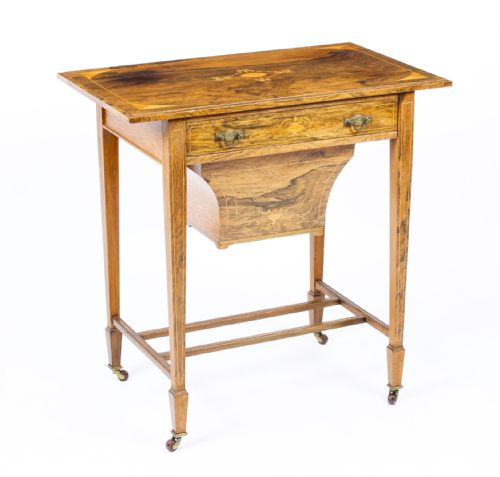


Sheraton Revival Sewing Table
A sheraton revival sewing table brings refined late nineteenth and early twentieth century elegance to a room, offering clever internal storage alongside classical proportions.
Sheraton Revival Sewing Table
A sheraton revival sewing table takes its design cues from late eighteenth century neoclassical forms, emerging in Edwardian and late Victorian workshops as both a practical work space and a decorative occasional piece. Buyers find pieces produced across the nineteenth century and the early decades of the twentieth century, with Edwardian examples appearing most frequently.
Makers constructed these items primarily as sewing or work tables, incorporating lift up tops and internal compartments alongside occasional and side table variants. The selection spans mahogany, satinwood and rosewood structures enhanced by decorative stringing and boxwood inlay.
How they were made
Cabinet makers utilised dense hardwoods such as mahogany and satinwood as the structural base, often applying contrasting boxwood inlay and delicate stringing to define the geometric panels. Fine grain timbers provided a stable canvas for both hand painted details and traditional polished finishes.
Constructors integrated brass hardware and leather inserts where writing surfaces or functional compartments required durable touchpoints. The joinery relies on period cabinet making techniques designed to support hinged lids and internal workboxes without compromising the slender leg profiles.
A late Victorian work writing table neatly bridges the gap between darning a sock and penning a stern letter.
What varies in quality
Quality rests in the crispness of the boxwood inlay and the selection of figured timber veneers on the top and sides. Superior examples display precise botanical or classical motifs that align cleanly with the structural edges.
The sophistication of the internal compartmentalisation and the integrity of the lift up mechanism separate standard utility items from finer decorative pieces. Heavier framing and balanced proportions across the legs and skirts also indicate higher workshop standards.
The Sheraton Revival Sewing Table Glossary
- Sheraton Revival
- A design movement drawing inspiration from the late eighteenth century neoclassical style of George Sheraton. It dominated late Victorian and Edwardian cabinet making.
- Satinwood
- A durable, lustrous timber with a golden yellow sheen that takes a high polish. It served as a favoured veneer for high status decorative tables.
- Boxwood Inlay
- Contrasting pale wood inserted into recesses within a darker timber surface to create linear borders and geometric patterns. This technique defines classical revival styling.
- Work Table
- A specialised piece of furniture featuring a fitted interior for sewing implements and needlework materials. These items often double as side or occasional tables.
Sheraton Revival Sewing Table: Frequently Asked Questions
How were sewing tables used originally?
These tables served as functional stations for sewing, mending and embroidery, keeping threads and tools organised within specialised internal compartments. The lift up lids concealed storage trays while providing a stable surface for detailed handcrafts.
Over time their decorative appeal allowed them to function equally well as occasional or side tables in sitting rooms and boudoirs.
How do you date an Edwardian sewing table?
Dating relies on examining the timber species, construction methods and stylistic markers recorded in the piece. Edwardian examples often employ satin walnut, lighter mahogany veneers and crisp boxwood stringing.
Comparing the hardware styles and the nature of any hand painted decoration against established period references helps confirm the decade of manufacture.
Where should you place a sewing table?
A sewing table fits naturally beside a sofa or armchair where its compact proportions and lift up top remain easily accessible. Many people utilise them as decorative side tables or occasional display surfaces in drawing rooms.
Placing them away from direct heat sources protects the polished timber surfaces and sensitive veneer work over time.