

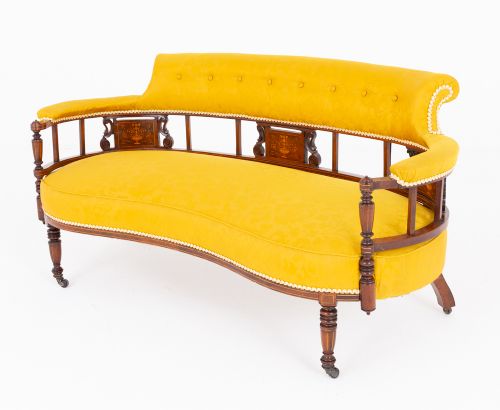


Sheraton Revival Settee
A sheraton revival settee brings neoclassical elegance and light woodwork into a room, offering refined seating shaped by late nineteenth and early twentieth century craftsmanship.

Sheraton Revival Settee
When searching for a sheraton revival settee, you are looking at graceful seating pieces created during the late Victorian and Edwardian periods. These pieces draw heavily on eighteenth century classical forms, reinterpreted by makers working between eighteen seventy and nineteen ten.
The version you are most likely to meet on this page is an Edwardian mahogany two seater sofa featuring delicate satinwood inlay. They appear in forms ranging from salon settees and window seats to painted satinwood couches and occasional parlour suites.
Originating in Britain during a period of revivalism, these settees combine light wood frames with structured upholstery designed for formal parlours and drawing rooms. They reflect a Victorian and Edwardian desire for refined historical aesthetics adapted to domestic comfort.
How they were made
Makers constructed these frames predominantly using mahogany and satinwood, often combining the two timbers to create contrasting borders and decorative panels. Satinwood inlay provides the characteristic pale banding and floral motifs associated with the style.
Surface decoration frequently involves painted details applied directly to the wood, alongside traditional upholstery methods using fabric, velvet, and occasionally canework. Brass fittings and castors appear on select pieces to aid mobility.
Joinery techniques rely on solid timber construction for the structural frame, while decorative elements depend on precise veneering and inlay work. Frames are shaped to support upholstered seats and backs while maintaining slender, tapered legs.
Sheraton Revival Settee Retail Price Guide 2026
Typical asking prices for sheraton revival settee among the pieces listed under this phrase on Sellingantiques today, from the lower quarter to the upper quarter. They describe what is for sale here now, not the wider market.
Some small painted canework couches from nineteen ten offer a breezy alternative to heavy velvet, perfect for resting a hat while reading the morning post.
What varies in quality
The distinction between standard and superior pieces rests on the crispness of the satinwood inlay and the finesse of any hand painted decoration. Finer examples display meticulous botanical or classical motifs integrated seamlessly into the mahogany body.
Proportion and structural grace also dictate value, with superior settees maintaining balanced lines and slender supports without sacrificing stability. The integration of quality upholstery materials and retained original finishes elevates the standing of an individual piece.

The Sheraton Revival Settee Glossary
- Satinwood inlay
- A decorative technique where contrasting pieces of pale satinwood are inserted into recesses within a darker primary wood like mahogany. This creates geometric or botanical patterns along the frame.
- Parlour suite
- A matching set of seating furniture designed for a formal reception room, often comprising a settee and matching chairs. These suites share identical wood types and inlay motifs.
- Shield back
- A chair or settee backrest shaped like a heraldic shield, frequently appearing in classical revival seating designs. It requires careful carpentry to curve the wooden frame smoothly.
Sheraton Revival Settee: Frequently Asked Questions
What is a sheraton revival settee?
A sheraton revival settee is a piece of upholstered seating produced during the late nineteenth and early twentieth centuries. These pieces emulate the light, neoclassical furniture designs popularized in the eighteenth century.
They typically feature mahogany frames enhanced with satinwood inlay, tapered legs, and slender proportions. Makers designed them for formal reception rooms rather than heavy daily lounging.
How do I date an Edwardian settee?
Dating an Edwardian settee involves examining the timber selection, construction methods, and stylistic markers recorded in the period evidence. Pieces from this era often utilise mahogany paired with satinwood inlay and exhibit lighter frames than mid Victorian furniture.
Makers working between eighteen seventy and nineteen ten combined historical neoclassical revival styles with contemporary upholstery techniques. Comparing the specific inlay patterns and wood finishes helps narrow the period of manufacture.
Where should I place a salon settee?
A salon settee suits spaces designed for light entertaining, such as a drawing room, bedroom, or large landing. Their slender mahogany frames and decorative inlay make them effective focal points against a plain wall or placed informally near a window.
Because many examples were built for formal reception spaces, pairing them with lighter antique tables or chairs maintains the intended aesthetic balance.
Are painted satinwood settees original?
Painted satinwood settees date primarily from the late Victorian and Edwardian revival periods when decorative painted motifs enjoyed renewed popularity. Artisans applied floral or classical designs directly onto the pale wood surface to complement the inlaid borders.
Evaluating the integration of the paintwork with the surrounding satinwood and mahogany helps confirm its period origin. These painted finishes form an intentional part of the decorative scheme.
How do I care for inlaid wood furniture?
Caring for inlaid wood furniture requires protecting the delicate satinwood veneer and mahogany surfaces from excessive moisture and direct sunlight. Regular dusting with a soft, dry cloth preserves the polished finish without harming the inlay.
Avoiding abrasive cleaners ensures the painted details and thin wooden veneers remain intact. Maintaining stable indoor humidity prevents the timber from expanding and loosening the inlay work.