





Sheraton Revival Bedside Cupboards
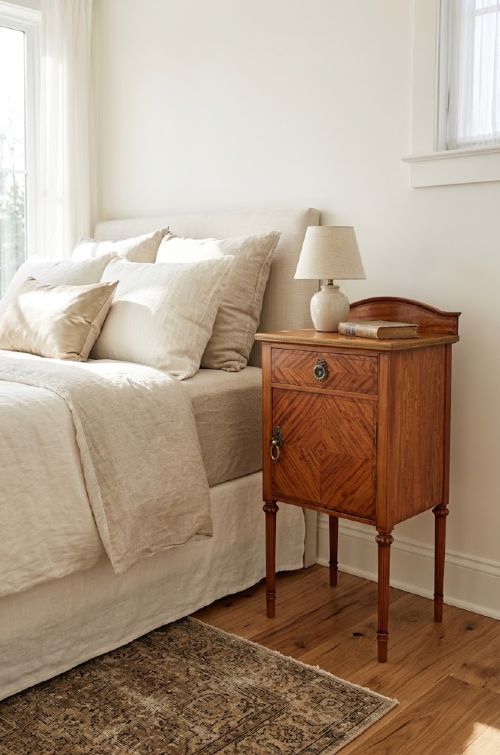
Sheraton revival bedside cupboards offer graceful lines and classical inlay, bringing refined proportions to the bedroom.
Sheraton Revival Bedside Cupboards
Sheraton revival bedside cupboards bring the elegance of the eighteenth century into later domestic spaces. Buyers searching for these pieces often encounter refined satinwood and mahogany forms from the Edwardian era and the early twentieth century. The selection ranges from bow-fronted single cabinets to symmetrical pairs designed for twin beds.
Most examples date from the Edwardian period or around nineteen hundred, alongside occasional Victorian interpretations from the late nineteenth century. These cabinets typically take the form of bedside chests, commodes, or small side cabinets with enclosed storage. Makers drew inspiration from classical neoclassical motifs, resulting in pieces that balance decorative appeal with practical bedside utility.
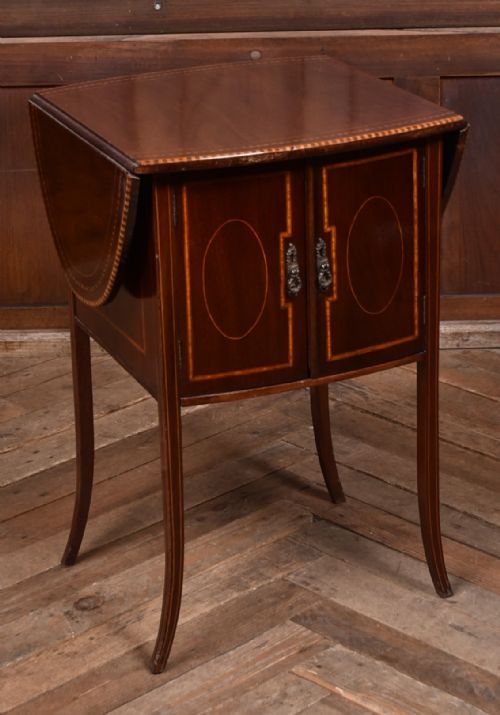
The assortment includes drop-leaf tables and side tables that share the same stylistic vocabulary. Satinwood and mahogany form the primary carcasses, often enriched by contrasting stringing and marquetry. Whether rendered in a serpentine profile or straight lines, these cupboards provide compact storage with a distinctly polished appearance.
Distinguishing quality in the range
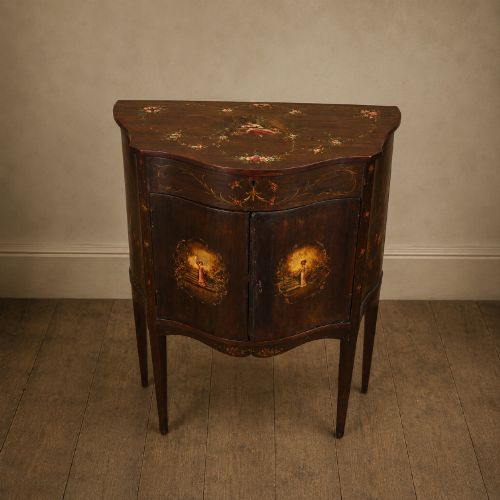
Quality rests upon the selection of timber veneers and the precision of the marquetry work. Finer pieces display crisp boxwood stringing and well-executed hand-painted motifs that remain sharp and intact. The choice between standard mahogany and highly figured satinwood shifts the visual impact significantly.
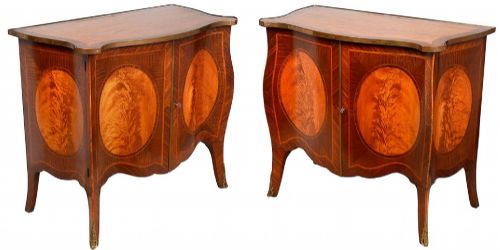
Structural refinement shows in the handling of serpentine and bow-fronted profiles, where smooth curves require advanced joinery. Original brass hardware and clean interior construction elevate individual pieces above simpler utility cupboards. Symmetrical pairs demand a higher standard of matching timber selection across both cabinets.
Forms on this page include bedside cabinets, side tables, commodes, and drop-leaf configurations.
The Sheraton Revival Bedside Cupboards Glossary
- Sheraton Revival
- A design movement drawing inspiration from the late eighteenth-century neoclassical furniture of Thomas Sheraton. It relies on symmetrical geometry, fine veneers, and delicate inlay.
- Satinwood
- A lustrous tropical hardwood with a golden-yellow sheen used extensively for fine veneer and cabinet surfaces. It forms the bright ground for many Edwardian decorative pieces.
- Marquetry
- The art of applying pieces of veneer to a structure to form decorative patterns and pictures. Craftsmen cut various woods to fit flush within the primary surface.
- Bow Front
- A convex curved cabinet front that projects outward in a smooth arc. This shape requires specialised joinery to achieve the curved door and frame.
- Serpentine
- A front profile characterised by a central convex curve flanked by concave sweeps. It adds visual movement and complexity to case furniture.
Sheraton Revival Bedside Cupboards: Frequently Asked Questions
What periods do these cupboards date from?
The pieces span the Edwardian era and the early twentieth century, alongside Victorian examples from the late nineteenth century. Most reflect a revivalist interest in eighteenth-century classical design.
Craftsmen produced these cabinets primarily around nineteen hundred and the decades immediately following, utilising traditional timber techniques.
How were these cabinets used originally?
Bedside cupboards served to house chamber pots, water jugs, and nighttime personal items within a domestic bedroom setting. Their enclosed doors kept necessities neatly out of sight.
Over time, their role shifted toward general bedside storage for books, lamps, and personal effects while maintaining their decorative function.
What woods should I look for?
Mahogany and satinwood form the predominant timbers seen across these listings, providing either a deep reddish-brown tone or a bright golden finish. Boxwood and rosewood appear frequently as contrasting inlay elements.
Selected pieces also feature hand-painted detailing or painted surfaces that enhance the primary timber grain.
Are pairs difficult to find?
Matching pairs appear regularly alongside single cabinets, offering symmetrical options for twin bedroom layouts. These pairs share identical timber grains and inlay patterns.
Finding a matched pair requires careful attention to the subtle variations in hand-painted details and timber ageing.