
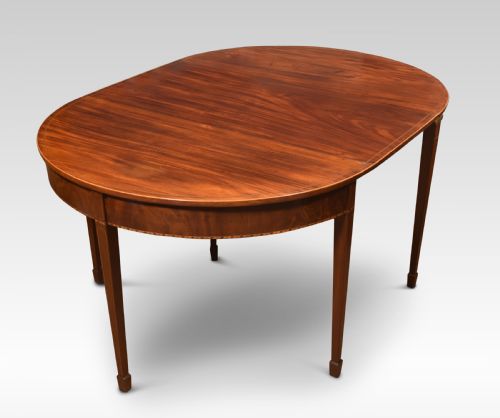


Sheraton D End Table
Sheraton d end table pieces bring refined geometry and delicate inlay into a room, offering adaptable surfaces rooted in the late eighteenth and nineteenth centuries.
Sheraton D End Table
A sheraton d end table search reveals pieces spanning the late eighteenth century through the Edwardian era, alongside Georgian, Victorian, and Regency examples. Buyers most frequently encounter occasional tables, side tables, nests of tables, and Pembroke tables built during the Edwardian period or the Sheraton Revival.
The inventory includes specialised forms such as lamp tables, writing tables, bookcases, and dining tables. These objects reflect the lighter proportions and classical restraint characteristic of the Sheraton style.
Origins stretch from genuine late eighteenth-century periods to later revivals in the nineteenth and early twentieth centuries. The selection balances standalone side supports with nested sets and drop-leaf designs.
Materials and construction
Construction relies heavily on mahogany and satinwood timbers, often accented with contrasting boxwood inlay and marquetry detail. Selected pieces incorporate rosewood and painted surfaces to enhance the decorative scheme.
Cabinetmakers utilised precise stringing and timber matching to create crisp geometric borders and delicate floral motifs. Brass hardware appears on functional elements such as drawers and drop leaves.
The listings here encompass pieces in mahogany, satinwood, and rosewood, spanning Georgian, Victorian, and Edwardian periods.
Distinctions in quality
Quality reveals itself in the crispness of the satinwood and boxwood inlay, where tight joints and precise botanical or geometric motifs elevate a piece above simpler production. The choice of timber grain, particularly figured mahogany or smooth satinwood, dictates visual depth.
Structural integrity and the subtlety of painted decoration separate workshop output. Hand-painted floral details and well-executed marquetry show the touch of a skilled hand rather than a mechanical stencil.
The Sheraton D End Table Glossary
- Sheraton
- A neoclassical design style originating in the late eighteenth century defined by straight tapered legs, contrasting veneers, and classical restraint. It takes its name from the furniture designer Thomas Sheraton.
- Pembroke table
- A small rectangular table featuring two hinged drop leaves on opposing sides. It often includes one or two drawers and slender tapered legs.
- Marquetry
- Decorative veneer patterns formed by fitting together thin pieces of wood, shell, or ivory to create pictorial or geometric designs. This technique adds rich surface texture to tabletop panels.
- Satinwood
- A durable tropical timber known for its golden lustre and fine grain. It served as a primary wood or a contrasting veneer in high-status neoclassical furniture.
- Boxwood inlay
- Narrow strips of pale boxwood embedded into darker timber to form contrasting borders and geometric stringing. This detail accentuates the structural lines of table edges.
Sheraton D End Table: Frequently Asked Questions
What is a sheraton d end table?
A sheraton d end table is a piece of furniture featuring the characteristic semicircular or D-shaped profile associated with the late eighteenth-century neoclassical style.
These tables function individually against walls or join together to form larger dining surfaces, reflecting the versatile interior layouts of the period.
How do I identify a sheraton revival piece?
Sheraton revival pieces date from the late nineteenth and early twentieth centuries, mimicking the lighter proportions and inlay work of eighteenth-century originals.
Examination of secondary timbers, construction methods, and modern machine finishing typically distinguishes these revival items from older periods.
Where should I place a pembroke table?
Pembroke tables suit reception rooms and hallways as lamp or side tables because their drop leaves allow the footprint to adjust.
Raising one or both leaves provides an immediate surface for writing or display without crowding a smaller interior space.
What woods were used in these tables?
Makers relied predominantly on mahogany and satinwood as primary cabinet timbers, complemented by rosewood in select examples.
Boxwood and contrasting veneers provided the fine stringing and inlay work that defined the decorative vocabulary.