
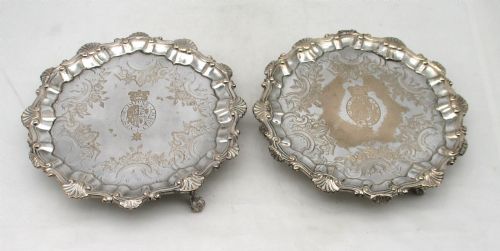


Sheffield Silver Salver
A sheffield silver salver brings solid silver or layered plate to the table, offering a firm flat surface for serving drinks or holding cards.
Sheffield Silver Salver
When you search for a sheffield silver salver, you encounter circular trays, small card trays and large oval serving pieces spanning the eighteenth, nineteenth and twentieth centuries. The selection includes Georgian, Victorian, William IV and Edwardian pieces, alongside specific styles such as Rococo Revival and Regency.
The objects take the form of flat serving trays and raised salvers, often standing upon scroll feet or ball and claw feet. Many pieces are designed simply for display or for holding calling cards, while others serve larger dining roles.
Materials and construction
Makers utilised sterling silver, solid silver, silver plate, copper and Old Sheffield Plate. Old Sheffield Plate involves fusing a thin layer of silver onto a thicker copper base, a technique visible along cut edges or worn spots.
Pieces frequently carry hallmarks indicating Sheffield manufacture, and many feature chased or engraved surface decoration, reticulated pierced borders and applied scroll or cast feet.
Some small trays spent centuries catching calling cards left by callers who timed their visits to ensure nobody was home.
Judging execution and finish
The weight and gauge of the metal determine the rigidity of the tray, distinguishing heavy solid silver pieces and thick Old Sheffield Plate from lighter plated items. Crispness in engraved borders, hand-chased foliage and reticulated piercing separates routine work from finer studio output.
The integrity of the fused silver layer on copper plates matters greatly, as does the secure attachment of cast scroll or ball and claw feet to the main body.
S.C. Younge & Co.·Harrison Bros·Padley Parkin·J Dixon & Sons·Lee & Wigfull·Goldsmiths & Silversmiths·Martin Hall & Co.·Albert Faulkner·Thos Bradbury & Sons·Mappin & Webb·Douglas Heeley·Atkin Bros·Fordham & Fordham·William Hutton and Sons
The Sheffield Silver Salver Glossary
- Old Sheffield Plate
- A composite material made by fusing a sheet of silver to a copper ingot, developed in the eighteenth century. This predates modern electroplating.
- Reticulated
- Pierced or openwork metal decoration forming a lattice or patterned border. This technique appears on trays and serving pieces.
- Salver
- A flat tray used for serving drinks or presenting cards and letters. They often rest upon small feet.
- Hallmark
- Official stamps struck into precious metal to indicate standard of purity, maker and year of assay. Sheffield output carries specific town marks.
Sheffield Silver Salver: Frequently Asked Questions
What is Old Sheffield Plate?
Old Sheffield Plate is an early composite material created by thermally fusing silver onto a copper base. This method produces durable items with distinct metallic layers.
Makers used this technique before electroplating became common in the nineteenth century.
How do I clean a silver salver?
Clean these items using a mild silver polish and a soft cloth to protect the engraved details and surface finish. Avoid abrasive pads that can wear down thin plating.
Regular gentle dusting preserves the original shine without removing historic patination.
What is a card tray?
A card tray is a small salver historically used in hallways for visitors to leave calling cards. They often feature raised rims and decorative feet.
These compact trays measure smaller than dining service pieces but share the same decorative styles.
How can I tell the age?
Age is determined by consulting hallmarks, maker marks, and stylistic indicators such as Georgian rococo scrollwork or Edwardian proportions. Testing techniques also reveal underlying copper in older plated pieces.
Comparing construction methods helps separate eighteenth-century items from later Victorian reproductions.