



Sevres Style Porcelain Lamps
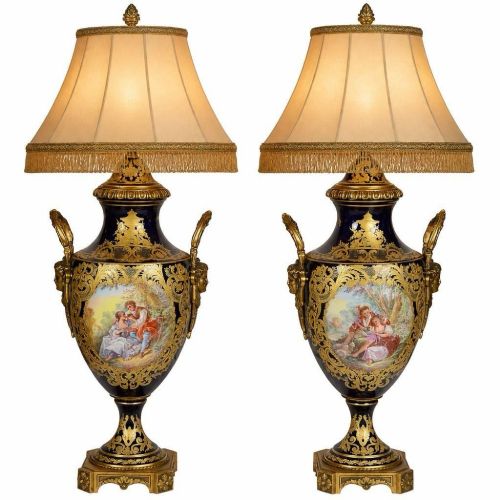
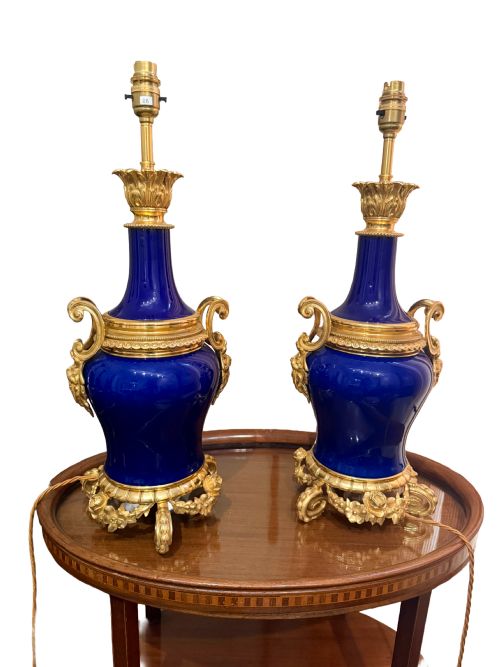
These sevres style porcelain lamps bring rich French chateau presence and heavy gilt mounts into a room.
Sevres Style Porcelain Lamps
When you search for sevres style porcelain lamps, you encounter decorative lighting rooted in nineteenth-century French tastes. These objects typically take the form of table lamps and converted oil lamps, designed to sit prominently in a formal interior.
The versions you meet most frequently on this page date from the nineteenth century, including specific years around eighteen seventy, eighteen eighty, eighteen ninety, and nineteen hundred. They frequently appear as pairs, combining porcelain bodies with substantial metal mounts.
The aesthetic draws heavily on French Rococo Revival, Louis XVI style, and French Neoclassical traditions. Makers adapted traditional vase and urn forms, often painted in cobalt blue, bleu celeste, or bleu royale, and mounted them for electrical use.
How they were made
The construction relies on the combination of fired ceramic bodies and cast metal components. Porous porcelain forms were hand-painted, frequently featuring intricate details and applied pate sur pate techniques before receiving a protective glaze.
Mounts and bases incorporate ormolu, gilt bronze, brass, and gilt metal, which were cast and chased to frame the ceramic sections. These metal elements provide structural stability while adding the characteristic nineteenth-century French decorative flourish.
Sevres Style Porcelain Lamps Retail Price Guide 2026
Typical asking prices for sevres style porcelain lamps among the pieces listed under this phrase on Sellingantiques today, from the lower quarter to the upper quarter. They describe what is for sale here now, not the wider market.
Listings on this site feature porcelain and ormolu lamps spanning the nineteenth century, including specific dates from 1870 to 1900.
What varies in quality
The distinction between standard and superior pieces rests largely on the precision of the hand-painting and the depth of the ceramic colour. Rich hues like bleu celeste and cobalt blue require careful firing, while painted scenes demand steady brushwork by skilled hands.
The quality of the metalwork also separates the ranges, specifically the crispness of the chasing on the ormolu and gilt bronze mounts. Heavier, more detailed metal castings indicate a higher grade of production that elevates the entire piece.
The Sevres Style Porcelain Lamps Glossary
- Ormolu
- A technique of applying finely ground high-carat gold to a bronze object. It provides a bright, durable golden finish on the metal mounts.
- Pate sur pate
- A ceramic decoration method where layers of liquid clay are built up on a dark body to create a low relief cameo effect. This technique allows for subtle translucent details within the design.
- Bleu celeste
- A bright sky blue ceramic ground colour popular in nineteenth-century French porcelain production. It creates a striking contrast against gilded bronze mounts.
- Bleu royale
- A deep, saturated royal blue glaze used on decorative porcelain vessels. It serves as a dark backdrop for hand-painted details and gilt highlights.
- Louis XVI style
- A neoclassical design movement characterised by straight lines, symmetry, and classical architectural motifs. It heavily influences the proportion and mount design of these lamps.
Sevres Style Porcelain Lamps: Frequently Asked Questions
What periods do these lamps date from?
The pieces seen here belong primarily to the nineteenth century, with specific examples recorded from eighteen seventy, eighteen eighty, eighteen ninety, and nineteen hundred.
This broad nineteenth-century span captures the height of French revivalist interior decoration and manufacturing.
Were these lamps originally electric?
Many examples began as oil lamps or decorative vases before being adapted for electricity at a later date. This conversion process allows historical ceramic bodies to function as modern table lighting.
Makers utilised the existing vessel structure to run internal wiring while preserving the external ormolu and porcelain decoration.
How do I identify the different blue ground colours?
Ceramic bodies on these pieces generally feature distinct tones such as cobalt blue, bleu celeste, and bleu royale. Cobalt offers a dark, intense shade, while bleu celeste provides a lighter sky blue appearance.
Examining the saturation under natural light helps separate these specific nineteenth-century colour variations.
How do I style a pair of these lamps?
Their substantial presence suits formal living spaces, sideboards, or large mantelpieces where French chateau and neoclassical aesthetics dominate. Fabric and silk shades are typically chosen to complement the gilt metal and painted porcelain bases.
Pairing them with neutral surroundings allows the hand-painted details and ormolu mounts to remain the visual focal point.