



Sevres Style Garniture
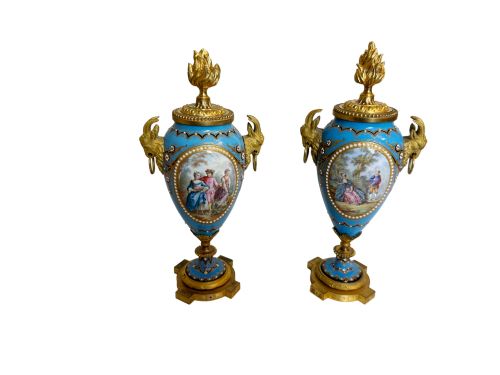
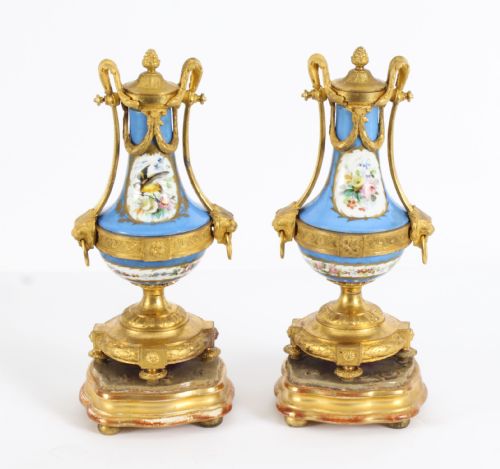
A sevres style garniture brings nineteenth-century French porcelain and gilt metal together on the mantelpiece, offering matched balance and decorative presence.
Sevres Style Garniture
A sevres style garniture comprises matched sets of ornamental vases, urns, cassolettes, or candelabra arranged around a central clock or displayed as balanced pairs. These sets emerge primarily from nineteenth-century French workshops during periods spanning the Victorian era through the early twentieth century.
Buyers most frequently encounter three-piece configurations featuring a central clock flanked by twin vases, or pairs of lidded urns finished in distinctive blue grounds and classical mounts. The forms draw directly on French Rococo Revival, Louis XVI Style, and Empire aesthetics popular across the nineteenth century.
The phrase sevres style garniture unites porcelain bodies with metal mounts, reflecting the enduring nineteenth-century appetite for opulent domestic decoration. Surviving examples demonstrate how makers combined ceramic vessels with gilt bronze, ormolu, and glass domes to create unified interior displays.
What varies in quality
The precision and weight of the ormolu and gilt bronze mounts distinguish finer garnitures from simpler productions, particularly in the crispness of cast foliage and scrollwork. Heavier bronze foundations and more intricate chryseous finishes indicate superior workshop output.
The depth of the porcelain glaze and the finesse of the painted enamel scenes govern the visual standard of each set. Richer cobalt grounds and carefully detailed figurative panels separate standard decorative pieces from exhibition quality works.
Listings feature nineteenth-century pieces incorporating porcelain, gilt bronze, ormolu, enamel, and glass across French Rococo Revival and Louis XVI styles.
VINCENTI of PARIS
The Sevres Style Garniture Glossary
- Garniture
- A set of matched ornamental objects designed to be displayed together on a mantelpiece or sideboard. These typically consist of a central clock flanked by two vases or candelabra.
- Cassolette
- A dual-purpose decorative vessel featuring a reversible lid that transforms the piece from a lidded urn into a burner or candle holder. They frequently appear in pairs within nineteenth-century sets.
- Ormolu
- Gilded bronze used for mounts and decorative fittings on furniture and porcelain. The technique involves applying a gold amalgam to a bronze base.
- Bleu de Roi
- A deep royal blue ceramic glaze developed in France and widely utilised on nineteenth-century porcelain pieces. This intense colour serves as a backdrop for gilded highlights.
- Bleu Celeste
- A bright turquoise blue glaze characteristic of mid to late nineteenth-century decorative porcelain. The hue provides a lighter counterpart to deeper royal blue tones.
Sevres Style Garniture: Frequently Asked Questions
What is a garniture set?
A garniture set is a coordinated grouping of ornamental objects, typically comprising a central timepiece accompanied by matching vases, urns, or candelabra. These arrangements were designed to sit symmetrically on a mantelpiece.
The tradition of matching mantel ornaments gained significant popularity in nineteenth-century France, where workshops produced complementary pieces in porcelain and gilt metal to unify interior decorative schemes.
How do you clean ormolu mounts?
Ormolu mounts require gentle dusting with a soft, dry brush to prevent the accumulation of dirt within the cast details. Moisture and chemical polishes can damage the historic gilded surface.
Avoiding abrasive cloths preserves the original gilding on the bronze elements. Careful maintenance ensures the metal retains its intended lustre without wearing away the underlying finish.
Where were these pieces displayed?
These sets traditionally occupied prominent positions upon drawing room mantelpieces, positioned centrally beneath mirrors or paintings. Their balanced composition created a formal focal point within nineteenth-century reception rooms.
Larger configurations occasionally incorporated glass domes to protect the delicate porcelain and gilt surfaces from coal smoke and dust in period interiors.
How do you date a garniture?
Dating relies upon examining the style of the mounts, the ceramic body, and the mechanical components of any associated clock movement. Nineteenth-century pieces frequently combine revival styles with specific casting techniques.
Maker stamps on the movement or porcelain base help narrow the production period. Stylistic shifts between Rococo Revival and Louis XVI Revival provide further chronological markers.