


Sevres Panel Mantel Clock
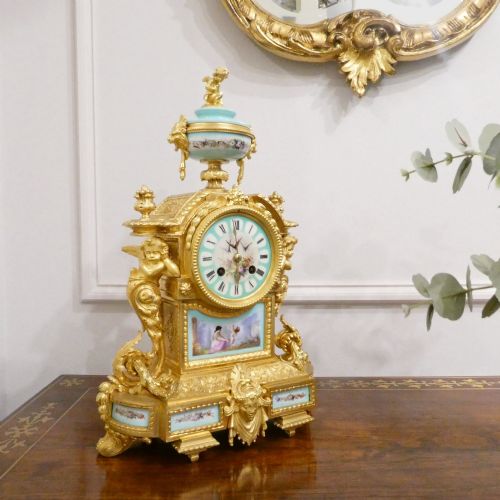
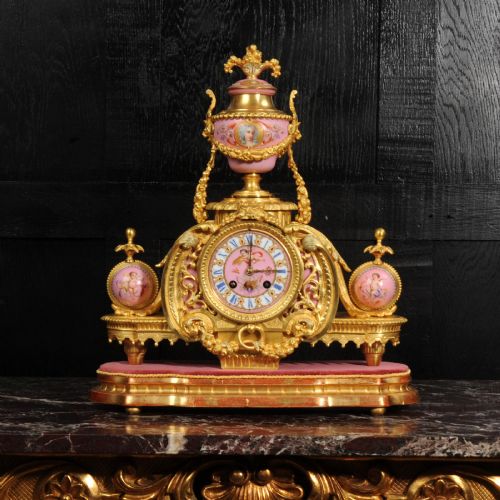
These sevres panel mantel clock pieces combine gilded metalwork with painted ceramic plaques, offering a classic focal point for a mantelpiece.

Sevres Panel Mantel Clock
A sevres panel mantel clock brings together nineteenth-century French clockmaking with decorative porcelain plaques. You will most frequently encounter these items set within ormolu, gilt bronze, or gilt brass housings dating from the Victorian era and the mid-to-late nineteenth century.
The objects take the form of mantel clocks, often incorporating stylistic elements from the French Second Empire, Rococo Revival, and Louis XVI Revival movements. Surviving examples range from traditional architectural cases to crystal regulators and pieces displayed beneath glass domes.
Makers and horologists whose names appear on these works include Achille Brocot, Japy Frères, Henri Jacot, JP Delettrez, and Servant of Paris. Many pieces also feature porcelain panels painted in the distinct Sèvres style alongside enamel dials.
Materials and construction
The primary structural metal is ormolu or gilt bronze, cast and chased to create ornate frames, scrollwork, and decorative mounts. These metal housings frequently receive a fire-gilt finish that yields a deep, enduring lustre.
Porcelain panels, often hand-painted with floral motifs or pastoral scenes, are fitted directly into the metal cases or used as dials. Enamel is applied to numerals and dial faces, while subsidiary elements may include glass panels and velvet lining within protective domes.
Materials documented across these listings include porcelain, gilt bronze, ormolu, enamel, glass, velvet, gilt brass, and gilt metal.
Judging quality in a sevres panel mantel clock
Quality rests significantly on the crispness of the bronze or ormolu casting and the depth of the hand-chasing. Stronger examples display sharp detailing in the acanthus leaves, scrollwork, and figural mounts rather than soft, rounded edges.
The hand-painting on the porcelain plaques and the execution of the enamel dials further distinguish the tier of a piece. Finer works exhibit delicate brushwork and rich colour application on the ceramic panels, paired with a movement signed by a known maker such as Japy Frères or Achille Brocot.
Achille Brocot·Japy Frères·Henri Jacot·JP Delettrez·Servant of Paris
The Sevres Panel Mantel Clock Glossary
- Ormolu
- A gold-coloured bronze alloy used for decorative metal mounts and clock cases. It is finished through mercury gilding or modern electroplating to create a bright metallic surface.
- Sèvres
- A term describing porcelain made at the French national manufactory or pieces decorated in that distinct manner. These panels typically feature cobalt blue grounds and hand-painted reserves.
- Crystal Regulator
- A clock style enclosed entirely by bevelled glass panels held within a brass or gilt frame. This design allows light to pass through the movement and reveals the pendulum.
- Bell Striking
- A mechanical function where the clock chimes the hours and half-hours against a tuned metal bell. It indicates a striking train within the movement.
Sevres Panel Mantel Clock: Frequently Asked Questions
How do I wind a sevres panel mantel clock?
Most of these clocks use a key-wound mechanical movement that requires a gentle turn in the winding arbours. Care must be taken not to overwind the mainspring.
Consult the square arbours on the dial face to determine whether the movement drives the timekeeping, the striking train, or an alarm function.
Where should I place a sevres panel mantel clock?
These clocks suit sturdy mantelpieces, credenzas, or console tables away from direct sunlight and moisture. Placing them on a level surface ensures the pendulum swings evenly.
Some delicate examples come with protective glass domes and stands that require a stable, dedicated tabletop surface.
What periods do these clocks represent?
The available pieces originate primarily from the nineteenth century, spanning the Victorian era and the decades around eighteen-seventy and eighteen-eighty. Stylistic influences draw heavily from French Second Empire and Louis XVI Revival aesthetics.
Earlier mid-nineteenth-century items also appear alongside later Victorian interpretations.
How do I identify a Sèvres style panel?
Panels in this style generally feature hand-painted scenes or floral arrangements framed by rich borders on porcelain. They serve as decorative plaques on the front base or sides of the clock case.
Some panels bear painted or glazed marks on the reverse indicating their factory origin.