


Set of Six Silver Spoons
These a set of six silver spoons comprise matched dining implements collected for domestic service or display.
Set of Six Silver Spoons
A set of six silver spoons brings together matched implements designed for tea, coffee, dessert, or general table service, originating across domestic and continental workshops. These groupings frequently emerge from Georgian, Victorian, and Edwardian households, alongside twentieth-century productions from the Art Deco and Mid-Century periods.
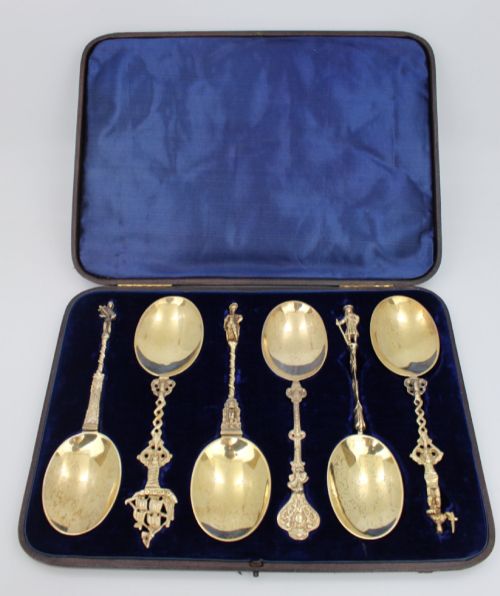
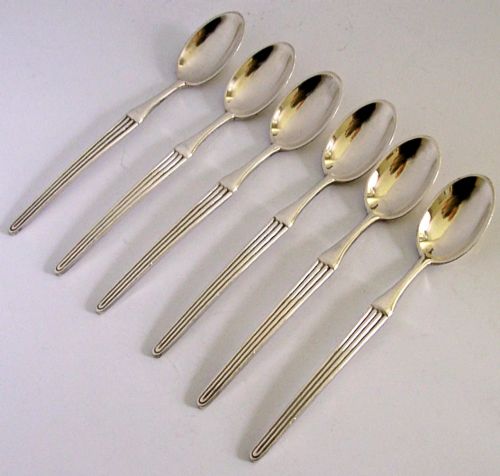
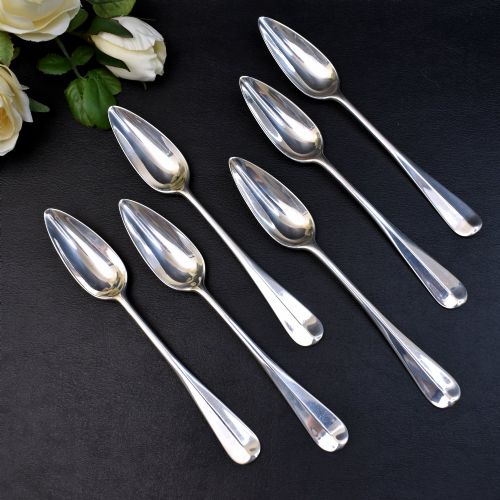
Teaspoons and coffee spoons dominate the available forms, accompanied occasionally by larger dessert spoons, tablespoons, and specialist grapefruit spoons. Many subsets arrive complete with fitted presentation cases lined in velvet, silk, or satin, sometimes accompanied by matching sugar tongs or strainers.
Materials and construction
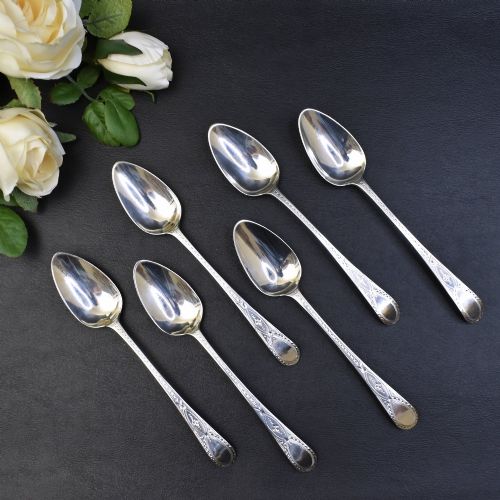
Solid silver and sterling silver form the primary structural material across these pieces, supplemented by silver-gilt finishes and occasional decorative accents of enamel, jade, and niello work. Metalwork techniques involve traditional casting, hammering, and bright-cut engraving executed by silversmiths operating within established assay office standards.
Fitted storage boxes utilise protective outer coverings of leatherette to house the metal implements securely within tailored interior linings.
Certain sets pair silver spoons with miniature butterflies or floral motifs, bringing miniature winged creatures directly to the afternoon tea table.
Factors determining quality
Quality separates through the crispness of bright-cut engraving, the precision of maker and assay office hallmarks, and the structural integrity of thin bowls and stems. Examples enhanced with vitreous enamel, gilding, or carved hardstones demand greater technical skill during fabrication.
The presence of an original fitted case lined in silk or velvet influences the preservation of the matching implements over time.
Hamilton & Inches·Vale Brothers and Sermon·Stepan Levin·Josiah Williams & Co·Liberty & Co·William Eley II
The Set of Six Silver Spoons Glossary
- Sterling silver
- An alloy consisting of 925 parts silver per thousand, widely adopted for British tableware and marked with standard assay symbols.
- Silver-gilt
- Silver objects coated with a thin layer of gold applied through chemical or electrolytic processes, sometimes termed vermeil.
- Bright-cut engraving
- A surface decoration technique using faceted angled cuts to reflect light from shallow grooves carved into the metal.
- Assay office
- An official body charged with testing the purity of precious metals and stamping items with requisite hallmarks.
- Demitasse
- A small cup used for serving strong black coffee, paired here with appropriately scaled spoons.
Set of Six Silver Spoons: Frequently Asked Questions
How were these spoons used historically?
These utensils served formal dining rituals, from measuring loose tea leaves to sweetening beverages and consuming desserts or grapefruit.
Specific forms aligned with distinct courses, requiring smaller bowls for demitasse coffee and larger proportions for table service.
Why do some sets include tongs?
Sugar tongs accompanied teaspoons for transferring sugar lumps into cups before the widespread adoption of granulated varieties.
These matching accessories were housed within the same fitted presentation cases alongside the spoons.
How can I identify the age?
Assay office hallmarks stamped directly onto the metal provide official date letters and city symbols corresponding to specific years of manufacture.
Stylistic indicators such as bright-cut engraving or geometric Art Deco forms also point toward particular eras.
What does silver-gilt mean?
Silver-gilt describes solid silver items that have received a secondary coating of gold across their surfaces.
This treatment added decorative contrast and protected the underlying metal from tarnishing during daily handling.