

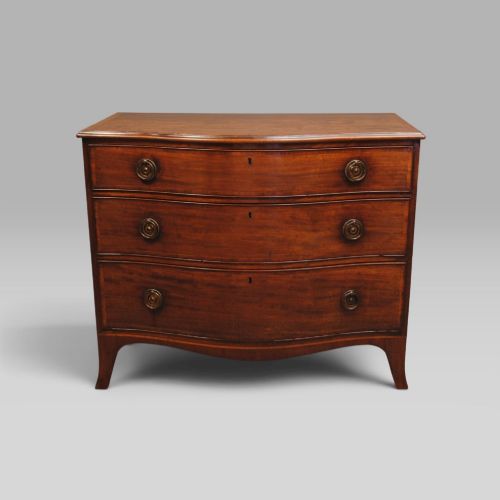
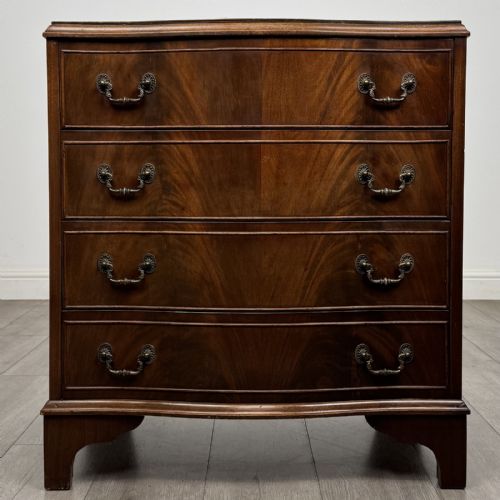
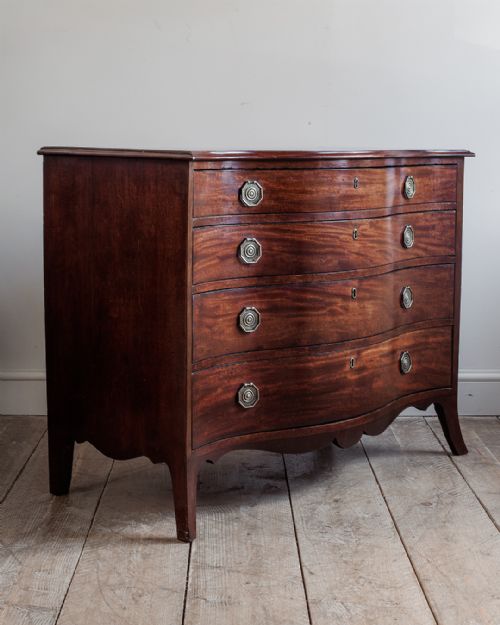
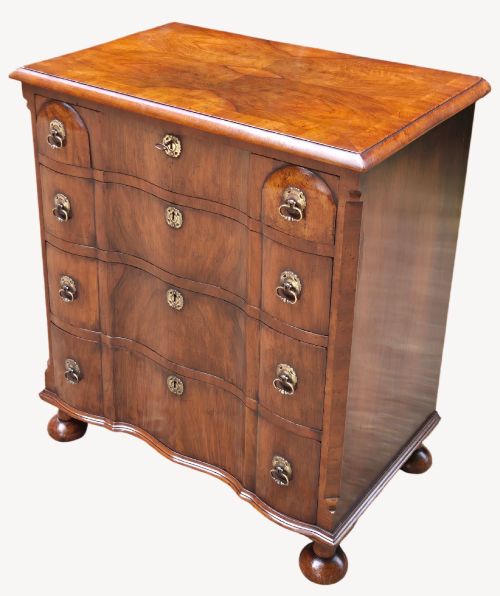






Serpentine Wooden Bureau
These serpentine wooden bureau and chest forms combine fluid sweeping drawer fronts with cabinetwork that demands serious skill from the bench.
Serpentine Wooden Bureau
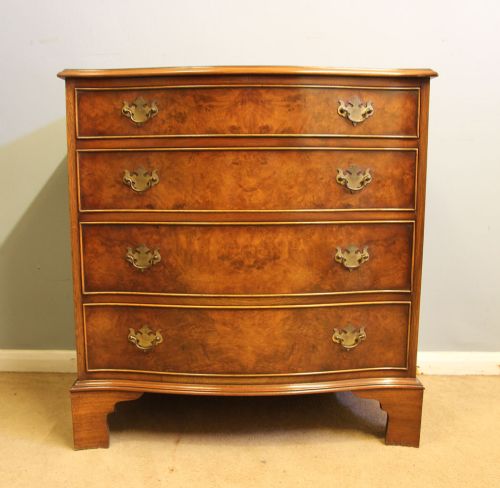
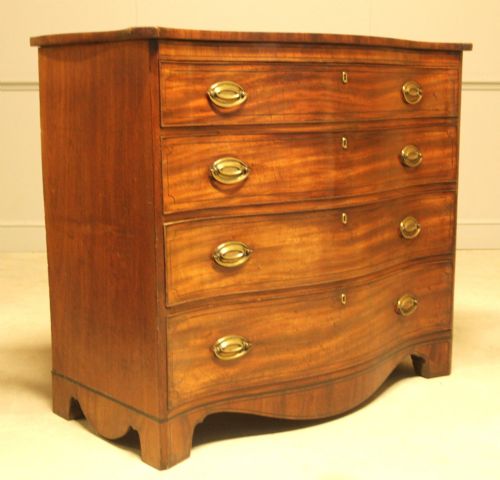
A serpentine wooden bureau or chest presents a distinctive undulating front where the timber curves outward in the centre and inward at the corners, creating movement across the piece. Buyers searching this phrase most commonly meet mahogany examples originating from the Georgian period, alongside later revivals.
The form appears predominantly as chests of drawers rather than sloping-front writing desks, though cabinetmakers applied the same curved-front vocabulary across various domestic storage pieces. Makers shaped these fronts from solid timber or thick veneers, requiring precise hand-planing to achieve the signature rhythm.
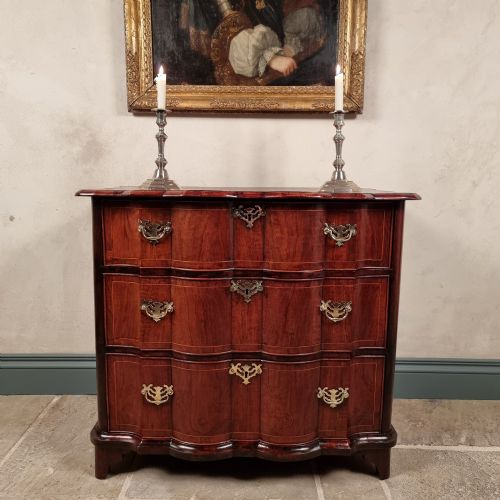
Origins stretch from eighteenth-century workshops in England and Scotland to Dutch makers working in elm, as well as later Edwardian and twentieth-century interpretations. These later revivals borrow heavily from George III, Hepplewhite, and Chippendale design idioms while employing walnut, satinwood, and boxwood inlay.
How they were made
Cabinetmakers constructed these undulating fronts using dense hardwoods like mahogany, walnut, and elm, often selecting figured veneers such as burr walnut or fiddleback mahogany to catch the light across the curves. These primary timbers sat over robust secondary woods, joined with traditional dovetailing on the drawer carcases.
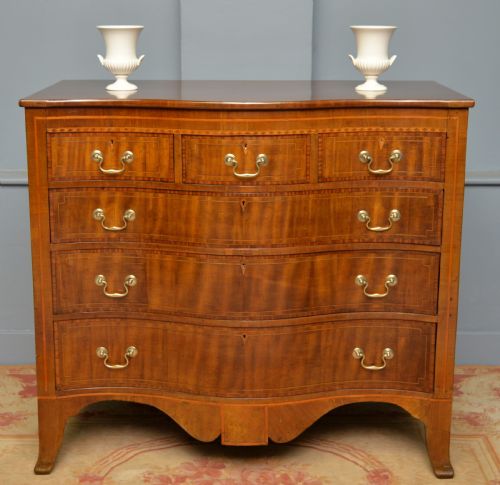
The curved drawer fronts required timber of sufficient thickness to be shaped by hand, or carefully bent and layered construction. Brass handles and escutcheons were fitted to punctuate the drawer arrangement, while boxwood stringing and inlay added linear contrast to the figured surfaces.
Serpentine Wooden Bureau Retail Price Guide 2026
Typical asking prices for serpentine wooden bureau among the pieces listed under this phrase on Sellingantiques today, from the lower quarter to the upper quarter. They describe what is for sale here now, not the wider market.
Listings span Georgian, Victorian, Edwardian, and 1930s periods, showing mahogany, walnut, oak, and elm construction.
What varies in quality
Quality rests primarily in the ambition of the timber selection and the precision of the curved carcase work. Fiddleback and burr walnut veneers demonstrate a higher grade of material choice than plain straight-grained boards, particularly when matched symmetrically across the undulating drawer fronts.
The crispness of the joinery and the restraint of the inlay define the upper tier of production. Pieces bearing recognisable workshop signatures or maintaining their original brass hardware command attention through the integrity of their survival.
Maple & Co
The Serpentine Wooden Bureau Glossary
- Serpentine
- A front profile characterised by a convex centre flanked by concave curves toward the ends. This sweeping shape creates a fluid sense of movement across the piece.
- Fiddleback mahogany
- Mahogany timber exhibiting a wavy, rippled grain pattern resembling the back of a violin. Cabinetmakers prized this figure for high-status furniture.
- Burr walnut
- Wood taken from a walnut tree outgrowth, displaying intricate, swirling knot formations. It provides a rich, highly decorative surface texture.
- Boxwood inlay
- Contrasting light wood inserted into recesses in the primary timber to create geometric lines or borders. It defines the edge work on inlaid pieces.
- Chippendale style
- A design vocabulary drawing on mid-eighteenth-century pattern books associated with Thomas Chippendale. It frequently incorporates ornate drawer shaping and bracket feet.
Serpentine Wooden Bureau: Frequently Asked Questions
How do I spot a later revival piece?
Revival pieces from the Edwardian era or the nineteenth century often utilise machine-sawn internal timbers and standardised hardware fixings. Their proportions and timber ageing differ subtly from eighteenth-century originals.
Examine the secondary woods inside the drawers and the crispness of the boxwood inlay to determine the manufacturing period.
Where were these chests made?
The majority originate from English workshops, though Scottish cabinetmakers also produced notable serpentine examples. Dutch makers contributed provincial pieces using alternative timbers like elm.
Regional differences appear in the choice of secondary woods and the specific execution of the bracket feet.
Are all these pieces desks?
Most items matching this search consist of chests of drawers rather than sloping writing bureaus. The serpentine profile applies primarily to the drawer banks.
Cabinetmakers reserved the curving front technique for storage pieces where the aesthetic impact of the undulating timber could dominate a room.
What timbers should I expect?
Mahogany dominates the selection, appearing in both plain and figured grains such as fiddleback. Walnut, burr walnut, and elm also feature across different periods.
Inlays frequently utilise boxwood to provide crisp linear contrast against the darker body timbers.