



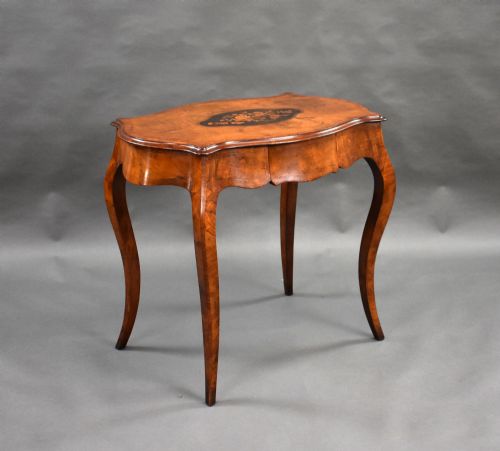


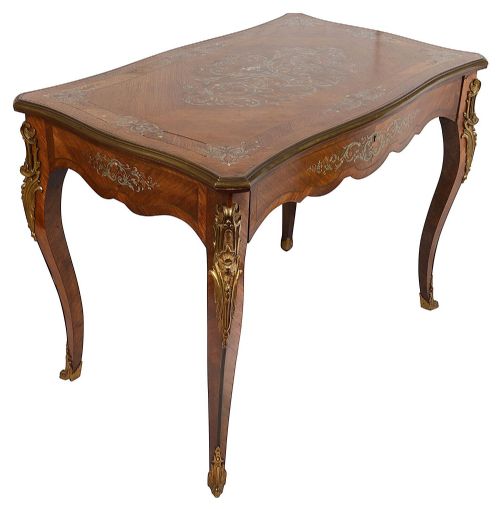


Serpentine Marquetry Centre Table
These serpentine marquetry centre tables bring fluent French curves and intricate wood inlays into the middle of a room.
Serpentine Marquetry Centre Table
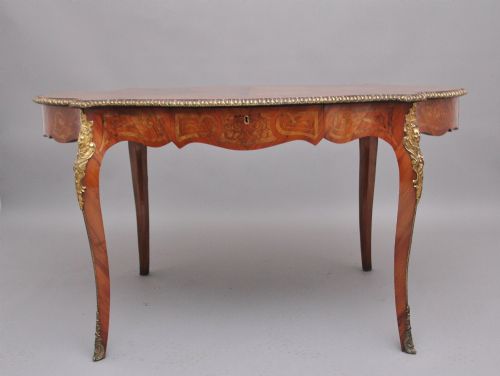
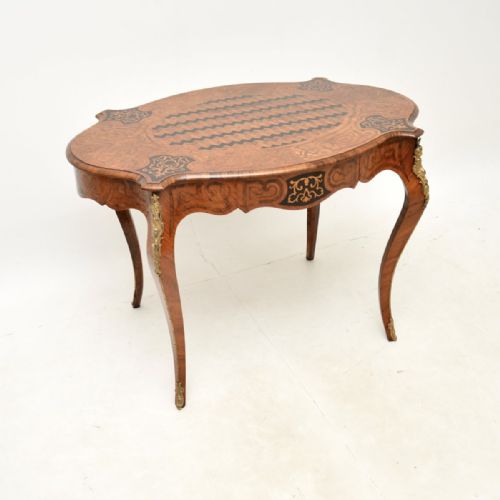
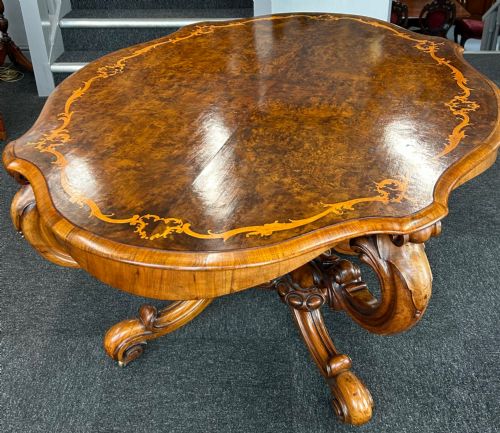
A serpentine marquetry centre table stands away from the wall to show its inlaid decoration on all sides. The defining feature is the undulating serpentine edge of the top, which curves inward and outward in a continuous, flowing line.
Most examples found here date from the nineteenth century and the Victorian period, drawing heavily on Louis XV and Rococo revival styles. These pieces often serve as occasional tables, writing desks, or bureau plats within a drawing room or salon.
Makers frequently shaped these tables with cabriole legs and freestanding profiles designed to command the centre of a reception space. Walnut, burr walnut, and kingwood form the primary foundations for these elaborate nineteenth-century designs.
Materials and construction methods
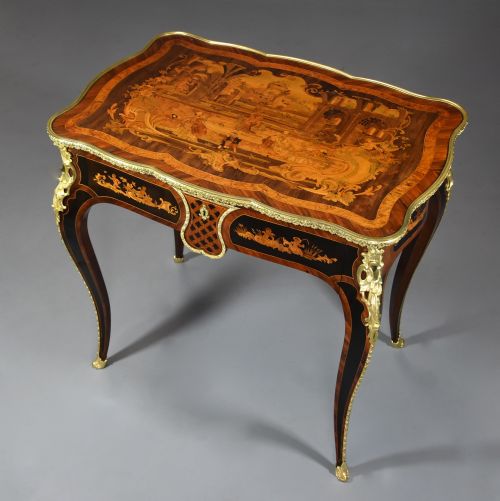
Cabinet makers built these tables using solid timber frames overlaid with fine veneers, applying burr walnut, satinwood, and kingwood to create rich grain patterns across the top and sides. Intricate marquetry and parquetry inlays combine fruitwoods, brass, and tortoiseshell to form floral or geometric motifs.
Ormolu and gilt bronze mounts protect vulnerable corners and accentuate the curving outlines of the apron and legs. Ebonised wood often provides a contrasting dark border to highlight the lighter inlay work within the centre panel.
Black forest tables join the lineup alongside French bureau plats, proving that nineteenth-century artisans loved a curve wherever they could put one.
Judging the quality of the work
Superior examples display crispness in the cutting of the veneer and seamless alignment in the botanical or geometric marquetry. The depth of the timber grain and the precision of the brass or ormolu mounts dictate the standing of the piece.
Finer tables maintain structural rigidity through robust internal framing beneath the veneered surfaces, ensuring the serpentine top remains stable. The fluency of the carved cabriole legs and the integration of the mounts reveal the skill of the workshop behind the construction.
Maison Millet·Gillows
The Serpentine Marquetry Centre Table Glossary
- Serpentine
- A shape defined by a line that curves inward and then outward in a smooth, continuous wave. This undulating profile appears principally on table tops and aprons of the period.
- Marquetry
- Decorative patterns formed by fitting together thin slices of various coloured woods, veneers, and sometimes other materials onto a structural surface. It differs from inlay by covering the entire background.
- Ormolu
- Gilt bronze mounts applied to furniture edges and legs for both decoration and physical protection. The technique involves coating cast bronze in a layer of gold amalgam.
- Bureau plat
- A freestanding writing desk finished on all sides with a flat top, frequently fitted with drawers. These tables often double as centre pieces in formal reception rooms.
- Boulle
- A style of marquetry utilising tortoiseshell and brass inlaid in elaborate scrollwork patterns. Named after the royal cabinet maker to Louis XIV, André-Charles Boulle.
Serpentine Marquetry Centre Table: Frequently Asked Questions
Where should a centre table go?
These tables are designed to stand away from walls, allowing the marquetry and ormolu mounts to be viewed from every angle in a principal room.
Position one in the middle of a drawing room or study where it can serve as a display surface or an occasional writing desk.
How do I care for nineteenth-century veneer?
Protect delicate wood surfaces by avoiding direct sunlight and keeping them away from sudden changes in room temperature or humidity.
Dust regularly with a soft, dry cloth and apply occasional specialist wax to nourish the antique timber without buildup.
What is the difference between marquetry and parquetry?
Marquetry uses varied wood veneers to create pictorial scenes, floral arrangements, or scrollwork across the surface of the table.
Parquetry arranges geometric blocks of timber like cubes or chequers to form repeating patterns across the top.
Are these tables suitable for writing?
Many of these pieces function as writing desks or bureau plats, offering a finished top surface and often concealed drawer space.
Ensure the working height matches your chair if you intend to use the table regularly for correspondence.