

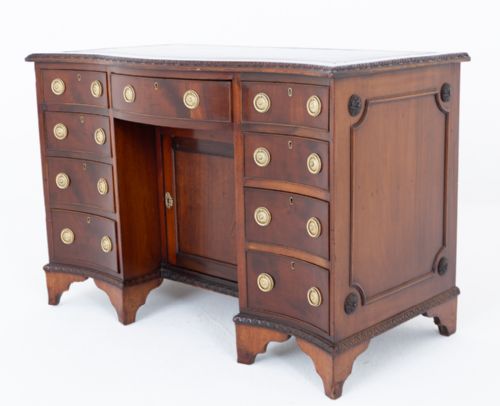


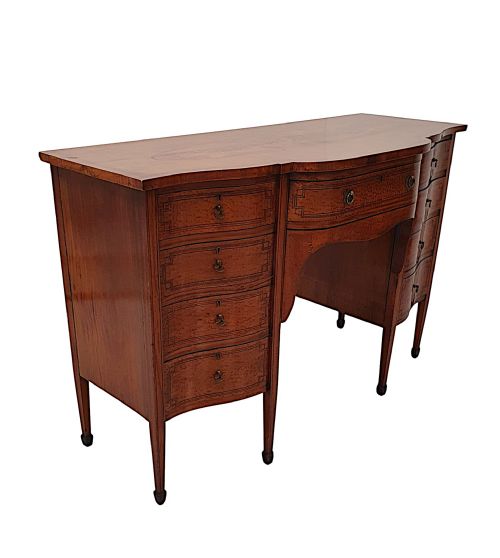


Serpentine Front Pedestal Desk
A serpentine front pedestal desk is a commanding workspace defined by its undulating profile, offering substantial presence and refined proportions for the study.
Serpentine Front Pedestal Desk
A serpentine front pedestal desk presents a sweeping, undulating facade that immediately distinguishes it from straight-fronted library furniture. These substantial pieces organise your study space around twin pedestals of drawers supporting a wide writing surface.
The versions most frequently encountered on this page range from Georgian originals and 18th-century English examples to later revival interpretations from the Edwardian era and the 1920s and 1930s. Alongside traditional mahogany and burr walnut, you will also discover occasional variations in oak and satinwood.
Makers such as Maple & Co. and Waring and Gillow occasionally appear among these records, alongside unmarked desks reflecting Georgian Chippendale and Queen Anne revival styles. Their forms stretch from compact kneehole desks to large partners pedestals and related sideboards.
Materials and construction
Cabinetmakers constructed these desks primarily using solid and veneered mahogany, burr walnut, and oak, often incorporating satinwood and brass hardware. Selecting richly figured timber allowed craftsmen to create striking grain patterns across the sweeping curves of the front facade.
The distinctive undulating shape required precise shaping of solid wood and skilful veneer work to follow the convex and concave contours without distortion. Drawers were fitted with dovetail joints, while the writing surfaces were frequently inset with tooled leather.
Inlaid details, hand-decoration, and cast brass handles complete the construction, bringing textural contrast to the polished timber surfaces. The integration of two separate pedestals with a central writing section demanded rigorous structural stability.
Judging quality and character
Quality in a serpentine front pedestal desk rests on the selection of timber and the ambition of its grain matching across the curved drawers. Highly figured burr walnut or richly patinated mahogany command attention through depth of colour and careful book-matching.
The fluidity of the serpentine curve itself reveals the maker's hand, separating fluid, hand-shaped contours from stiffer mechanical reproductions. Clean execution of crossbanding, stringing, and inlaid motifs further distinguishes superior examples.
Substantial proportions, such as those found in partners desks, combined with original brass hardware and well-preserved tooled leather inserts, elevate the standing of a piece. The survival of period finishes and patination speaks directly to the care the desk received over generations.
Maple & Co.·Waring and Gillow
The Serpentine Front Pedestal Desk Glossary
- Serpentine front
- A furniture facade featuring a central convex curve flanked by two concave curves, creating an undulating outline. This shape requires advanced cabinetmaking skills to execute successfully in solid wood and veneer.
- Pedestal desk
- A heavy freestanding desk comprising two supporting banks of drawers that hold up a wide top. They often include cupboards or additional drawers on the reverse side in partners configurations.
- Kneehole desk
- A compact form of writing table featuring a central recess for the user's legs, flanked by narrow columns of drawers. Eighteenth-century examples frequently incorporate a concealed central cupboard behind the kneehole arch.
- Burr walnut
- A highly figured timber harvested from walnut tree growths, prized for its swirling knot patterns and rich tonal variation. It appears prominently on fine desks from Georgian and later revival periods.
- Crossbanding
- A decorative technique where narrow strips of veneer are applied to the borders of a surface so the grain runs perpendicular to the central panel. This frames the primary timber and accentuates the geometry of the piece.
- Partners desk
- A large double-sided workspace designed for two people to use simultaneously, featuring drawers and cupboards accessible from both faces. These grand pieces often dominate large libraries and administrative rooms.
Serpentine Front Pedestal Desk: Frequently Asked Questions
How do I spot an 18th-century original?
Eighteenth-century desks display hand-cut dovetails, timber shrinkage appropriate to age, and natural patination built up through decades of polish and use. The internal drawer construction and secondary woods such as oak or pine offer reliable clues to period manufacture.
Revival pieces from the Edwardian era or the 1920s often use standardised machine methods and modern adhesives, even when copying George III or Chippendale styles precisely. Examining the construction beneath the surface clarifies the true age of the timberwork.
What is the difference between a kneehole and a partners desk?
A kneehole desk is designed for a single occupant, featuring a finished front with drawers on one side and a solid or panelled back. They suit tighter spaces while still providing substantial drawer storage.
Partners desks are substantially larger and finished identically on both sides, allowing two people to sit opposite each other. They incorporate drawers and cupboards accessible from both the front and the rear.
Are these desks suitable for daily computer work?
These desks accommodate modern technology well, provided the proportions of the writing surface match your equipment. Many historical desks offer generous knee clearance and broad top dimensions suited to laptops and paperwork.
Care should be taken with antique leather writing surfaces to avoid scratching or heat damage from electronic devices. Using a blotter or matching desk pad preserves the historic leather while providing a functional working area.
How do I care for burr walnut veneer?
Burr walnut veneer benefits from consistent indoor humidity and protection from direct sunlight to prevent the timber from drying out or fading. Gentle dusting with a dry, soft cloth prevents particulate build-up on the polished surface.
Applying a quality beeswax periodically nourishes the wood and maintains the soft lustre of the finish. Avoid silicone-based sprays and excess moisture, which can damage historic veneers and lift old glues.