


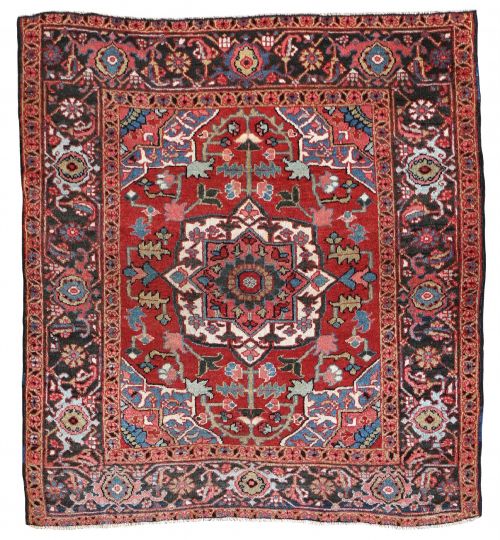


Serapi Style Area Rug
A serapi style area rug brings bold geometric motifs and rich colour to a room, offering the character of Northwest Persian Heriz weaving.
Serapi Style Area Rug
A serapi style area rug belongs to the tradition of Persian Heriz carpets, known for large-scale geometric medallions and structured corner designs. When you search for a serapi style area rug, you encounter room-size carpets and smaller rugs dating from the late nineteenth century through to the early decades of the twentieth century.
The pieces available span multiple decades, including examples from the 1880s, 1890s, 1900s, 1910s, 1920s, and 1930s. Alongside traditional medallion layouts, you will find variations featuring all-over designs across the field of the rug.
How they were made
These floor coverings are built with wool pile knotted onto a sturdy cotton foundation, providing the durability needed for high-traffic areas. The weavers of Northwest Persia utilised hand-spun wool and natural dyes to achieve the deep tones characteristic of Heriz production.
The structural integrity relies on dense knotting and robust cotton warps and wefts, which allow large carpets to lie flat and retain their geometric precision over generations of use.
Serapi Style Area Rug Retail Price Guide 2026
Typical asking prices for serapi style area rug among the pieces listed under this phrase on Sellingantiques today, from the lower quarter to the upper quarter. They describe what is for sale here now, not the wider market.
Every large carpet hides a village weaver's quiet geometry.
What varies in quality
Quality in a serapi style area rug rests on the crispness of the drawing and the balance of the geometric motifs. Finer examples display harmonious proportion in the central medallion and well-rendered corner spandrels that anchor the composition.
The handling of the wool and the depth of the dye saturation also separate standard production from superior pieces. Subtle variations in tone across the field demonstrate the complexity of the dyeing process used by traditional weavers.
The Serapi Style Area Rug Glossary
- Heriz
- A region in Northwest Persia renowned for bold, durable carpets with geometric designs. Carpets from this centre often feature a prominent central medallion.
- Medallion
- The large central ornamental motif set within the field of the rug. In Heriz weaving, this element usually takes a strong geometric form.
- Allover design
- A pattern layout where decorative motifs repeat across the field of the rug rather than centring on a single medallion. This style appears in several nineteenth and twentieth-century examples.
- Spandrels
- The triangular corner ornaments situated in the corners of the rug's field. They frame the central medallion and structure the overall composition.
Serapi Style Area Rug: Frequently Asked Questions
How do I date a Heriz carpet?
Dating relies on stylistic markers, structure, and dye characteristics observed across pieces from the late nineteenth and early twentieth centuries. Comparing the wool density and knot structure helps place a rug within periods such as the 1890s or 1910s.
Changes in palette and minor shifts in geometric drawing over these decades also guide the assessment of age.
Where were these rugs made?
These carpets originate from the town of Heriz and the surrounding villages in Northwest Persia. This region developed a distinct weaving tradition distinct from urban workshop centres.
The local weavers adapted workshop styles into robust, village-made carpets suited for heavy domestic use.
Are these rugs durable for daily use?
Wool pile combined with a cotton foundation creates a hard-wearing structure designed for floor placement. The sturdy construction handles foot traffic well in living spaces and dining rooms.
Regular rotation and proper underlay help preserve the wool pile over years of use.
What is the difference between a medallion and allover design?
A medallion rug centres attention on a single large geometric ornament in the middle of the field. An allover design distributes repeating motifs evenly across the entire surface without a dominant centrepiece.
Both layouts appear in traditional Northwest Persian production.