
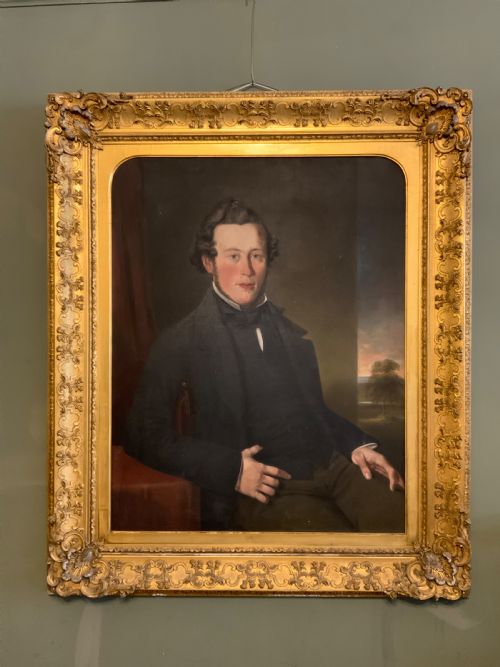
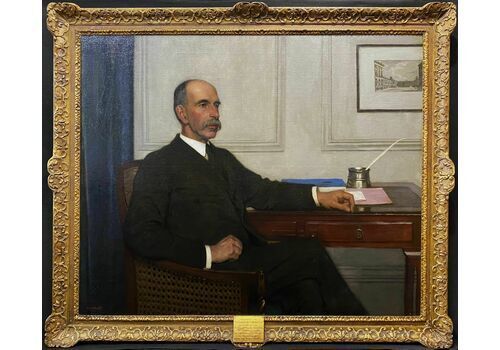


Seated Gentleman Oil Portrait
A seated gentleman oil portrait captures a specific figure in a canvas interior, offering a direct window into past character and social standing.
Seated Gentleman Oil Portrait
A seated gentleman oil portrait depicts a lone male subject, often positioned at a desk, near a window, or within a panelled interior. These works frequently record specific historical figures, clergymen, engineers, and scholars from the eighteenth century through to the mid-twentieth century. The versions most commonly met on this page belong to the nineteenth century and the Edwardian era, rendered in oil paint on canvas.
Many of these paintings originate from named British and European schools, spanning Georgian, Regency, and Victorian periods. Subjects are typically shown posed with objects denoting their profession or status, such as books, maps, or musical instruments. The scale ranges from intimate framed canvases to substantial, large-format works intended for prominent wall display.
How They Were Made
Artists built these works using oil paint applied to stretched canvas, and occasionally board, relying on the slow-drying medium to blend tones and achieve depth in skin and fabric. The supporting frames are commonly fashioned from wood, often finished with giltwood or plaster ornamentation to complement the scale of the painting.
The technique relies on layered brushwork, where foundational imprimatura is built up through opaque highlights and transparent glazes. This method allowed painters to capture the texture of wool coats, polished wood furniture, and the play of light across an interior setting.
Listings feature works executed in oil on canvas across the 18th, 19th, and 20th centuries, housed in wood and giltwood frames.
What Varies in Quality
The standard of a seated gentleman oil portrait rests primarily upon the draughtsmanship of the hands and face, alongside the artist's ability to render light and psychological depth. Superior examples demonstrate confident brush control and an accurate command of human anatomy, whereas lesser works rely on formulaic repetition and stiff postures.
Framing and preservation further distinguish the range, with original period gilt wood surrounds and stable canvas integrity commanding greater appreciation. The prominence of the sitter and the documentary evidence provided by signed inscriptions or well-documented provenance elevate certain pieces above anonymous studio output.
Harold Knight RA·Arthur Spooner·Henry William Pickersgill·Ramsay Richard Reinagle RA·James Archer RSA·Francis Alleyne·Cowan Dobson RBA RP·Stephen Taylor·Joseph Clover·William Dring RA·John Dalziel Kenworthy·Neville Stephen Lytton·Frank Samuel Eastman·Benno Fischer·James Bell Anderson RSA
The Seated Gentleman Oil Portrait Glossary
- Canvas
- A heavy woven fabric stretched across a wooden stretcher bar to serve as the foundational support for oil paint. It provides a textured surface that interacts with layered brushwork.
- Giltwood
- Wood carved and coated with a thin layer of gold leaf or metallic powder, commonly used to finish ornate picture frames. This treatment added brightness and formality to domestic interiors.
- Oil Paint
- A slow-drying medium composed of pigments suspended in a drying oil, typically linseed. It allows for smooth blending and rich tonal gradations.
- Academic Realism
- A style of painting produced under the influence of European academies of art, characterised by strict standards of finish, proportion, and anatomical accuracy.
Seated Gentleman Oil Portrait: Frequently Asked Questions
How do I identify the sitter?
Identification relies upon handwritten inscriptions on the canvas reverse, old labels, or accompanying biographical documentation linking the portrait to a specific historical figure.
Clues are often found in objects depicted within the scene, such as books, scientific instruments, or architectural backgrounds that relate to the subject's profession.
Where should I hang a large portrait?
These works require wall space with stable humidity away from direct sunlight to protect the canvas and oil pigments from degradation.
They pair well with traditional room layouts, positioned above sideboards, mantelpieces, or along stairwells where the scale of the frame can be appreciated.
What periods are represented?
The selection spans from the eighteenth century through the Regency and Victorian eras, extending into Edwardian and mid-twentieth century works.
Earlier pieces often feature classical poses and dark interiors, while twentieth-century examples display shifts toward broader brushwork and modern realism.
How were these portraits used originally?
Commissioned by institutions, families, or the sitters themselves, these paintings served to commemorate civic leaders, scholars, and professionals in their working environments.
They were displayed in private libraries, public halls, and drawing rooms as markers of status, achievement, and lineage.