
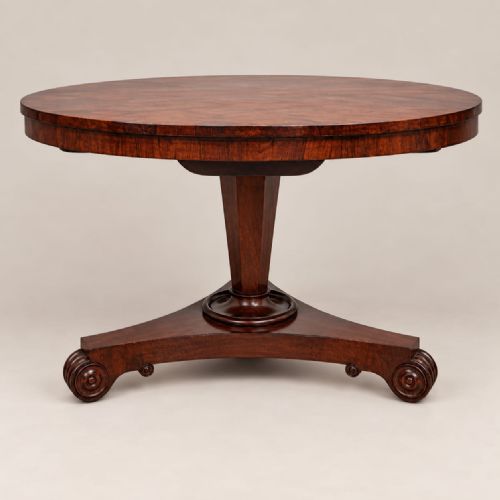
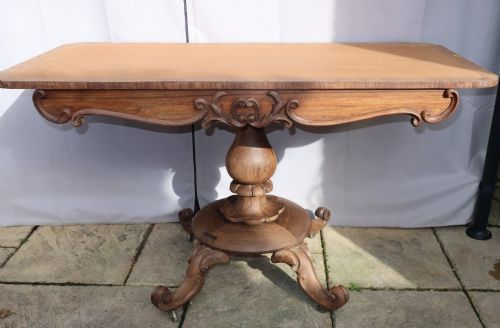
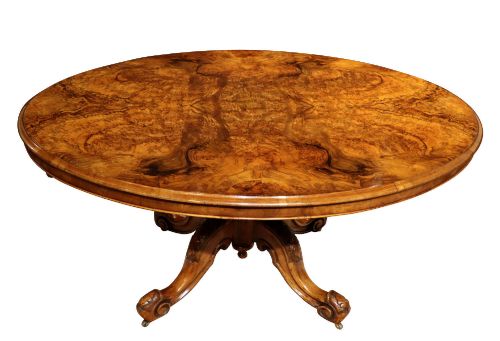
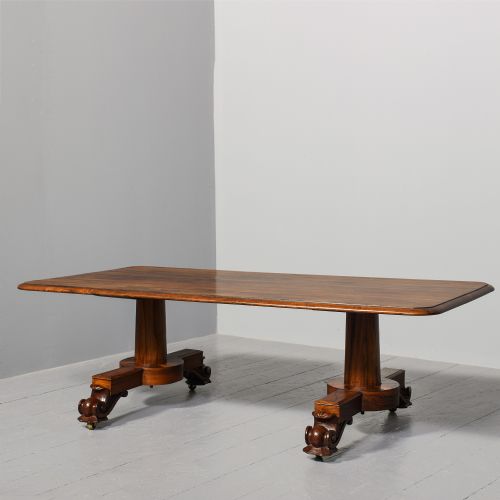
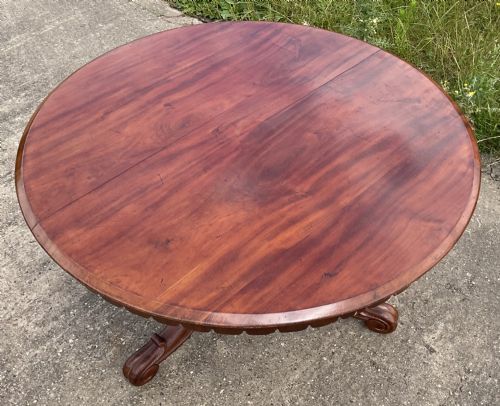
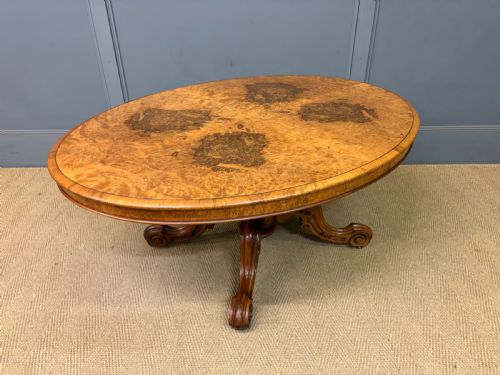
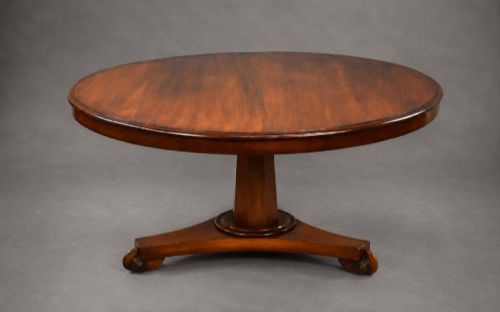
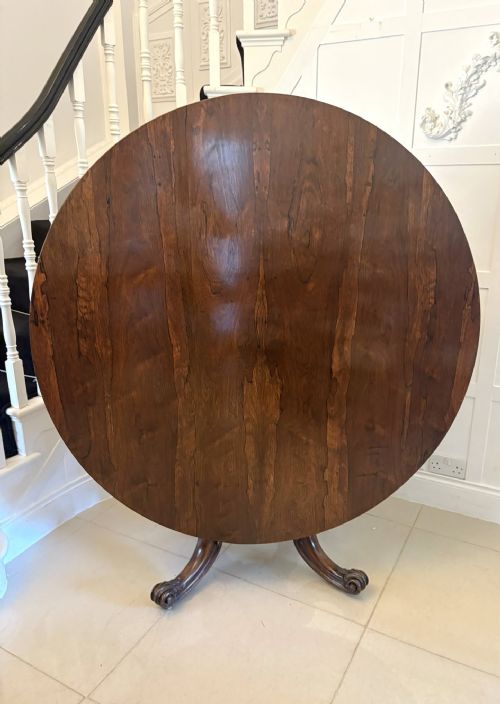
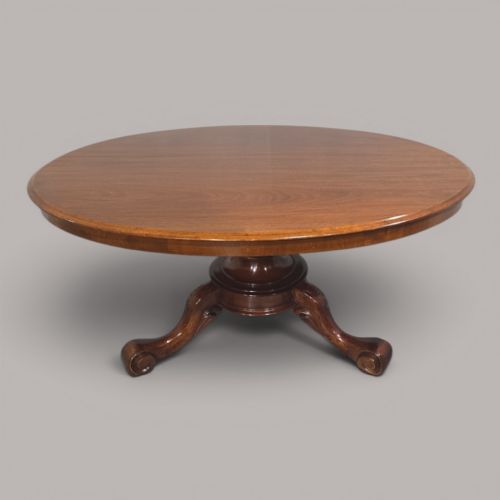

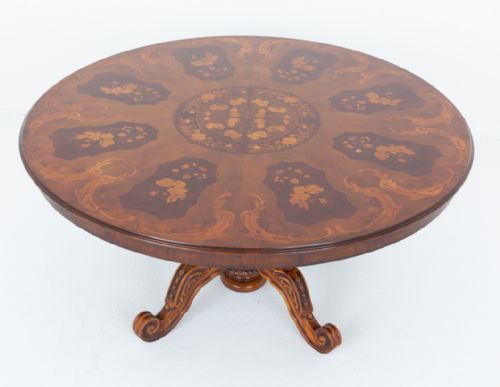


Scrolled Foot Centre Table
A scrolled foot centre table anchors a grand room with rich timber and sculptural support.
Scrolled Foot Centre Table
A scrolled foot centre table stands freely in a room, designed to be viewed from every angle rather than pushed against a wall. These pieces function variously as breakfast tables, dining tables, coffee tables, and console tables depending on their height and top configuration.
The version you are most likely to meet on this page is a Victorian or Regency circular or oval table in mahogany or rosewood, often featuring a tilt top or a central pedestal base with carved scroll feet.
How they were made
Cabinet makers built these tables using dense timbers such as mahogany, rosewood, walnut, burr walnut, and exotic goncalo alves, frequently applied as veneers over sturdy secondary woods. Surface enrichment included brass mounts, mixed wood inlay, and intricate marquetry.
Structural support relied on heavy pedestals, tripod or quadrapod bases, and carved wooden feet that required precise joinery to bear the weight of large circular or oval timber tops.
Several tables cleverly hide writing slopes inside their pedestals, proving that Victorians loved a secret compartment with their tea.
What varies in quality
The distinction between ordinary and superior pieces rests on the choice of timber figure, such as highly grained burr walnut or radially matched veneers, and the depth of hand carving on the pedestal and scroll feet. Heavier brass mounts and integrated mechanisms like writing slopes elevate the utility and sophistication of the design.
The Scrolled Foot Centre Table Glossary
- Centre table
- A freestanding table designed to stand in the middle of a room rather than against a wall. These pieces often feature decorative details on all sides.
- Tilt top
- A table top hinged to fold vertically when not in use. This mechanism allowed tables to be stored against room perimeters in tighter spaces.
- Quadrapod base
- A pedestal support resting on four feet. This configuration provided stability for large circular or oval dining and breakfast tables.
- Goncalo alves
- A dense exotic hardwood prized for its striking contrasting grain patterns. Makers utilised this timber for high status Regency furniture.
- Marquetry
- The art of applying decorative veneer pieces to a structure to form geometric or pictorial designs. This technique appeared on later Victorian revival pieces.
Scrolled Foot Centre Table: Frequently Asked Questions
Where should I place a centre table?
A centre table belongs in the middle of a spacious room where you can walk around it entirely. It serves as a natural focal point for displaying objects or gathering.
Ensure you leave sufficient clearance around the perimeter for seating and movement so the piece commands the space properly.
Can I use a breakfast table for dining?
Many breakfast tables share the same height and surface area as traditional dining tables, making them suitable for everyday meals. Their central pedestal design offers the practical advantage of eliminating corner legs.
Check the diameter and clearance beneath the apron to ensure chairs tuck in comfortably before setting places for dinner.
What is a tilt top mechanism?
A tilt top mechanism allows the horizontal surface of the table to hinge vertically against the central column. This clever engineering originally enabled servants to clear floor space quickly when the room was not in use.
Today, a functioning tilt top lets you admire the grain patterns and joinery on the underside when the table rests against a wall.
How do I identify Regency style?
Regency furniture draws heavily on classical neoclassical motifs, featuring clean lines, dark imported timbers, and restrained brass mounts. Tables from this period often display architectural proportions and refined carving.
Later Victorian interpretations tend to be heavier in scale, incorporating more elaborate foliate carving and bolder burr veneers.